We say it all the time—for contractors, the real tools of your trade aren’t hammers, nails, and ladders. In today’s world, especially when it comes to project management, your real tools are calculators, calendars, subdivided bank accounts, and spreadsheets.
I’m Scott Beebe with Business on Purpose, and today I want to talk about why these tools matter so much—especially for contractors trying to figure out their financial health job-to-job.
Are You Really Making Money?
A lot of contractors look at their year-end profit and loss statement. If there’s a number on the bottom line, they assume, “Well, I must be making money.” Then they check their bank account and think, “There’s money in there, so I must be doing fine.”
But here’s the truth: money is always in motion. You won’t really know if you’re profitable unless you do what’s known in the contractor space as job costing. And this concept doesn’t just apply to construction—it works in retail, service industries, and more.
Lead Well.
If you're looking for more resources to work ON your business, we have them.

Why Job Costing Matters
Job costing helps you understand your true margins. It lets you calculate your labor, material, and overhead costs for every job. Without it, you’re relying on a gut feeling instead of facts.
Business cash flow is rarely consistent. In some businesses like ours, we have recurring revenue and stable inflows. But in others, income is seasonal or sporadic. I used to work at the Charlotte Motor Speedway, where 80–90% of their revenue came from just two weekends per year. That model required extreme precision in planning and forecasting.
So ask yourself: Are you making money, or just receiving money? There’s a big difference between cash flow and margin.

Start Strong with a Project Start Sheet
Success begins with how you start a project. Between your financial dashboard and the actual project kickoff, there are several layers of planning. One of the simplest, yet most powerful tools is the Project Start Sheet.
Picture a spreadsheet. That’s it. It tracks two key areas: labor and material. These are your two most volatile cost centers. Add to that your schedule management, and now you have a real view of your profit potential.
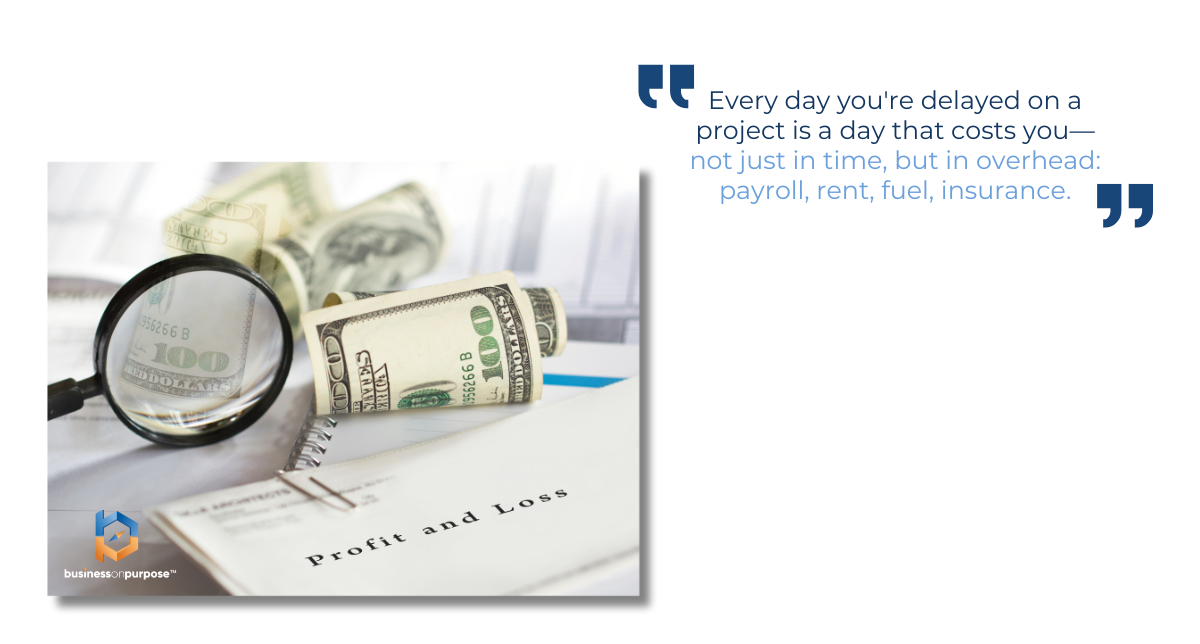
Every day you’re delayed on a project is a day that costs you—not just in time, but in overhead: payroll, rent, fuel, insurance. These don’t stop just because your project slows down. That’s why it’s essential to finish projects within the scheduled timeline.
Calendars and Spreadsheets: Your Secret Weapons
Job costing and scheduling might not be hard, but they’re tedious. Still, they’re the difference between guessing and knowing.
By using spreadsheets to track labor, materials, and overhead, you’ll gain a clear picture of each project’s financial health. You’ll know when to bill, when not to bill, and how to keep your schedule aligned with your cash flow.
Simple tools like spreadsheets and calendars can be more powerful than expensive software—at least until you’ve proven you can manage the basics. We often say, “Before you go buy software, prove to yourself (and to us as your coaches) that you can work a spreadsheet.”
Avoid Costly Delays
Delays in a project erode your profit margin. You may think, “We’ll get paid eventually.” But while your income gets pushed back, your expenses remain the same. Just a few weeks of delay can wipe out all your projected profits—leaving you working for free.
That’s why we recommend beginning every project with a clearly laid out Project Start Sheet, supported by a well-managed calendar. Together, these tools will keep you on schedule and on budget.
Take the Next Step
If you’re ready to get serious about running your business on purpose, dive deeper into job costing, project planning, and financial clarity with my new book: The Chaos Free Contractor. I wrote it to be under 120 pages so you and your team can read it together and start having real conversations about:
- Job costing
- Subdivided bank accounts
- Project scheduling
- Managing overhead
Grab your copy on Amazon
Then head over to mybusinessonpurpose.com/healthy to take the 5-minute health assessment for your business.
Scott Beebe is the founder of Business On Purpose (mybusinessonpurpose.com) and speaker for the AEC industry and author of the book Let Your Business Burn: Stop Putting Out Fires, Discover Purpose, and Build a Business That Matters. Business On Purpose works with business owners to articulate purpose, people, process, and profit to liberate owners from chaos and make time for what matters most.