Cash flow problems rarely show up overnight. They build quietly in the background while you are focused elsewhere, and by the time you notice, the damage is already done. Here is the truth most business owners need to hear: the biggest threat to your cash flow is not a bad economy or a slow season. It is neglect.
You Cannot Outsource Your Financial Awareness
There is a myth floating around in the small business world that says you can just hand your finances over to your accountant and move on with your life. That thinking feels logical on the surface, but it does not hold up.
Letting your accountant handle everything is like letting your doctor eat healthy for you. Your CPA and bookkeeper absolutely handle the transactional work, and that is valuable. But understanding your numbers, knowing your past, present, and future financial position, reading your balance sheets, P&Ls, cash flow statements, and budgets, that responsibility belongs to you as the owner.
“You cannot let your accountant handle what only you can own.”
Lead Well.
If you're looking for more resources to work ON your business, we have them.

A lot of business owners struggle with impostor syndrome around finances. They feel like they are not smart enough to understand the numbers, and honestly, our culture has reinforced that belief. Financial professionals have a habit of wrapping simple ideas in layers of complexity. But here is the thing: that complexity often covers up their own inadequacy in communicating clearly.
At its core, business finance is straightforward. Total revenue minus total expenses equals net income. That is the foundation. If you can grasp that concept, you are fully capable of understanding your business finances. The issue is not your intelligence. The issue is that you are not paying close enough attention.
The NEGLECT Acronym: Six Ways Business Owners Lose Control of Cash
Most cash flow problems trace back to one root cause: neglect. Let us walk through exactly what that looks like using the acronym N-E-G-L-E-C-T.
N: No Subdivided Bank Accounts
Most businesses run out of one, two, or maybe three bank accounts. Think of it like one giant popcorn bucket where all your money gets dumped in together. When a dollar comes in, your brain tells you it is all yours. But the reality is it is not.
Money has its own behavior. A dollar in is always less than a dollar because a portion already belongs to taxes, overhead, and other obligations. A dollar out is always more because of fees and related costs layered on top.
The solution is to subdivide your bank accounts into six, seven, eight, or even nine separate accounts. When revenue comes in, you cut it up and send each portion to its designated home: taxes, operating expenses, profit, owner compensation, capital reinvestment, generosity, and so on. This single habit creates instant financial clarity.
E: Expenses Growing Faster Than Revenue
This one sneaks up on you. It often happens emotionally. You land a new client or launch a new product, you get excited, you hire fast and spend freely to fulfill it, and suddenly your expenses have quietly crept past your revenue without you noticing.
Sometimes it happens because a business owner upgrades their service offering without realizing that expenses scale right along with it. They were counting on the old cost structure to fund the new product, and it simply does not work that way. The key is to count the cost before you enter the opportunity, not after you are already in it.
G: Guessing on Pricing and Profitability
Too many business owners sell a product or service, fulfill it, collect payment, and have no real idea whether they actually made money. Guessing on pricing is one of the fastest ways to drain your cash flow.
A practical fix is to break down what you sell per unit, whether that is per customer, per transaction, or per month, and analyze the real profitability of each. You can even upload your P&L into an AI tool, walk through your cost of goods and expenses, and get a clear picture of profitability per hour, per widget, or per service delivered. Once you know your true numbers, you can price with confidence and make sure revenue is consistently outpacing expenses.
“Guessing on your pricing is choosing to lose money slowly.”

L: Loosening Up on Payment Terms
You send an invoice and then you wait. And wait. And then you get frustrated when the client does not pay. Here is the reality: they probably just forgot, and you probably did not remind them.
A strong accounts receivable process includes not just sending the invoice, but following up consistently. Set a reminder cycle: three days out, seven days out, fourteen days out. Communicate this process to your clients upfront so there are no surprises. And make sure your clients know that a late payment triggers a late fee. When people know the rules in advance, they follow them.
E: Empty Awareness of Your Weekly Cash Position
You need to know your cash position at minimum on a weekly basis. Cash flow means exactly what it says: money is constantly flowing in and out, and the business owner needs to be aware of where things stand at any given moment.
When you have subdivided bank accounts, this becomes easy. You can open your online banking app right now and know exactly how much is sitting in your profit account, how much is reserved for taxes, how much is available for payroll and operating expenses, and how much you have set aside for capital reinvestment. No guessing. No stress. Just clarity.
C: Cycle Times That Are Too Long
Many business owners default to 30-day payment terms without questioning whether that actually works for their cash flow. And when those 30 days stretch to 45 or 60 days, payroll still comes due, overhead still piles up, and you are left waiting on money you have already earned.
Tighten your cycle times. A lot of business owners are afraid to do this because they worry it will upset clients, but when it is built into your process and communicated clearly from the beginning, it becomes the norm rather than the exception.
T: Tracking Without a System
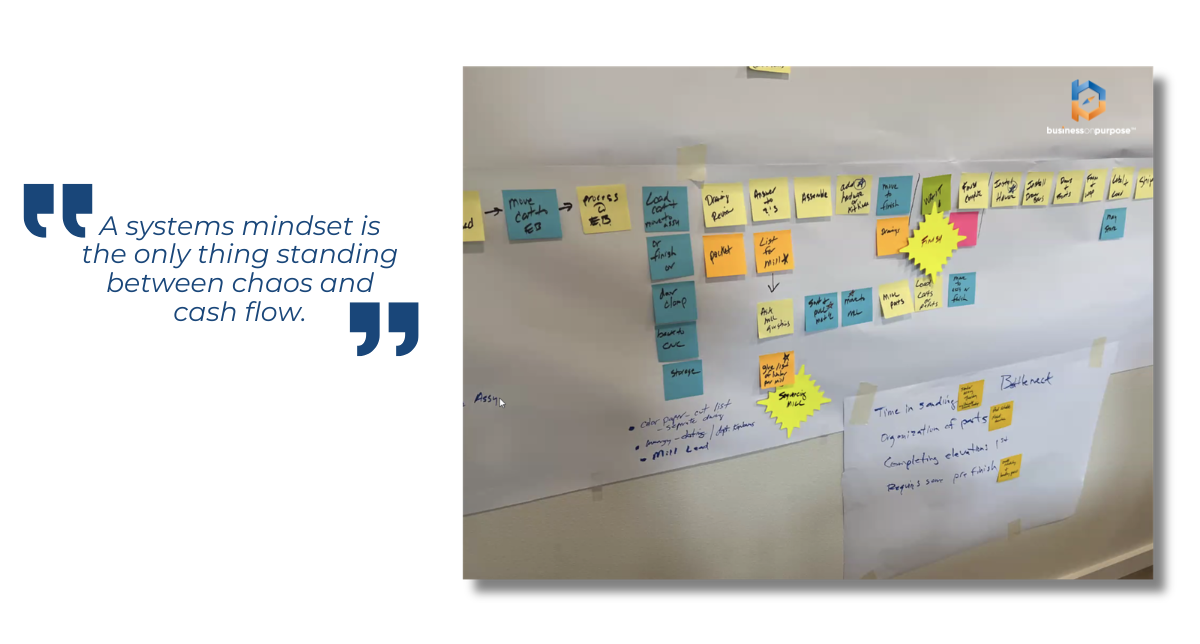
The final form of neglect is running your finances without a systematic approach. Too many business owners operate on gut feel, waking up and reacting to whatever is in front of them, with no consistent structure for tracking, reviewing, or managing their numbers. Balls get dropped not because of bad intentions, but because there is no system in place to catch them.
“A systems mindset is the only thing standing between chaos and cash flow.”
The Three-Part Solution: Subdivide, Track, and Review
Now that you know where neglect hides, here is how you steer your way out of it. Think of it as a three-spoke steering wheel.
Subdivide your bank accounts so every dollar that comes in has a designated purpose and a designated home.
Track your numbers regularly with a systematic approach so nothing falls through the cracks and you always know where you stand.
Review your financials every single week. Not monthly. Not quarterly. Weekly. The business moves too fast for anything less frequent.
If you commit to those three habits, subdivide, track, and review, you will start moving from cash flow chaos to predictable, manageable cash flow. And predictable cash flow is what gives you the freedom to actually run your business rather than being run by it.
Take the Next Step
You do not have to figure this out alone. At Business On Purpose, we have built an entire framework to help small business owners get healthy financially, operationally, and personally. If you are ready to stop neglecting your numbers and start building a business that works for you, visit businessonpurpose.com/healthy to get started today.
Scott Beebe is the founder of Business On Purpose (mybusinessonpurpose.com) and speaker for the AEC industry and author of the book Let Your Business Burn: Stop Putting Out Fires, Discover Purpose, and Build a Business That Matters. Business On Purpose works with business owners to articulate purpose, people, process, and profit to liberate owners from chaos and make time for what matters most.