By the end of this article, you will have a simple, implementable outline to build a business that can run and grow with or without you.
Have you ever tried to take time off, only to feel frustrated that the business slows down or completely stalls when you are gone? Are you exhausted from the emotional and financial hamster wheel of people constantly coming in and leaving? Does it feel like your company is the Taco Bell of turnover, with a brand new staff every four months?
Most business owners want a company that runs and grows without being dependent on them. Yet very few actually experience it.
What It Looks Like When Training Is Done Right
Over the last three years, I have taken anywhere from 14 to 30 days away from my business each year. Not partially away. Completely away. No cell phone. No email. No text messages. No one inside the company could reach me.
This past year, I spent 14 days hiking the El Camino with my son after he graduated college. We walked roughly 140 miles from Portugal to Spain, anywhere between 13 and 21 miles a day. There was plenty of time where distraction could have crept in. I could have been staring at email instead of walking beside my son.
Instead, I was fully present. I did not miss that time. And while I was gone, something even better happened.
“My team didn’t just run the business. They grew it while I was gone.”
Lead Well.
If you're looking for more resources to work ON your business, we have them.
That does not happen by accident. It happens through intentional investment in your team.
Training Is Not About Spending More Money
When people hear employee training and development, they often think about cash bonuses or expensive programs. That is not what I am talking about.
This is about reinvesting professional development back into your team.
Many owners know intellectually that training matters, but they do not know where to start. Some are skeptical and quietly think it is a waste of time.
If you look at the biggest companies in the world, their advantage is not magic. One of the reasons they grew so large is because they built world class training and development systems.
I worked with Pfizer earlier in my career. Much of our startup and ongoing work revolved around relentless training. We trained on disease states, medical terminology, and messaging over and over again.
Today, our small business has a team of 12. Each employee receives between 80 and 100 hours of training per year. That investment allows the business to run and grow without me because direction is clearly defined and reinforced through repetition.
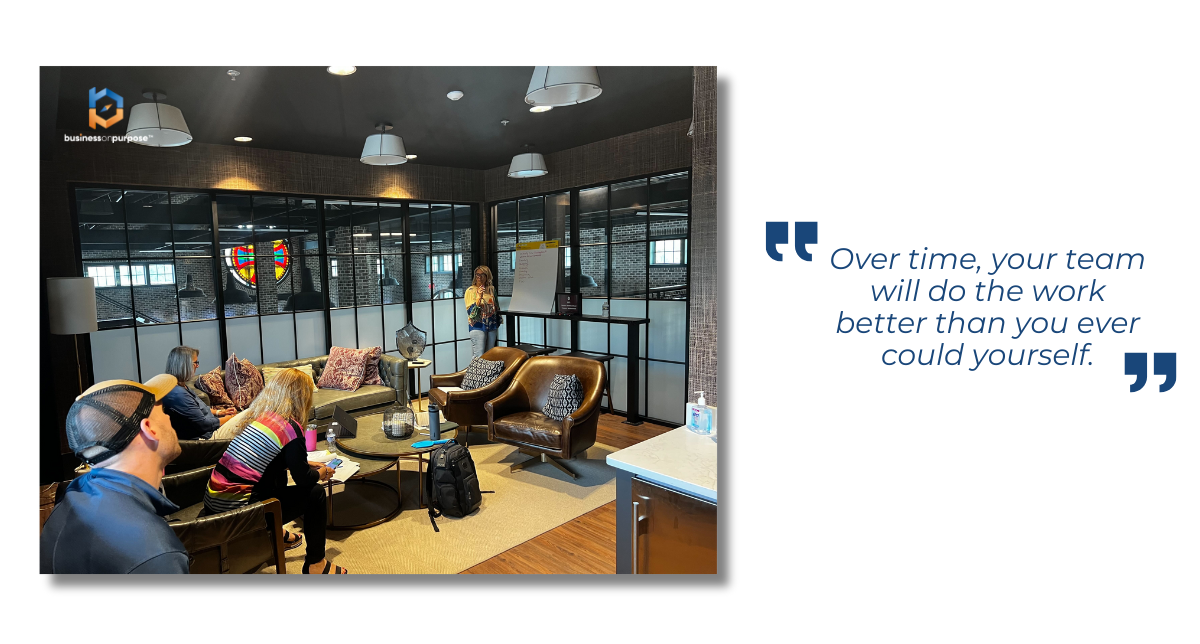
“Over time, your team will do the work better than you ever could yourself.”
Start With a Clear Vision
One of the most practical tools we use with every client is something called a vision story.
A vision story is a detailed snapshot of the future of your business, written across multiple pages and categories. It includes:
- The time horizon of the vision
- Family and personal freedom goals
- Financial targets
- Team structure
- Products and services
- Ideal clients
- Company culture
Life and business intersect. There is no reason to build a business if it does not support a meaningful life.
Our own business is now on version 10.0 of our vision story. We have updated it every year for over a decade.
But writing a vision once is not enough.
Training Works Like a Pump Station
Think about a town’s water system. Water does not just flow from a tower to your house. It requires pump stations along the way to reinforce pressure.
Training works the same way.
For us, one of those pump stations is something we call Vision Day. Six times a year, every other month, we replace a regular team meeting with a one hour Vision Day.
During Vision Day, I read our entire vision story out loud to the team. It is multiple pages long. It feels a little like story time. It even includes artwork to help visualize the future.
After that, I walk through three categories:
- Greens. What is working well
- Yellows. What needs attention
- Reds. What must be fixed quickly
There are always more greens than yellows, and more yellows than reds. That balance matters.
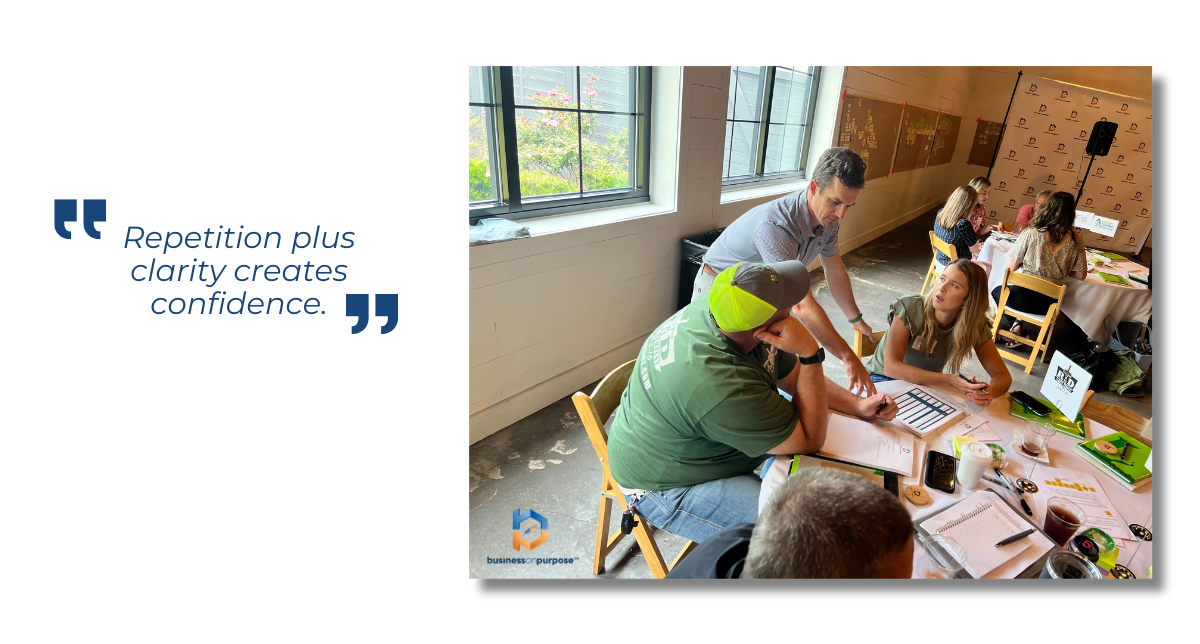
“Repetition plus clarity creates confidence.”
This rhythm keeps the vision alive and aligned inside the team.
The Real Cost of Training Employees
One of the most common objections is cost.
Here is a simple rule of thumb. Whenever we budget an employee salary, we add approximately 26 percent on top.
That covers payroll taxes, workspace, tools, benefits, and the time invested in training and development. If someone earns $100,000 a year, the real cost to the business is closer to $120,000 to $130,000.
Training is not a separate expense. It is part of employing people responsibly.
What Should You Actually Train?
This is where many owners freeze.
Do you buy a leadership book by John Maxwell and make everyone read it? Do you send people to seminars?
The truth is, most of your training already exists inside your business.
Start with a simple Master Process Roadmap.
Grab a sheet of paper and create four columns:
- Marketing
- Sales
- Operations
- Administration or Accounting
Under each column, list every process that exists. That list is your training curriculum.
If you already have a company handbook, congratulations. You already own a large portion of your training material.
The only missing piece is mapping it out over 52 weeks.
Keep It Simple and Predictable
You do not need expensive software. A simple spreadsheet works perfectly.
Training should be:
- Repetitive
- Predictable
- Meaningful
Those are the RPMs of great leadership.
Map what you already know across the year. Add anything new you want to teach. Deliver it consistently.
Your people will feel the investment, and the return shows up in retention and performance.
Why Training Protects Your Culture
People often ask, “What if I spend all this time and money training employees and they leave?”
That question was once asked of the leadership at PAL’s Sudden Service, known for having some of the best training systems in fast food.
The response was simple.
“What happens if we don’t spend it and they stay?”
That is how cultures rot from the inside.
“Vision without implementation is hallucination.”
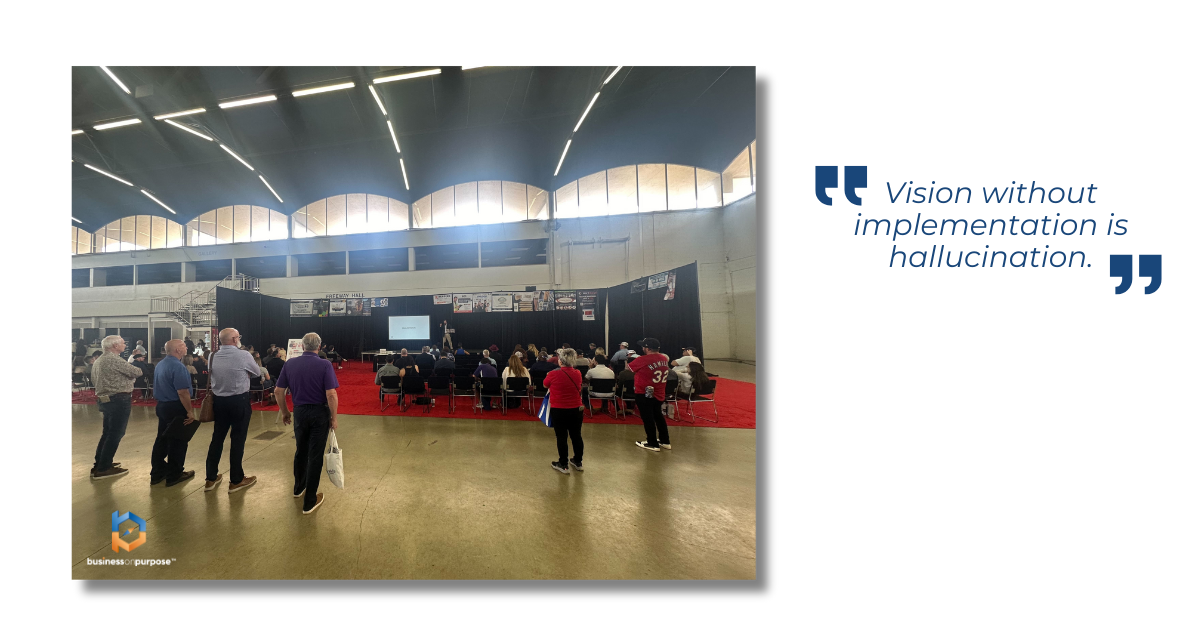
Those words from Thomas Edison still apply.
If you want a business that runs and grows without you, you must build a repetitive, predictable, and meaningful training system. It starts with new employees and continues for the life of the business.
Your Next Step
Write your vision. Define the purpose of your training. Budget the real cost. Use what you already have. Put it into a simple spreadsheet and map it across the year.
Then take action.
Because the goal is not just a better business. The goal is freedom to spend time on what matters most.
If you are ready to move from chaos to clarity and want a business that does not depend on you every day, start by building your employee training roadmap this week. Do not wait for perfect. Start simple and start now.
Scott Beebe is the founder of Business On Purpose (mybusinessonpurpose.com) and speaker for the AEC industry and author of the book Let Your Business Burn: Stop Putting Out Fires, Discover Purpose, and Build a Business That Matters. Business On Purpose works with business owners to articulate purpose, people, process, and profit to liberate owners from chaos and make time for what matters most.