Most business owners overvalue their company because it is their baby.
But here is the truth. Building a valuable business and a sellable asset is not magic. It is a structured, five step process.
This roadmap will help you turn your business from a high stress job into a true asset that can successfully transition to the next owner.
“If you do not have a succession plan, you actually do. The government has already built one for you.”
Lead Well.
If you're looking for more resources to work ON your business, we have them.
What Is Succession Planning?
Succession planning is the intentional process of preparing your business to transition successfully. That transition could be to family, employees, or a strategic buyer.
The word success is built into succession. That is not an accident.
A successful business is one that can operate and grow without being completely dependent on you, the owner. If everything lives in your head, there is very little transferable value.
Succession planning can also be called transition planning or exit planning. Regardless of the name, the goal is the same. Create clarity so your business can move forward without chaos.
The Numbers You Cannot Ignore
Let these numbers sink in:
- 4% of businesses see their 10th birthday
- 12% of that 4% make it to the second generation
- 30% of that 12% make it to the third generation
Business is hard. Leadership clarity is hard. Motivating people is hard.
There is another number you must remember:
- 80% of your net worth is likely locked in your business
- 80% of the value of your business is based on documented systems and processes
If your systems are in your head, they do not hold much value. If they are documented, trained, and repeatable, you are building something sellable.
“80% of the value of your business is based on the systems and processes that are articulated.”

How a Business Is Valued
Before you can plan succession, you must identify value.
There are three primary layers of value:
- Cashflow Value
Often calculated using EBITDA, which stands for Earnings Before Interest, Taxes, Depreciation, and Amortization.
In simple terms, EBITDA is your adjusted bottom line. It accounts for add backs such as personal expenses run through the business.
Your EBITDA is multiplied by an industry multiple. That multiple is influenced by your industry and your business attractiveness. You do not choose it. The market does. But you can influence it.
- Asset Value
This includes equipment, inventory, and sometimes real estate. A laundromat has machines and change systems as business assets. The building itself may be separate real estate.
- Brand Value
For most businesses with three to one hundred employees, brand value is smaller than asset and cashflow value. Large national brands may carry substantial brand equity.
A helpful acronym to remember is CAB:
- Cashflow
- Asset
- Brand
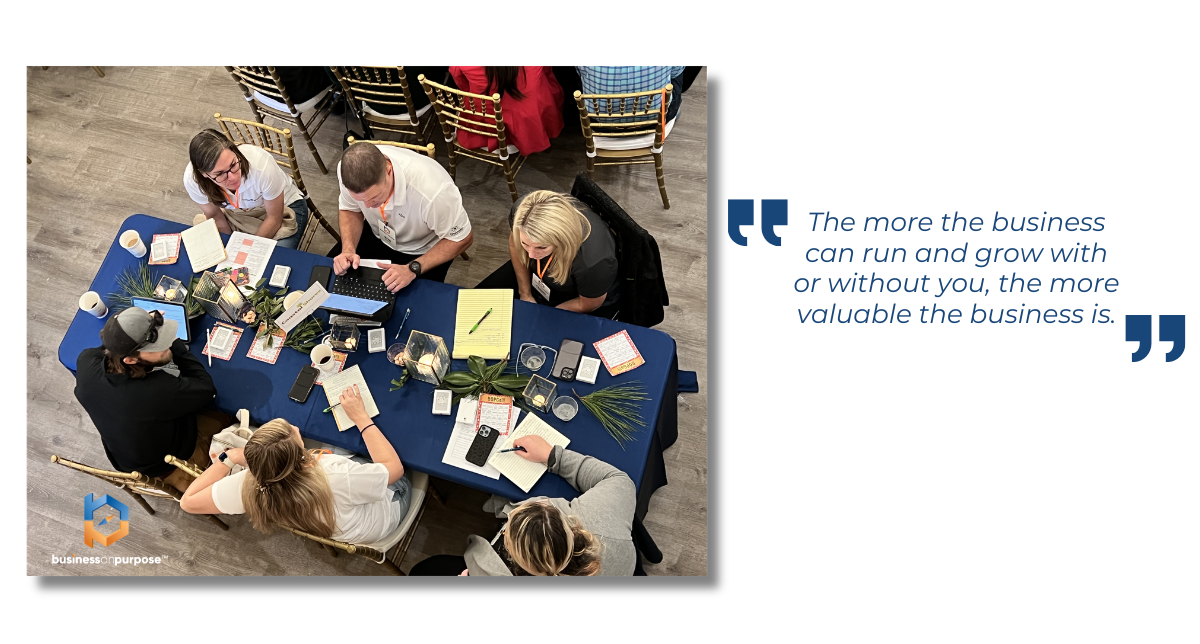
“The more the business can run and grow with or without you, the more valuable the business is.”
The Five Stages of the Succession Planning Process
Stage 1: Identify the Value
Start with a realistic valuation. A simple method is EBITDA multiplied by an industry multiple.
Beyond financials, assess:
- Personal readiness
- Business readiness
- Business attractiveness
Eighty percent of businesses that go up for sale never transact. The number one reason is personal unpreparedness.
You must ask yourself, are you truly ready?
Stage 2: Protect the Value
You can grow revenue, but if there are holes in the boat, it will sink.
Protect your business with:
- Proper insurance
- Estate planning
- Business law and contract clarity
Meet with your advisors. Document your agreements. Clarify ownership structures.
Nothing destroys value faster than an unprotected business.
Stage 3: Grow the Value
This is where most owners focus, but growth without protection is risky.
To grow value:
- Document everything in your head
- Capture processes in writing or video
- Train your team consistently
- Reduce dependency on the owner
When systems are documented and transferable, your multiple increases.
Your goal is simple. Build a business that runs without you.
Stage 4: Harvest the Value
Harvesting means taking chips off the table.
Options may include:
- Selling a portion to employees
- Implementing an ESOP
- Selling to a strategic buyer
- Selling 100% of the business
Business transactions offer flexibility in terms and structure. You can design creative solutions that meet your goals.
Stage 5: Manage What You Harvest
After the transaction, the money must be managed wisely.
This is where wealth management, investment planning, and family office strategies come into play.
But none of that matters if you never made it through stages one through three successfully.
The Shortcut That Is Not Really a Shortcut
If you want to influence your business value in a tangible way, start with vision.
Write down your vision. Clarify where you are going. Define your purpose, your people, your processes, and your profit strategy.
Clarity drives value.
Without clarity, succession becomes confusion.
Final Thoughts
Succession planning is not about leaving your business. It is about building it the right way.
Focus on three things:
- Identify value
- Protect value
- Grow value
Do this well, and you will create options.
And options create freedom.
Ready to Build a Business That Runs Without You?
If you are a business owner with three to one hundred employees and you want to build a company defined by purpose, people, process, and profit, now is the time to act.
Do not wait until you are forced to transition.
Start building a valuable, transferable asset today.
Take the first step. Clarify your vision. Protect what you are building. Document your processes.
Your future self will thank you.
Scott Beebe is the founder of Business On Purpose (mybusinessonpurpose.com) and speaker for the AEC industry and author of the book Let Your Business Burn: Stop Putting Out Fires, Discover Purpose, and Build a Business That Matters. Business On Purpose works with business owners to articulate purpose, people, process, and profit to liberate owners from chaos and make time for what matters most.