Most business owners assume the answer lives inside a piece of software. It does not.
Software will not solve the reality that 80 percent of your net worth is likely tied up in your business. Strategic planning sessions happen every year. Consultants host half-day meetings, full-day workshops, and multi-day retreats. You walk away with binders, notes, and slide decks.
And then what?
Too often, nothing changes.
Strategic planning ultimately comes down to one thing: implementation.
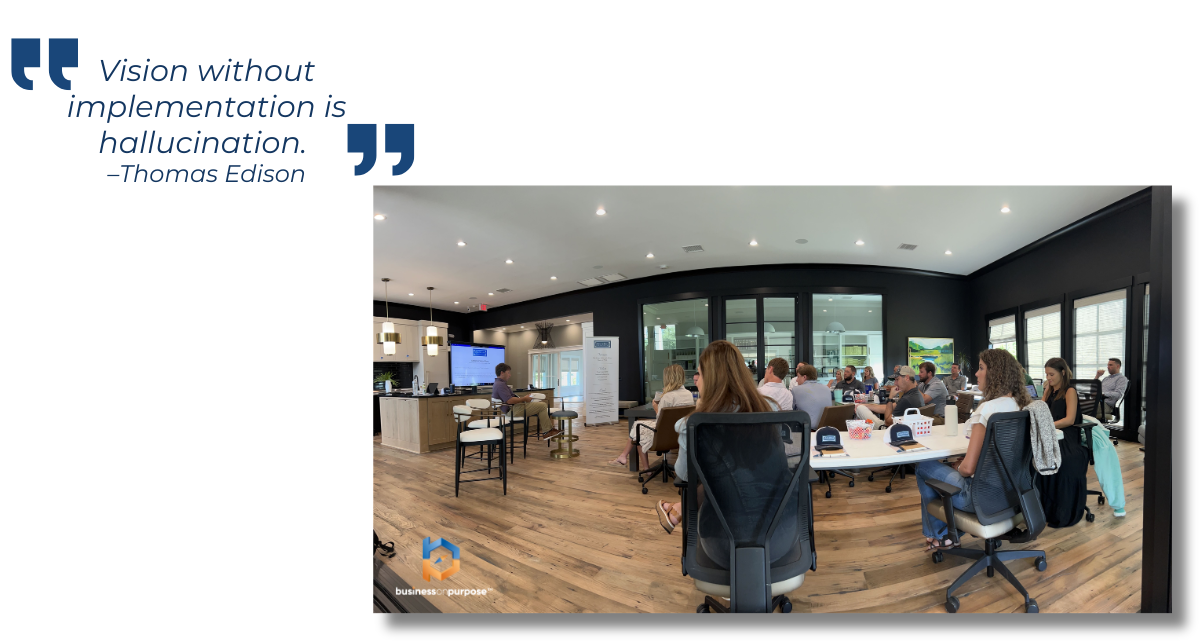
“Vision without implementation is hallucination.” – Thomas Edison
Lead Well.
If you're looking for more resources to work ON your business, we have them.
If your plan is not implemented, it is simply a thoughtful idea.
First Measure of Success: Is It Written Down?
Before you look at dashboards or metrics, start here.
Is your strategic plan documented?
If it is written down, it exists. If it is not, it does not.
It does not have to be printed. It can be a shared document, a recording, or a video. The format is not the issue. Accessibility is.
When your plan lives only in your head, you are expecting your team to read your mind. That never works.
As a Certified Exit Planning Advisor, I was trained in a scoring methodology from 1 to 6. Imagine an invisible line between 2 and 3.
- A business with a world-class system that delivers amazing results but is not documented receives a 2.
- A business with a weak system that is documented receives a 3.
Documentation beats brilliance that stays in your head.
When people cannot access the plan, they lack clarity. When clarity disappears, chaos takes over. No organization thrives in chaos.
“If it is not written down, it does not exist.”

The Four Ps Framework for Measuring Strategic Success
To objectively measure the success of your strategic plan, use the Four Ps:
- Purpose
- People
- Process
- Profit
If these are missing, the pain will show up in your business.
- Purpose
Purpose creates clarity.
This is where you define:
- Your vision, a detailed snapshot of your company’s future
- Your values, the guardrails that guide behavior
- Your mission, in 10 words or less
Yes, 10 words or less.
Most mission statements are long and complicated. That is why no one remembers them. Your mission must be short enough to be repeated and carried throughout the organization.
A strategic plan without clear purpose is not a plan. It is an idea.
- People
If purpose defines the destination, people determine whether you arrive.
Start by outlining your organizational structure across four core systems:
- Marketing
- Sales
- Operations
- Administration
Write these vertically. Under each category, define the specific roles required.
Think role first, not person. People may come and go. Roles provide structure.
For each role, document the exact tasks required to move the company toward the vision defined under purpose. Do not rely on generic job descriptions. Write down what must be done in your business.
From there, build daily, weekly, monthly, quarterly, and annual checklists. These become scorecards that clarify expectations and performance.
Also examine your hiring and onboarding process. When structure, role clarity, and onboarding align, you create integrity within your team.
- Process
Now evaluate your business through the lens of process.
Try this exercise:
- Take a blank sheet of paper.
- Write marketing, sales, operations, and administration across the top.
- Set a timer for five minutes.
- Brain dump every process you can think of under each category.
This simple activity creates immediate clarity.
The roles you defined under people are responsible for executing these processes. When processes are documented, improvement becomes measurable.
- Profit
Every strategic plan must account for financial metrics.
Cash is the fuel that provides options.
If you are living week to week, receivable to receivable, or using tomorrow’s deposits to pay yesterday’s bills, your business lacks stability.
Create profit integrity by:
- Subdividing cash into separate bank accounts
- Allocating funds for operating expenses, taxes, cost of goods, capital reinvestment, and profit
- Avoiding dependence on spreadsheets alone for cash discipline
Think of it as a business version of the cash envelope system. It is about behavior and visibility.
Layer in budgets for projected spending, proformas for revenue forecasting, and dashboards to track performance in real time.
When purpose, people, process, and profit align, you can clearly measure whether your strategic plan is working.
“The ultimate success of a strategic plan is measured by whether it is documented, implemented, and driven forward by aligned people.”

How to Consistently Measure Strategic Success
Put this into action:
- Write out the Four Ps.
- Break your business into marketing, sales, operations, and administration.
- Brain dump processes under each category.
- Review progress weekly or monthly against what you documented.
When everything is written down, accessible, and reviewed regularly, your strategic plan becomes a living system instead of a forgotten document.
Ready to Move From Chaos to Clarity?
If you want to grow your business and create time for what matters most, start by documenting your Four Ps today.
Clarity builds confidence. Documentation builds value. Implementation builds results.
Write it down. Review it consistently. Lead your team with intention.
Scott Beebe is the founder of Business On Purpose (mybusinessonpurpose.com) and speaker for the AEC industry and author of the book Let Your Business Burn: Stop Putting Out Fires, Discover Purpose, and Build a Business That Matters. Business On Purpose works with business owners to articulate purpose, people, process, and profit to liberate owners from chaos and make time for what matters most.