Most business owners believe they are the key linchpin to transitioning their business.
Here is the hard truth.
Nobody wants to buy your job.
They want to buy a business.
When we talk about succession planning, we focus on the word success. But success cannot happen without people. The critical factor in succession planning is not just purpose, profit, and process. It is people. Without people, there is nothing to transition.
So how do you identify the critical roles that make your business transferable and valuable?
Let’s walk through it.
Step 1: Build a Vision Story
Before you can identify critical roles, you need clarity about where your business is headed. That clarity starts with what we call a vision story.
A vision story is a detailed snapshot of the future of your business, usually 18 to 36 months out. It is broken into seven categories.
- Term of the Vision
How far out are you looking? Define the number of years.
- Family Freedom
Yes, this is part of your business vision.
Your business directly impacts your family and your freedom. Write down what you want your family life and personal freedom to look like during that time frame.
- Finances
How much profit do you want to draw in salary and owner distributions?
This number drives your revenue and expense targets.
- Product
What products or services will generate the revenue needed to fund your family and freedom?
Break this into subdivisions and scope.
- Team
Who will deliver those products or services?
List the roles, not the names. This is where succession planning begins to take shape.
Lead Well.
If you're looking for more resources to work ON your business, we have them.

- Client
Who is your ideal client? Who is not?
Without the right clients, there is no revenue to transition.
- Culture
If a client were talking about you behind your back, what would you want them to say?
Write it out in full sentences.
When you complete this exercise, you will gain visual clarity of your future business. That clarity informs which roles are truly critical.
Step 2: Create a Simple Org Chart
Most org charts feel like a bowl of spaghetti.
They should feel like a skeletal structure holding up the body of your business.
Start simple. Write the four core systems of every business across the top of a page:
- Marketing
- Sales
- Operations
- Admin
Under each category, list the roles required to support that system.
Important:
Think roles first. Be people-agnostic.
Do not design roles based on what another business is doing. Let your vision determine the roles. When the vision drives the structure, those roles become essential to a transferable business.
Step 3: Define Job Roles With Radical Clarity
An org chart shows structure. A job role defines responsibility.
A job role is a detailed breakdown of tasks tied to each position. Without this clarity, people get frustrated and leave.
We often say, “Nobody wants to work anymore.”
The truth is they do not want to work without clarity.

Take each role and break it into daily, weekly, monthly, semi-annual, and annual responsibilities. You can even turn it into a scorecard. A simple spreadsheet works.
This creates accountability without micromanagement.
Healthy Leadership vs. Micromanagement
Think of leadership like a seesaw of predictability.
On one side is the right question.
On the other side is the right time.
Ask the right question at the right time and you demonstrate healthy leadership.
Ask the wrong question at the right time, or the right question at the wrong time, and you slip into micromanagement.
For example:
- Asking for sales results from 12 years ago during a marketing meeting is the wrong question at the right time.
- Asking for last week’s sales results at 11:37 on a Friday night is the right question at the wrong time.
Role scorecards reduce this tension. They provide clarity so leaders do not need to babysit their team.
A Real-World Example
We hired a full-time implementation assistant.
The role was built from a simple brain dump of tasks that no longer required the owner’s involvement. From there, the responsibilities were categorized into marketing, sales, operations, and admin.
Each week, that team member reviews a structured checklist. When new tasks are added, a short training video is recorded and linked directly inside the checklist. As tasks become obsolete, they are removed.
The result is clarity, ownership, and freedom.
The Myth That Destroys Business Value
There is a dangerous myth in business ownership:
“I’ll just sell my business.”
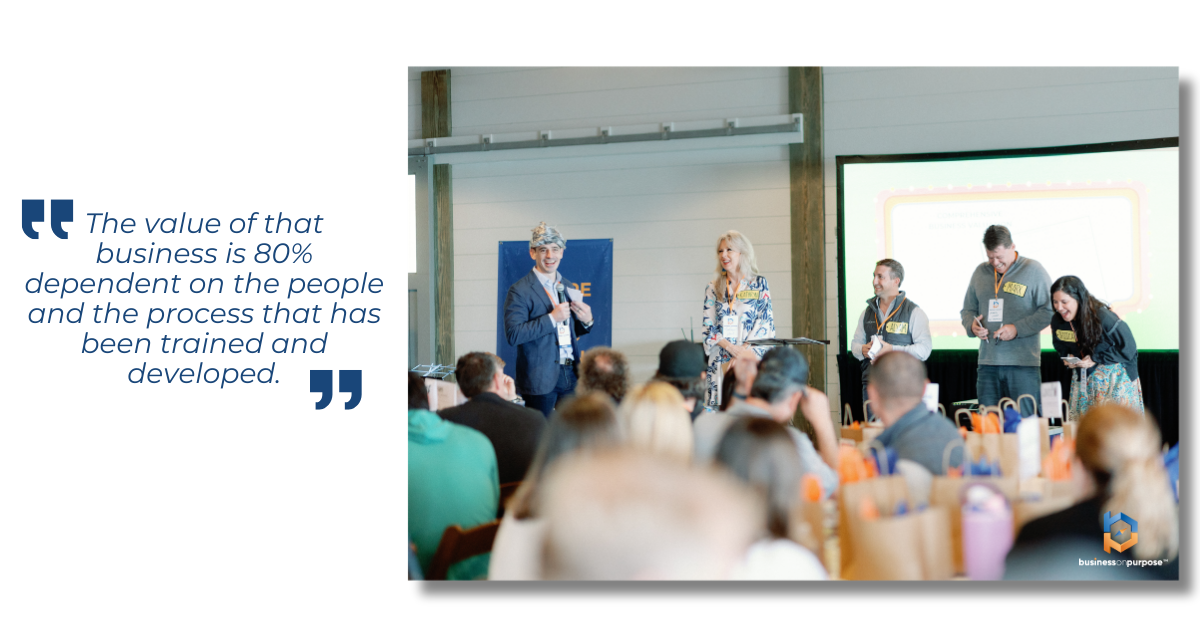
Your business is only worth what someone else is willing to pay. Its value depends heavily on the strength of its people and processes.
A system of well-built processes and clearly defined roles creates a business that is transferable, scalable, and truly valuable.
That is the goal.
Not a high-stress job.
A sellable asset.
Build a Business That Runs With or Without You
If you want a transferable business that grows without your constant involvement, start with clarity.
- Write your vision story.
- Build a clean org chart.
- Define detailed job roles.
- Create scorecards that empower leadership.
When you do this, you move from chaos to clarity.
And clarity builds value.
Ready To Create Radical Clarity?
If you are serious about succession planning and building a business that works for you instead of because of you, take the time to build your vision story in detail.
Clarity is not optional. It is foundational.
Start today.
Your future exit depends on it.
Scott Beebe is the founder of Business On Purpose (mybusinessonpurpose.com) and speaker for the AEC industry and author of the book Let Your Business Burn: Stop Putting Out Fires, Discover Purpose, and Build a Business That Matters. Business On Purpose works with business owners to articulate purpose, people, process, and profit to liberate owners from chaos and make time for what matters most.