You looked at your profit and loss statement and everything showed green — and then Friday came and you could not make payroll. If that story sounds familiar, you are not alone, and the fix is not what you think it is. You do not need more revenue to solve cash flow problems. You need to understand the flow of cash.
The 2:38 A.M. Wake-Up Call
Early in running a business, there is a very specific kind of anxiety that hits somewhere around 2:37 or 2:38 in the morning. You go to bed after a busy day, and then your brain fires up with a script on loop: Are we going to have enough? Is enough coming in? Are we spending it the right way?
That script is exhausting. And the worst part is not even the empty bank account. The worst part is not understanding why the bank account is empty when your P&L shows a positive balance. You look back and think, “I know we made money this month — so where did it go?”
That question is the real cash flow problem. And there is a system that answers it.
You do not need more revenue. You need to know where your cash is going.
Lead Well.
If you're looking for more resources to work ON your business, we have them.
The CASH FLOW Acronym: Your Complete Framework
To fix cash flow chaos, there is an eight-step system built around one simple acronym: CASH FLOW. Each letter represents a specific action you can take to gain clarity, reduce anxiety, and stop guessing about your money. Let’s walk through each one.
C — Cut Up Your Cash
Right now, most small businesses run out of one, two, or three bank accounts. Every dollar that comes in lands in the same bucket, and you have no idea if that money is meant for taxes, payroll, profit, capital expenses, or cost of goods sold. This creates a dangerous myth: “As long as there’s money in the bank, I must be making money.”
That is not true. The reality is: as long as there is profit in the bank, you are making money. And if you cannot identify that profit separately from everything else, you are operating on paper profit — a number printed on a P&L sheet — rather than real, usable cash.
The solution is to open five, six, seven, or even nine separate bank accounts, each holding a specific type of fund: profit, taxes, operating expenses, capital expenses, and cost of goods sold. For many businesses, cost of goods sold can represent 30 to 90 percent of every dollar that comes in. That money is owed to other people. It should not be sitting in the same bucket as your profit.
Cutting up your cash gives you immediate clarity. You stop living under a false narrative and start seeing your money for what it actually is.
A — Automate Your Receivables and Payables
Too many business owners are still collecting checks the old-school way. The result? Receivables that are 60, 90, or even 120 days outstanding. By the time you collect, you have deeply discounted the value of that money simply by waiting for it.
You need to start leveraging technology to automate both your accounts receivable (AR) and accounts payable (AP). Accept credit cards. Set up automated invoicing. Stop letting cash sit in someone else’s hands when it should be working for you.
S — Systematically Track Your “Slim Pants”
This step is about living lean in your business and tracking it consistently. Before you can track anything, you need to understand three core numbers as the business owner: total revenue, cost of goods sold, and gross margin (revenue minus cost of goods). If you do not know these numbers off the top of your head, cash flow problems are inevitable.
The “slim pants” framework breaks down nine tracking elements across two categories:
The “S” side (Schedule): Are you on schedule with your products and services? What does labor cost look like? What is your inventory hold time? Are you budgeting for mistakes, callbacks, and warranties?
The “Pants” side: Pricing, accounts receivable and payable, new equipment and capital reinvestment, taxes, and debt service.
These nine elements can live in a simple spreadsheet. Once a week, you review the metrics across each one. That regular habit is what keeps you from being blindsided.
H — Hold Weekly Cash Meetings
Every week, you sit down — whether alone, with your bookkeeper, or with your accountant — and look at a few key numbers. First, you check your subdivided bank accounts to see your real-time cash position. Not a P&L from two weeks ago. Not a balance sheet. Real-time cash, right now. Second, you review outstanding receivables and upcoming payables.
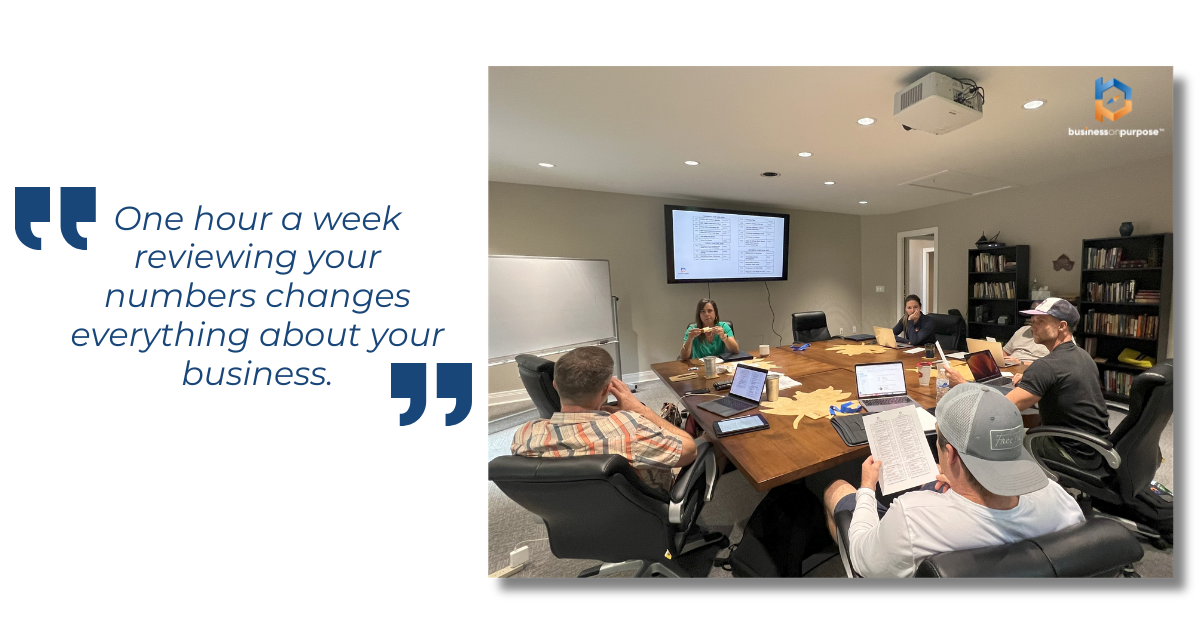
From there, you run through your slim pants checklist: schedule performance, labor costs, mistakes, and reinvestment. The whole meeting can happen in under an hour. But that one hour per week is one of the most powerful habits you can build as a business owner.
One hour a week reviewing your numbers changes everything about your business.
F — Forecast 13 Weeks Ahead
There are 52 weeks in a year. Divide by four and you get 13 weeks — one full quarter. The goal is to always be forecasting on a rolling 13-week window. What does your pipeline look like? What is your cash position? What receivables are coming in and what payables are going out?
A 13-week forecast gives you a buffer. You stop reacting to cash surprises and start anticipating them. This is where business owners begin to feel real peace of mind.
L — Lock Down Payment Terms
This step ties directly into your accounts receivable. You need to define your payment terms based on your actual pricing and product cycle. If 30-day terms do not fit your business model, move to 14 days. If 14 days does not work, move to seven. Whatever the number, communicate it clearly and consistently with your customers.
The goal is to get paid more quickly and predictably. Cash is the fuel that gives your business options. Income needs to be repetitive, predictable, and meaningful. If you do not have cash, you do not have options.
O — Organize with the ABCs
The ABCs stand for Accounts, Bookkeeping, and Customers. Here is how it works in practice:
Accounts: Once a week — say, every Monday — take a snapshot of the balance in each of your subdivided bank accounts and record it in a spreadsheet. Do this for all 52 weeks of the year. After 12, 24, or even 36 months of doing this, you will have a living, breathing picture of how cash actually flows through your business across seasons and cycles.
Bookkeeping: Keep your records current and consistent so your weekly meeting is based on real numbers, not estimates.
Customers: Know who owes you money, when it is due, and follow up without hesitation.
Over time, this simple spreadsheet habit eliminates the need to pull static cash flow reports. You will be able to see the flow of your cash with your own eyes.
W — Wipe Out Guessing
If you had to trace every cash flow problem back to a single root cause, it would be this: guessing. We guess on pricing. We guess on our tax liability. We guess on when receivables will come in. We guess on whether we can afford that new hire or piece of equipment.
The entire CASH FLOW system exists to replace guessing with knowing. Not hoping. Not estimating. Knowing your cash position, your receivables, your payables, your pricing, your tax liability. All of it.
Cash flow chaos is not a money problem. It is a guessing problem.
You Can Stop Waking Up at 2:38 A.M.
Cash flow chaos is one of the most draining and disorienting experiences a small business owner can have. But it is solvable. The eight steps in the CASH FLOW system — cut up cash, automate payables and receivables, systematically track your slim pants, hold weekly cash meetings, forecast 13 weeks out, lock down payment terms, organize with the ABCs, and wipe out guessing — give you a complete, practical framework to build clarity into your finances every single week.
You made money this month. Now it is time to know exactly where it went and where it is going next.
Ready to Put This Into Action?
If you want a step-by-step tool to help you implement everything covered here, visit businessonpurpose.com/healthy. The team at Business On Purpose has built resources designed to help small business owners just like you gain real financial clarity, reduce chaos, and build a business that works for you — not the other way around.
Scott Beebe is the founder of Business On Purpose (mybusinessonpurpose.com) and speaker for the AEC industry and author of the book Let Your Business Burn: Stop Putting Out Fires, Discover Purpose, and Build a Business That Matters. Business On Purpose works with business owners to articulate purpose, people, process, and profit to liberate owners from chaos and make time for what matters most.