Let’s talk about where AI fits into your marketing and sales system, how to use it without becoming robotic, and how it can actually free you up to be more human, not less.
The Order Matters More Than the Tool
Here is something worth noticing right away: the real conversation is not about AI at all. It is about marketing and sales — in that order. Marketing comes first. Sales follows. When you get that sequence backwards, no tool in the world will fix it.
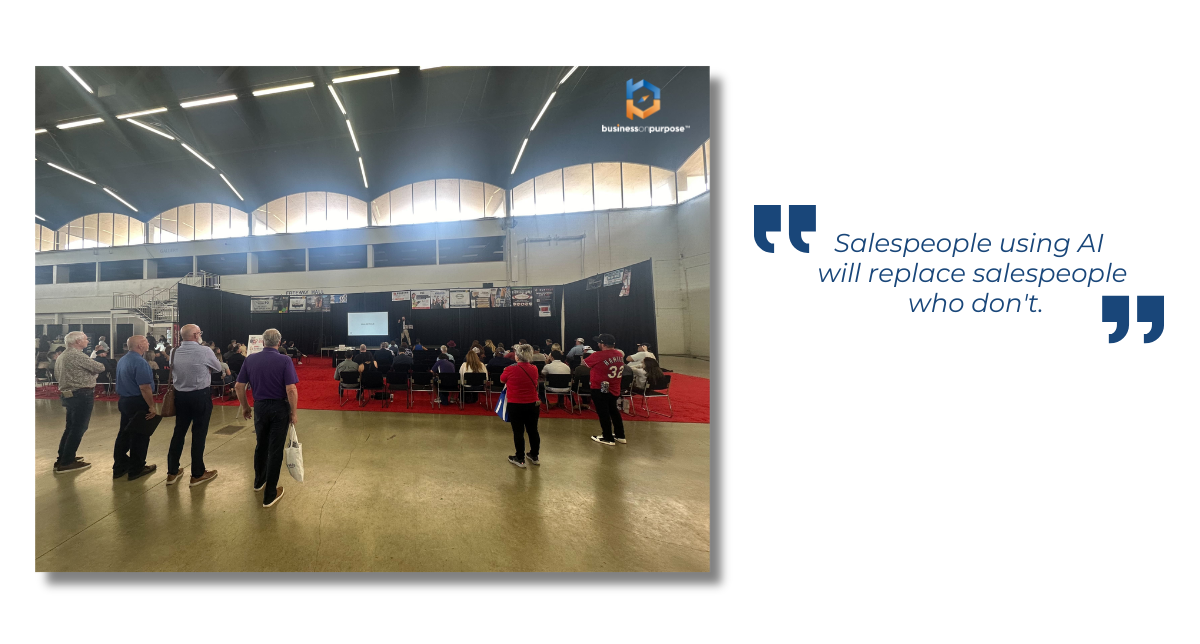
The second thing to understand is this: AI is not going to replace your sales team. But salespeople who use AI will replace salespeople who do not. The competitive edge is not in the technology itself — it is in how you apply it.
About three years ago, one of our clients was building a drip email nurture sequence for prospects he was meeting at trade shows and events. He wanted to do it himself instead of hiring a marketing copy agency, so we gave him a framework and sent him to work. He came back with something solid. We made a few tweaks, and it looked great.
Then we asked how long it took him.
“About eight hours,” he said.
Eight hours at a minimum billable rate of $200 per hour for a business owner. That is $1,600 of the owner’s time poured into one email sequence. Fast forward to today — with AI tools and the recorded sales conversations we had already captured, we can build that same nurture sequence in about 20 minutes.
“Salespeople using AI will replace salespeople who don’t.”
Lead Well.
If you're looking for more resources to work ON your business, we have them.
Two Principles You Cannot Skip
Before you start feeding everything into ChatGPT and calling it a day, there are two foundational principles that will determine whether AI works for you or against you.
Principle One: BYOC — Bring Your Own Creativity. Do not approach AI the way you used to approach Google, just searching for someone else’s template or sequence. AI is not a search engine. It is a production engine. You have to bring your own thinking into the relationship first.
Principle Two: The 10-80-10 Principle. Think of every AI task in three parts.
The first 10% is you. This is your prompt — and your prompts should be paragraphs and pages, not a single sentence. Think deeply about what you are asking, what you want to produce, and what context AI needs to do the job well.
The middle 80% is AI doing the heavy lifting. You bring the raw material — your sales conversations, your operational processes, your customer stories — and AI assembles it into something usable. A nurture sequence. A job description. An outline. An objection-handling guide.
The final 10% is you again. Do not take what AI produces straight off the shelf. Review it. Polish it. Put your voice and your spin on it. AI does the grunt work, but you make it human.
Where AI Can Do the Most for Your Sales Process
One of the most practical uses of AI in sales is objection handling. Take every objection your team has ever received, feed them into AI, and ask it to expand the list. Then use AI to run your team through repetitive role-play scenarios so they stay sharp when those objections show up in real conversations.
This kind of consistent, low-cost training is something most small businesses skip entirely — not because they do not want it, but because building it from scratch takes too long. AI eliminates that excuse.
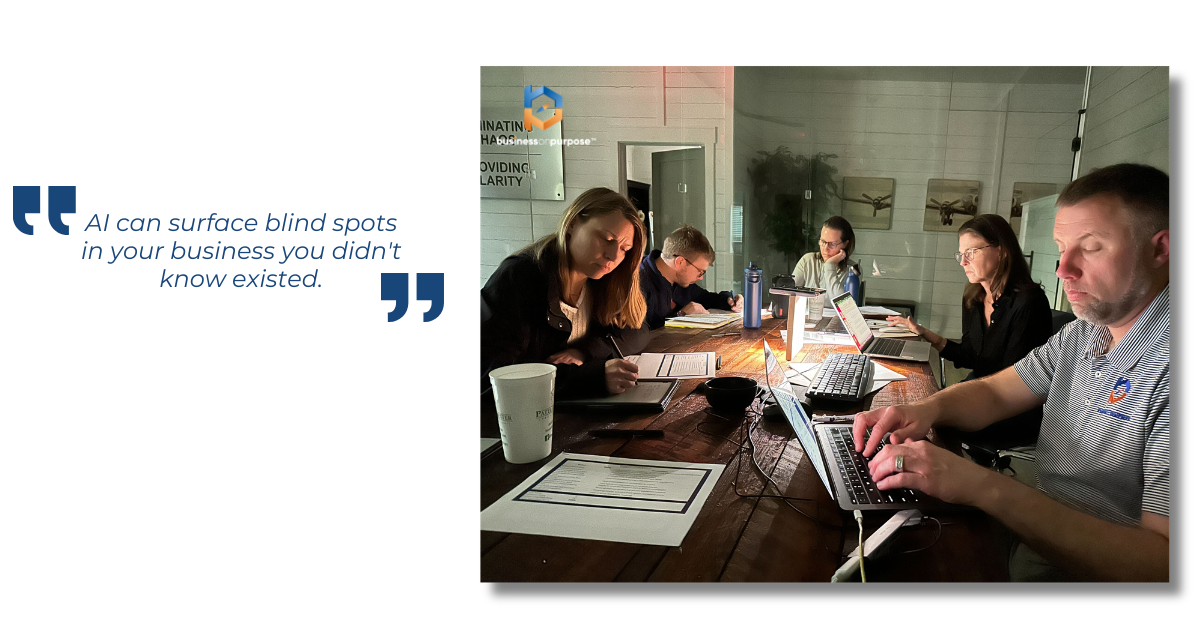
Another powerful use is recording your sales and operational conversations — using a wearable recorder or a voice memo on your phone — and uploading those recordings into AI. From there, AI can surface bottlenecks, blind spots, and hidden objections you may not even know exist. It can help you tighten your messaging, serve customers better, and reduce the chances of losing someone during the relationship cycle.
Customer feedback and testimonials are another goldmine. Feed them into AI and let it turn them into marketing content, training material, or both.
“AI can surface blind spots in your business you didn’t know existed.”
AI Can Make You More Human, Not Less
This is where a lot of people get nervous, and understandably so. The worry is that using AI for relationship building will make everything feel cold and automated. But that is a misunderstanding of what AI is for in this context.
Think about it this way. A framework for a marriage does not make the marriage robotic — it protects it. A simple rhythm like “dialogue daily, date weekly, depart quarterly, dream annually” is a system, but it exists in service of something deeply human. The alternative — no system, no rhythm, no intentionality — does not make the relationship more authentic. It just makes it more neglected.
The same is true in business relationships. AI can remind you to reach out to someone. It can help you find the right words when you have a thought about a client or a prospect but are not sure how to say it. It can help you acknowledge people — to let them know you see them.
In a world full of digital noise, that is what people are really asking: Do you see me?
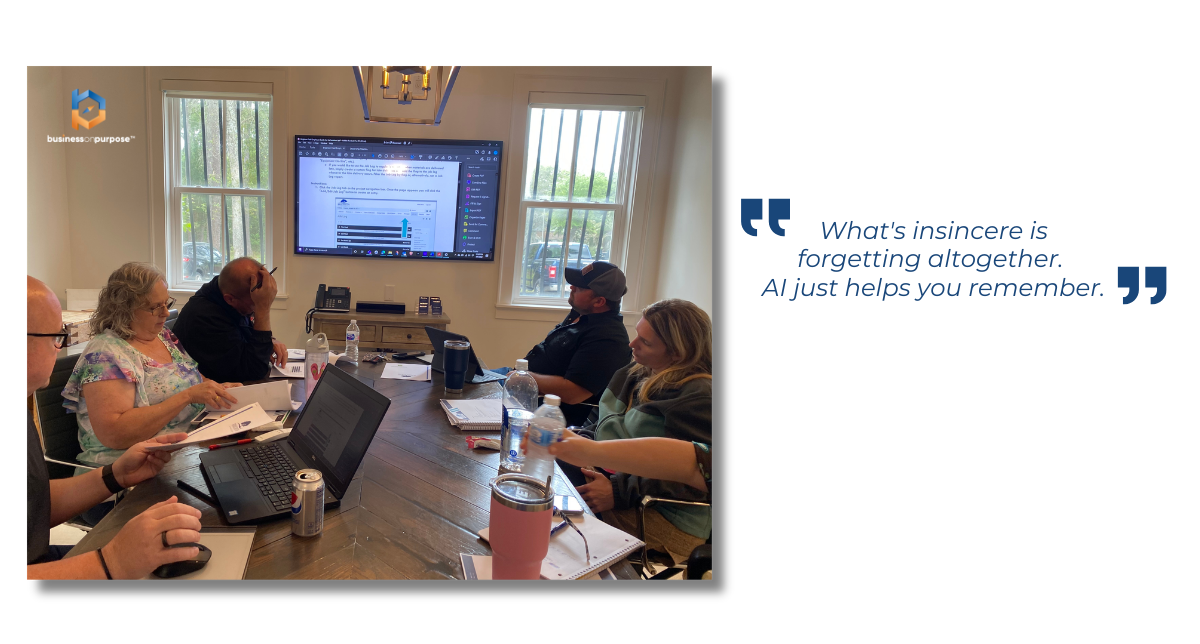
What is insincere is forgetting altogether. What is sincere is using a tool to make sure you do not forget — and then reaching out as a real human being.
AI can help us be more human if we let it do that job. It can also make us more robotic if we let it do that instead. The choice is yours.
Let AI Handle the Repetitive, So You Can Focus on What Matters
Beyond marketing and sales, AI is exceptional at taking repetitive tasks and putting them on autopilot. Content creation is a perfect example. Rather than spending hours outlining every video, every blog post, or every training session from scratch, you can give AI your raw notes and let it build the framework. You bring the ideas. AI structures them. You review and refine.
That is the 10-80-10 principle in action — and it works across every part of your business.
The bigger goal here is not just delegating to AI. It is using AI to help you build systems you can delegate to people. Ultimately, the mission is to hand off your marketing, sales, operations, and admin to a capable team so your business can run and grow with or without you in the room.
“What’s insincere is forgetting altogether. AI just helps you remember.”
You Do Not Have a Marketing Problem — You Have a Process Problem
Here is the truth that most business owners need to hear: the issue is rarely a lack of effort. It is a lack of designed, scripted, built-out process. Marketing has not been systematized. Sales conversations are not being recorded or reviewed. Objections are not being trained on regularly. And the owner is still doing work that AI or a trained team member could handle.
AI is one of the most powerful tools available right now to close that gap — to move you from reactive and overwhelmed to predictable, repeatable, and free.
But it only works when you bring your own creativity, give it the right inputs, and take the time to review what it produces. The tool is only as good as the person using it.
Ready to Build a Business That Runs Without You?
If this resonated with you, the next step is building the systems — not just the AI prompts, but the full operating framework that gives your business predictability and gives you your life back.
Visit businessonpurpose.com/healthy to find out how healthy your business really is and get a clear path forward.