The good news is that accountability is not something you hire or fire your way into. It’s something you build, conversation by conversation, with the right mindset and the right tools. Here’s how to do it.
The Mindset Shift That Changes Everything
Let’s be honest for a second. About six months ago, I let a difficult conversation with a team member build up for way too long. I kept avoiding it, sweeping it under the rug, and eventually that rug started to mound up. And then it blew up. Not because anyone was being mean, but because I kept choosing passivity over progress.
Here’s the principle I had to internalize, and it’s one I borrowed from a group I’m part of: In order to grow in maturity, we must reject passivity and instead move toward, be responsible for, and depend on.
That is the foundation of accountability as a leader. You stop stepping away from tension. You start moving toward it.
One of my personal goals is to become what leadership thinkers like Murray Bowen, Ed Friedman, and Steve Cuss call a well-differentiated, self-regulated, non-anxious presence. Think of it this way. You’ve probably seen the Peanuts character Pig-Pen, who walks around with a cloud of dirt swirling around him. Some team situations can feel exactly like that. A well-differentiated leader comes into proximity with the dust cloud without jumping inside it. You stay close enough to lead, but regulated enough not to absorb someone else’s anxiety as your own.
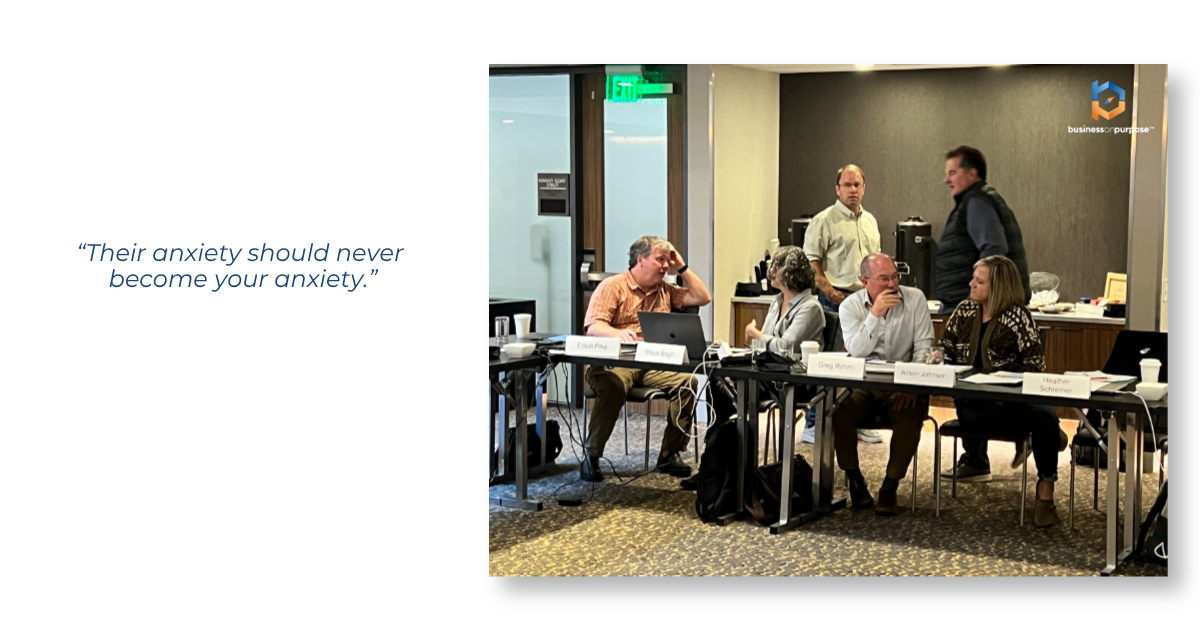
Their anxiety should never become your anxiety.
Lead Well.
If you're looking for more resources to work ON your business, we have them.
Accountability Versus Micromanagement: Know the Difference
One of the biggest reasons business owners avoid accountability conversations is because they’re afraid of coming across as a micromanager. So let’s clear that up right now.
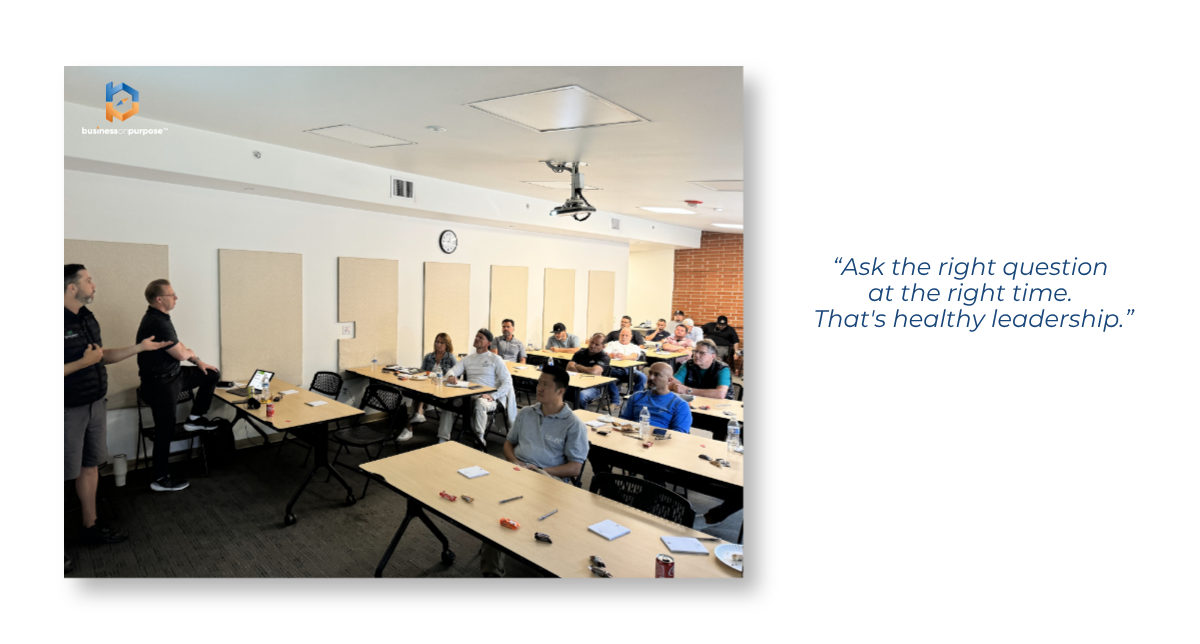
Think of it as a seesaw with a fulcrum in the middle. On one side you have the right question. On the other side, you have the right time. Healthy leadership is asking the right question at the right time. That’s it. When those two things are in balance, you’re leading well, even if it makes someone temporarily uncomfortable.
Micromanagement happens when the seesaw tips out of balance. That looks like asking the wrong question at the right time, or asking the right question at the completely wrong time. For example, texting a team member at 10 p.m. on a Thursday to ask about last month’s project plans is the right question at absolutely the wrong time. That creates unpredictability, and unpredictability breeds a culture of anxiety rather than accountability.
Ask the right question at the right time. That’s healthy leadership.
Build the Foundation First: Your Business Operating System
Before you can hold anyone accountable for anything, you need to have a documented foundation. You can’t hold someone to a standard that was never written down. Here’s how to think about that foundation.
Every business runs on an operating system. The problem for most small business owners is that their operating system exists entirely inside their own head. When you power up the business, you get a blank screen because everything is locked away in the owner’s brain. Steve Jobs isn’t sitting next to me running my Mac. He built an operating system that runs it. You need the same thing for your business.
That business operating system is built on four foundational cornerstones:
- Purpose – your vision, mission, values, and culture handbook
- People – org charts, job roles, hiring process, and delegation maps
- Process – all the steps it takes to deliver your product or service
- Admin – accounting, HR, and the administrative glue that holds it all together
Inside the process cornerstone, you need what we call a Master Process Roadmap. This is a spreadsheet that breaks your entire business into four core systems: marketing, sales, operations, and admin. Every team member should have a job role with tasks clearly laid out across those four areas.
From there, each team member gets an RO Scorecard. This tells them exactly when to do their tasks, whether that’s daily, weekly, monthly, quarterly, or annually. Now your team knows what they’re responsible for and when. That’s the structure that makes accountability possible in the first place.
The One-on-One Check-In: Where Accountability Happens in Real Life
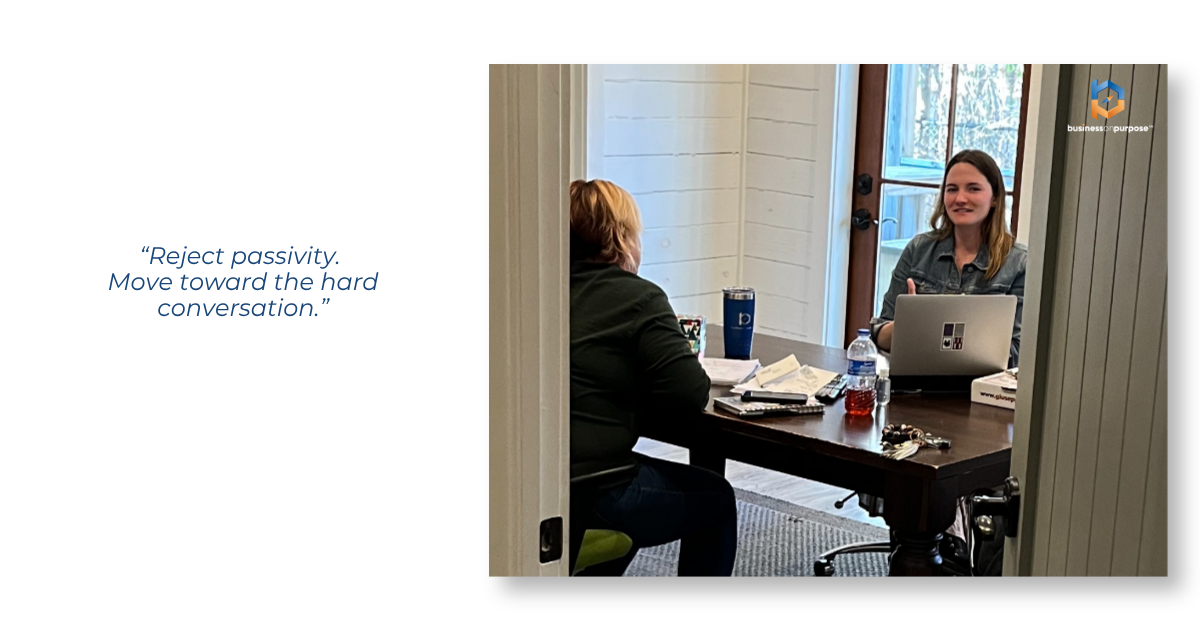
With your foundation in place, it’s time to talk about the actual conversations that build accountability. This is where you reject passivity and move toward your team.
Twice every month, you should be having a one-on-one check-in with each of your direct reports. Not with everyone in the business, just your direct reports. If your direct reports are literally everyone in the company, that’s a delegation problem you need to solve first.
These check-ins are 20 minutes long. Here’s the structure:
Start with a 30-second big win. Ask your team member to share one win from the past couple of weeks, personal or professional. Then you share one too. This sets a tone of positive momentum before anything else.
Move into the RO Scorecard review. Spend five to eight minutes on it. Ask three things: Where do you feel like you crushed it? Where did you fall short of your own standards? And what do you need help with?
Then spend the remaining time on these four questions:
- What are you seeing and thinking right now, about me, the business, the market, or customers?
- What blind spots do I have as a leader?
- What do you need from me right now?
- This one is a statement, not a question: “Here’s what I see, and here’s what I need from you.”
That fourth one is your accountability moment. That is where you move toward the hard conversation instead of away from it. With the org chart, the job role, and the scorecard all in front of you, you have everything you need to give clear, grounded feedback.
Reject passivity. Move toward the hard conversation.
Implementation Is the Only Thing That Matters Now
Thomas Edison reportedly said that vision without implementation is just hallucination. Reading about accountability without actually putting any of this into practice is no different. The structure works. The conversations work. But only if you use them.
You deserve a business that runs without you carrying every single piece of it in your head. Your team deserves a leader who moves toward them with clarity instead of away from tension with avoidance. All of this, the operating system, the scorecard, the one-on-one check-ins, exists for one reason: to liberate you from the chaos so you can make time for what matters most.
Ready to Build a Healthier Business?
If you’re ready to put these systems in place and finally build a business that runs without you, visit businessonpurpose.com/healthy to get started. The tools, the frameworks, and the support you need to lead your team with confidence are all right there waiting for you.