Here is exactly how to free those processes, document them, and finally build a business that does not depend on you being in the room every time something needs to get done.
The Contractor Who Built a Handbook One Question at a Time
A while back, we were working with a contractor who said something that sounded painfully familiar: “I feel like all I do is repeat myself over and over again.”
The solution was simple. We told him to repeat himself one more time, but this time, we recorded it.
The very next question his team brought to him was about paid time off. He was exhausted answering it. So instead of answering it again, we wrote it down and put it into a handbook. That handbook started with exactly one policy: paid time off.
The next question that came up was about how to use the company credit card. So we recorded that too. It went into the handbook. Then we trained the team on it. Then the next question came. Then the next policy got added.
Over time, he built a full handbook, one question at a time. Every time his team asked him something, instead of just answering it, he captured it, documented it, and trained on it. The questions stopped repeating because the answers were finally written down.
That right there is the core of how you streamline a business. But let us zoom out and show you the full picture so you understand exactly where that handbook fits.
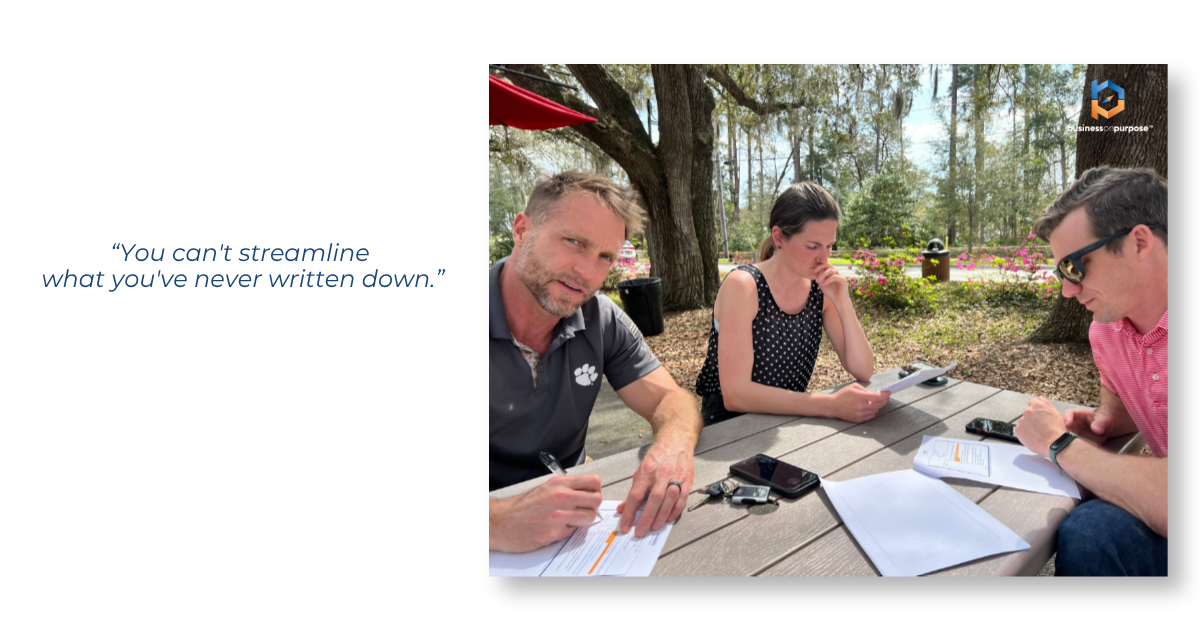
“You can’t streamline what you’ve never written down.”
Lead Well.
If you're looking for more resources to work ON your business, we have them.
Captive Processes Are Costing You Everything
Here is the truth. Your actual process is probably not the problem. What you have built over the years works. You know how to do the job. The issue is the process you use to delegate that work to someone else, and that process is broken because it only exists inside your head.
A captive process sounds like it could be a good thing, but it is not. A captive process is locked behind the bars of your mind. It means your team cannot grab it, replicate it, or run with it. It means that if you ever want to step back from your business, sell it, or simply take a real vacation, there is nothing there for anyone else to hold onto.
And when all your processes are trapped in your head, you are not just selling a product or a service. You are selling yourself. And nobody wants to buy you. What your customers are actually buying is the experience you deliver, which is a product of your process.
Think about two high-end steakhouses serving the exact same cut of meat. Same wagyu tomahawk, same ambiance, same table setting. The difference is that one restaurant just drops the plate in front of you, no greeting, no experience, nothing. The other follows the principles of unreasonable hospitality and wraps the meal in a full, intentional experience.
Which steak tastes better? Most people say the second one, even though the cut of meat is identical. The experience, which is the process, is what they are actually buying.
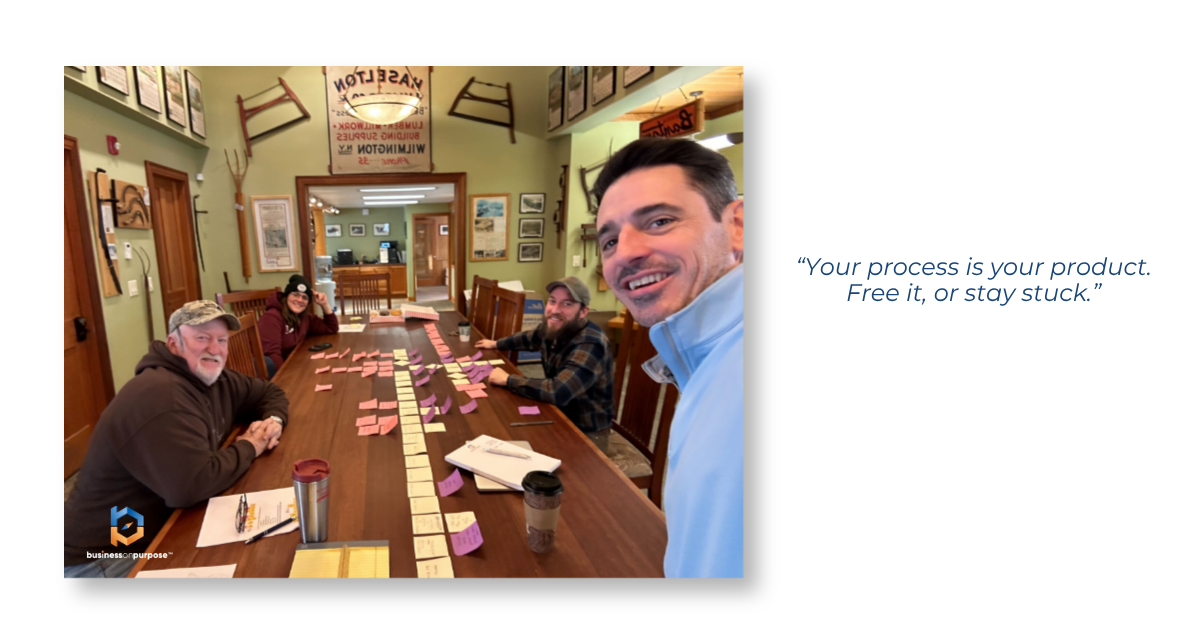
Your process is your product. And if that process lives only in your head, it cannot scale, it cannot be delegated, and it cannot run without you.
“Your process is your product. Free it, or stay stuck.”
The Three Layers of a Streamlined Business
To fully understand how streamlining works, you need to understand how a business is built. There are three major layers.
Layer One: The Operating System. Think of this like the operating system on your phone or computer. Your employees need a foundation to operate from, just like a device needs software to boot up. Your operating system is built on what we call the four Ps: purpose, people, process, and profit. If you do not have those four things documented, then as far as your business is concerned, they do not exist. That operating system includes your vision, mission, values, handbook, org chart, job roles, and about 28 to 30 tools that run the business side of your business.
Layer Two: The Master Process Roadmap. This is where your actual product delivery lives. It is organized into four core systems: marketing, sales, operations, and admin. These are the processes that create the experience your customers are paying for. This is where your captive processes need to be documented and organized.
Layer Three: The Anchor. This is a simple spreadsheet with 52 weeks of the year across the top and every operational ingredient down the left side. One of those line items is training. When you document a new process, you schedule it into the anchor for regular retraining throughout the year. This is how you create repetition, predictability, and meaning in the business.
Your 15-Minute Brain Dump Exercise
Here is where we get practical. Grab a sheet of paper or a sticky note right now. Write down these four categories: marketing, sales, operations, and admin. Admin includes accounting and HR.
Set a timer for 15 minutes. Under each category, write down every process that currently exists in your business. Just the titles, not the details. You are doing a categorical brain dump.
In marketing, you might list 4 to 15 processes. Sales might have 3 to 8. Admin will have things like accounts receivable, accounts payable, payroll, and insurance certificates. Operations will likely be your biggest category, and in a contracting business, you can break it down into preconstruction, construction, and closeout, or by division if you run multiple types of work.
For preconstruction alone, you might list a sales-to-operations handoff meeting, a permitting process, a site demo review with civil, and more. For the construction phase, you might list framing, concrete foundation, demo, cabinets, and so on. Write it all down. Just the titles.
When you finish, something is going to happen. You are going to feel a little bit of relief. All of that stuff that has been swimming around in your head, keeping you up at night, making you irritable with the people you love most, is now on paper in front of you. That was never supposed to live permanently in your mind. Getting it out is the first step to getting free.
How to Document a Process Using AI
Now pick one. Pick the process that irritates you most, the one you feel like you have to redo every single time, the one where you catch yourself explaining the same steps over and over again.
Let us say it is pulling permits.
The next time you pull a permit, document it like it is the last time you will ever do it yourself. Film yourself doing it. Use screen capture software. Leave yourself a voicemail walking through each step. There are a thousand ways to record something today, so there is no excuse not to.
Once you have that recording, take it to AI and give it a simple prompt like this:
“I recorded myself walking through the process of pulling a permit. Here are my brand standards. I want to build a process document my team can use so that I never have to pull a permit again. Ask me up to 10 questions to help you craft the best possible process document.”
Answer those 10 questions. AI will create a clean, usable process document for you. Drop it into your operations folder. Link it to your master process roadmap spreadsheet. Then schedule it into your anchor for retraining every 10 to 20 weeks.
You have now streamlined a process. Do that one more time. Then again. Then again. Over time, you build a business that can run without you in the room.
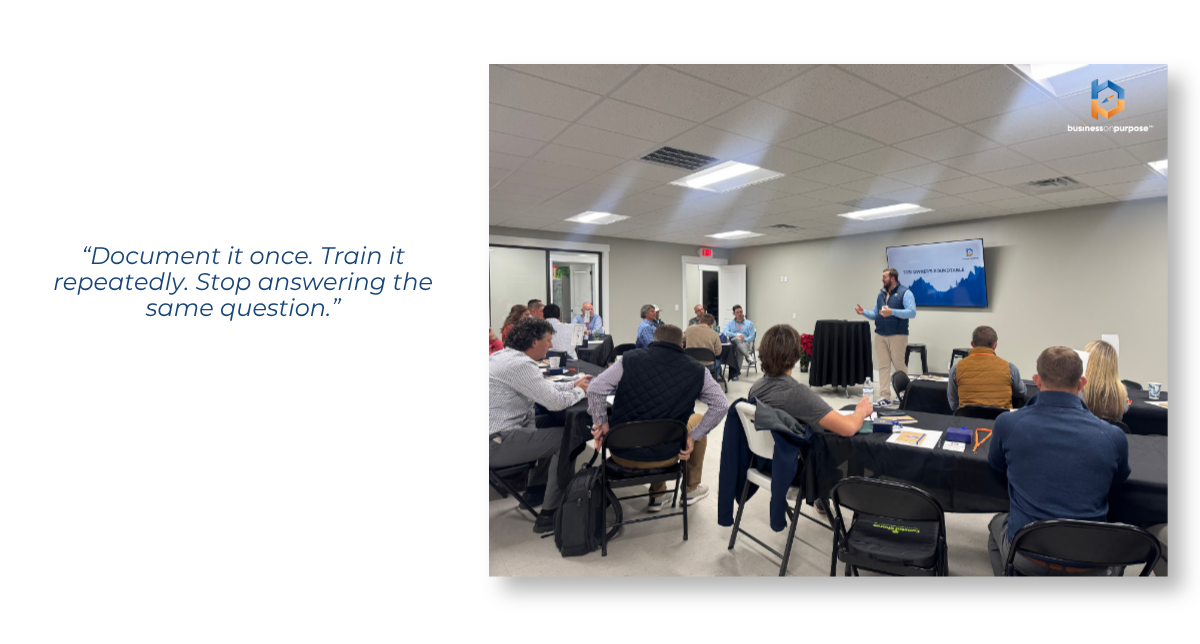
“Document it once. Train it repeatedly. Stop answering the same question.”
Liberation Is the Goal
Most contractors live in chaos. The firefighting, the constant interruptions, the feeling that nothing works unless you are personally involved in it, that is not a badge of honor. It is a sign that the business is running you instead of the other way around.
Every process you document is a step toward freedom. Freedom to lead. Freedom to grow. Freedom to actually be present for the people and moments that matter most to you outside of work.
You have got the tools. You have got the framework. Now it is time to use them.
Ready to Build a Business That Runs Without You?
If today’s content hit home, the next step is simple. Visit businessonpurpose.com/healthy to get the resources you need to start building a healthier, more documented, and more liberated business today. Your future self, and your family, will thank you for it.