You worked hard for every dollar that came into your business, so why does your bank account tell a different story than your profit report? If you have ever stared at a year-end statement showing profit on paper while your account sat nearly empty, you are not alone — and you are not helpless. Understanding the real causes of cash flow problems is the first step to taking back control.
Your Cash Has a Personality — Do You Know It?
Think about parenting for a moment. Most parents spend years trying to understand their kids — their cycles, personalities, and ambitions. It takes time, attention, and intention. Running a business is no different. As a business owner, you need to know your cash the same way a good parent knows their child.
Too many owners hand that responsibility off entirely. They say, “My CPA handles that,” or “My bookkeeper takes care of it.” And while your financial team can absolutely handle the transactional work, the direction, the expectations, and the system must come from you. When you abdicate that responsibility, you end up at the end of the year with a profit on paper and an empty bank account wondering where the money went.
Here is a simple way to think about it. Your business finances are like a bathtub. You have a faucet bringing water in and a drain letting it out. For too many business owners, the drain is far too large and the faucet far too small. The goal is not just to increase the inflow — it is to understand and control both sides of the tub.
To make this easy to remember and action, we are going to walk through the four causes of cash flow problems using the acronym KNOW.
Either you control cash like a tool, or the tool controls you.
Lead Well.
If you're looking for more resources to work ON your business, we have them.

K — Keeping Spending Without Receiving
The first cause is straightforward, but do not dismiss it just because it sounds obvious. Many business owners are spending more than they are bringing in, and the deeper problem is that they have no visibility into where the money is actually going.
Here is why that happens. Most businesses run all their money through one, two, or maybe three bank accounts. When every dollar lives in one big pile, you will spend it. It is just human nature. Think about a giant bucket of popcorn — if it is sitting in front of you, you will eat the whole thing. But if you split that same amount into seven or eight smaller cups, you stop and think before reaching for more.
That is exactly why every client at Business On Purpose runs a minimum of six, seven, or eight separate bank accounts. When you subdivide your dollars by purpose, you can see exactly how much is available for each category, and you naturally start to modulate your spending.
This is also why we use the RAGE framework — tracking Revenue, Actual Costs, Gross Margin, and Expenses. The rule is simple: if you are not willing to track, stop spending. But if you are willing to track, you have the freedom to keep investing in your business with confidence.
N — Not Receiving Money Fast Enough
The second cause is a collections problem. You are not receiving money fast enough. This shows up in your accounts receivable — the money customers owe you for work already done or products already delivered.
You budget based on when you expect to be paid. But when a client takes twice as long to pay as you planned, your entire cash timeline gets thrown off. That gap between expectation and reality is where cash flow problems are born.
The accounts payable side of this equation also matters. Some owners think holding onto cash longer is smart, but letting your own payables pile up creates a different problem. Eventually, you are hit with a large lump sum you were not prepared for, and you end up borrowing on a revolving line of credit that never seems to shrink.
The fix on both sides is the same: build a rhythm. Automate your receivables and payables wherever possible. Set up a recurring weekly time to handle billing and collections. Set up recurring payments through credit cards for regular expenses. Consistency and predictability are what bring cash flow under control.
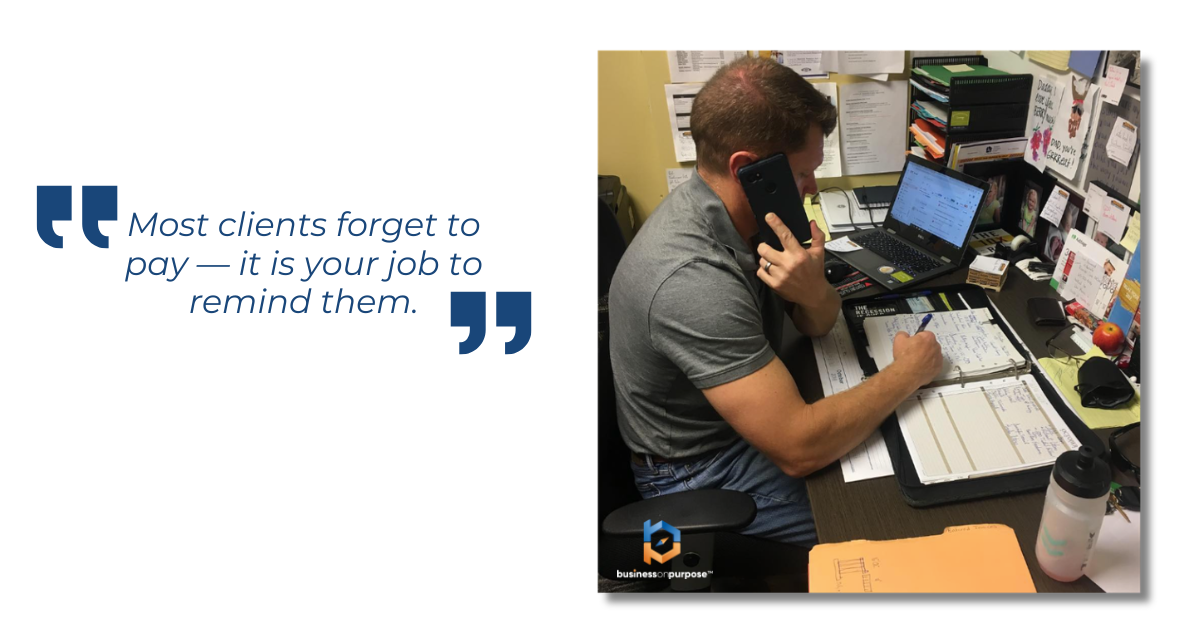
Most clients forget to pay — it is your job to remind them.
O — Outpacing Revenue With Expenses
The third cause is one of the most common traps for growing businesses. Revenue starts climbing, and the owner gets excited. They hire more people, buy more trucks, add software subscriptions, upgrade equipment — and they do all of it without tracking whether the revenue actually supports those decisions.
You have probably heard the old saying, “Sales solve everything.” But the reality is that you can have more sales and less cash. When revenue spikes, panic sets in. You feel the pressure to scale fast and start spending before the money has even fully landed. Suddenly, you are out of cash — even though business looks great from the outside.
Every expenditure should be made in light of what you are earning, not based on what you feel you need. Feelings are not a financial strategy. Tracking is. Once you are tracking consistently, you can make growth decisions based on real numbers instead of momentum and emotion.
W — Wrong Timing on Payments
The fourth cause is closely related to the collection issue, but it is specifically about timing. You might be collecting deposits too early or too late. You might be sending invoices on an inconsistent schedule. You might be following up on receivables sporadically instead of systematically.
The number one reason clients do not pay on time is not that they are unwilling — it is that they forget. Life is busy. Your invoice is not the top priority on their list. But it is on yours, and there are professional, tasteful ways to stay top of mind.
If you have a seven-day billing cycle, send a reminder three days before the due date, two days before, and one day before. This is not being pushy. This is being professional. It sets the expectation, keeps the client informed, and dramatically improves your on-time payment rate.
A quick note worth making here: when people talk about “cash flow,” they often mean a cash flow statement from their accounting software. The problem is that report is static the moment you print it. True cash flow management is about understanding the timing and behavior of your money — how quickly it comes in, how quickly it goes out, and whether your expenses are staying within the boundaries your revenue creates.
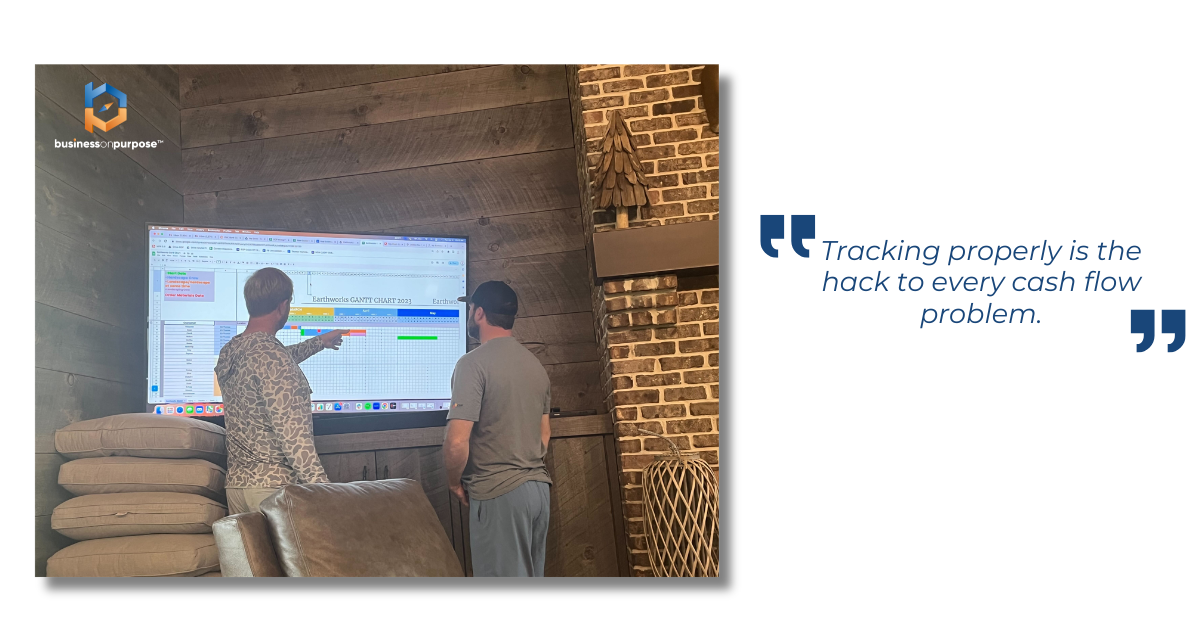
Tracking properly is the hack to every cash flow problem.
Knowing Your Cash Changes Everything
Here is the summary. The four causes of cash flow problems are:
- K — Keeping spending without receiving (no visibility, no subdivided accounts)
- N — Not receiving money fast enough (slow collections, inconsistent payments)
- O — Outpacing revenue with expenses (emotional spending without tracking)
- W — Wrong timing on payments (no billing rhythm or follow-up system)
The hack that ties all of this together is tracking — consistently, intentionally, and on a rhythm. At Business On Purpose, we call this the RPMs of great leadership: Repetition, Predictability, and Meaning. When you apply those three principles to how you manage money, you stop reacting to cash crises and start leading your finances with confidence.
We had a builder who dropped five million dollars in revenue but actually made more profit — and we saw it coming three months in advance. That kind of clarity is not luck. It is what happens when you know your numbers and understand the behavior of your cash.
You can get there too. It starts with one decision: to stop being a passenger in your own business finances and start driving.
Ready to Stop the Cash Flow Drain?
The Business On Purpose team has built a complete resource to help you set up the right metrics, the right accounts, and the right systems so you always know where your money is going. It is practical, it is proven, and it is designed specifically for small business owners who are ready to get healthy.
Visit businessonpurpose.com/healthy to get started today. Implement the system, take control of your cash, and free yourself to focus on what actually matters in your business.
Scott Beebe is the founder of Business On Purpose (mybusinessonpurpose.com) and speaker for the AEC industry and author of the book Let Your Business Burn: Stop Putting Out Fires, Discover Purpose, and Build a Business That Matters. Business On Purpose works with business owners to articulate purpose, people, process, and profit to liberate owners from chaos and make time for what matters most.