Imagine generating $2 million in revenue, carrying $1 million in debt, and taking home just $30,000 in net income. That is a reality for more small business owners than you might think, and it does not have to be yours. Most cash flow problems can be fixed, but only if you approach them with a clear, repeatable system.
That is exactly what the SOLVE system is designed to do. Let us walk through each step so you can start taking control of your cash flow today.
The Hard Truth About Cash Flow Problems
When business owners come to us for help, it is not unusual to see a business doing $2 million in revenue with only $30,000 in net income and a million dollars in debt. That is barely over one percent profit. You might think, “I could scale that up,” but the reality is that scaling a broken model just creates a bigger problem.
There have been moments where we have had to tell people honestly that they might be better off getting a job than continuing to run the business under that model. The stress of waking up at 2:38 in the morning wondering how you are going to make payroll or pay down debt is not sustainable. You might be funding a lifestyle on the surface, but you are paying for it in ways that go far deeper than money.
“If you don’t control money by setting up systems, the money will control you.”
Lead Well.
If you're looking for more resources to work ON your business, we have them.

The good news is that cash flow problems are solvable. The SOLVE acronym gives you a step-by-step framework to work through. And paired with another tool called the “Rage Over Slim Pants” methodology, you will have everything you need to bring order to the chaos.
S: Subdivide Your Bank Accounts
The first step in the SOLVE system is to subdivide your bank accounts. Instead of running your business out of one, two, or three accounts, you are going to create six, seven, eight, or even ten separate accounts. Every time money comes in, you divide it and move it into its designated home.
A lot of business owners respond with, “I can just do that on a spreadsheet.” The honest answer is that you probably will not. When it comes to money, there is something deeply psychological happening. Even the greatest teachers in history, including Jesus, talked about money more than almost any other topic. That tells us something about the emotional and unseen forces at work when we deal with finances.
When you partition your money the moment it arrives, you can see exactly where every dollar is intended to go. When a specific account runs low, your business is talking to you. It is telling you, “There is not enough here to do what you planned.” But when everything flows through one account, you have no idea what is going where. Subdividing your accounts is the foundation of cash flow control.
O: Organize a Tracking System Using “Rage Over Slim Pants”
The second step is to organize a tracking system. This is where the “Rage Over Slim Pants” methodology comes in. It sounds unusual, but it is one of the most practical frameworks you will ever use.
RAGE stands for:
- R – Total Revenue
- A – Actual Cost
- G – Gross Margin
- E – Expenses
You would be surprised at how many business owners cannot tell you what their total revenue was last year, even in a general ballpark. And when you ask about their cost of goods sold, they might say 30 percent, but when you actually dig into the numbers, it turns out to be 60 percent. That is a massive difference, and it changes everything about how you run your business. Understanding your revenue and actual costs gives you your gross margin, which tells you how much you can afford to spend to grow.
“Most cash flow problems exist because owners don’t know where they stand.”

SLIM stands for the four operational areas you need to stay lean in:
- S – Scheduling
- L – Labor
- I – Inventory
- M – Mistakes
Scheduling is crucial because when it slips, billing backs up and cash flow slows down. Meanwhile, your monthly overhead never takes a day off. Labor is another common leak. As businesses grow, it is easy to hire reactively instead of thoughtfully, and suddenly labor costs are outpacing revenue. And mistakes? Most businesses have no budget line for refunds, call-backs, or warranty work. You should have a couple of percent set aside for this category, because it will happen.
PANTS rounds out the methodology with five more critical areas:
- P – Pricing
- A – Accounts Receivable and Payable
- N – New Equipment and Capital Reinvestment
- T – Taxes
- S – Servicing Debt
When you have systems in place for all of these and review them regularly, you are living in “slim pants.” You are lean, intentional, and protected from cash flow surprises.
L: Lock Down Your Payment Terms
Every business operates under some form of payment terms, whether that is immediate payment at a register or net-30 invoicing on a construction project. The problem is that most business owners never think carefully about the consequences of those terms.
For example, you might price your work assuming a 30-day payment cycle is fine, but your pricing actually requires faster cash inflow to keep operations moving. You might need a 7-day cycle instead. The market does not really care what your terms are. What it does care about is that you are clear and that you follow up consistently.
Here is a key insight: most clients do not pay late because they want to. They pay late because they forgot. Lock down your terms, communicate them clearly upfront, and follow up when they are due. That one discipline alone can dramatically improve your cash position.
V: View Cash Weekly
The V in SOLVE stands for viewing your cash every single week. This means tracking your subdivided accounts, your accounts receivable, and your accounts payable on a weekly basis. When you review these two core metrics consistently, you always know where you stand.
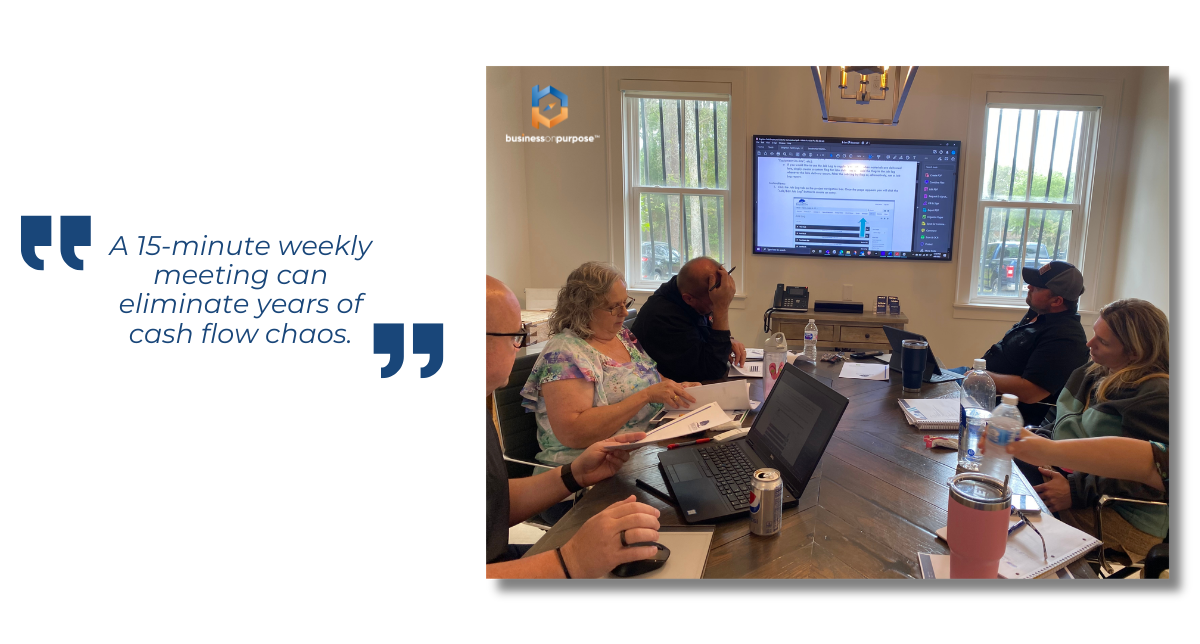
This does not have to be complicated. A 15 to 30-minute agenda-driven leadership meeting each week is enough. Same agenda every time: cash position, revenue, costs, gross margin, expenses, and the slim pants metrics like scheduling, labor, mistakes, debt servicing, and taxes. Keep it tight and keep it consistent.
“A 15-minute weekly meeting can eliminate years of cash flow chaos.”
E: Eliminate Guessing
The final step in the SOLVE system is to eliminate guessing. Too many business owners spend their days making decisions based on gut feeling rather than real data. That is not a winning strategy, and over time it will lead you straight into cash flow problems.
When you combine subdivided bank accounts, an organized tracking system, locked-down payment terms, and weekly cash reviews, you replace guesswork with clarity. Money stops being something that controls you and becomes a tool you control.
If you are feeling overwhelmed right now, here is a simple promise: if you build all of this into one spreadsheet and review it weekly from now until the end of the year, you will have more clarity than you ever thought possible. You will be in a strong position to fix the cash flow problem you have today, or head off the one that is coming.
You Do Not Have to Figure This Out Alone
Cash flow problems are serious, but they are solvable. The SOLVE system gives you a clear path forward, and you do not have to walk it by yourself. The team at Business On Purpose has put together a full Cash Flow Solution Handbook that walks you through this entire process step by step.
Take the first step toward being liberated from cash flow chaos and making time for the things that matter most. Visit businessonpurpose.com/healthy to get the resources you need and start building a business that works for you.
Scott Beebe is the founder of Business On Purpose (mybusinessonpurpose.com) and speaker for the AEC industry and author of the book Let Your Business Burn: Stop Putting Out Fires, Discover Purpose, and Build a Business That Matters. Business On Purpose works with business owners to articulate purpose, people, process, and profit to liberate owners from chaos and make time for what matters most.