Cash flow problems kill businesses every single day, and the worst part is that most of them are completely avoidable. We once helped a builder sidestep bankruptcy with a six-month heads-up, and the system we used is something any small business owner can put in place starting right now.
80% of business failures are rooted in cash flow issues. Here is a five-step system to keep you ahead of the crisis instead of scrambling to survive it.
The Groundhog Day Problem That’s Costing You Everything
We once spoke with a business owner who was considering becoming a client. He said something that stopped me cold: “I’ve been surprised by cash flow problems three times this year, and each time it completely stressed me out.”
My response? I get being surprised once. But the second time? That is not a surprise anymore. That is a predictable frustration. By the third time, you have built yourself a Groundhog Day loop, singing from the same sheet of music every single month instead of changing the tune entirely.
Are you tired of being in reaction mode? Do you want to look ahead and say, “I see that coming, and I am going to make a different choice”? That is exactly what this system gives you. We are not just solving the problem in the moment. We are building systems to spot problems on the horizon before they ever arrive.
“Being surprised by cash flow problems three times is not a surprise anymore.”
Lead Well.
If you're looking for more resources to work ON your business, we have them.

Step 1: Automate Your Receivables and Payables
The first step to avoiding cash flow problems is to automate both your receivables and your payables. Too many business owners take this for granted, assuming the money will just keep coming in. It will not, at least not fast enough, if you are still chasing paper checks.
It is remarkable how many realtors, builders, and subcontractors are still driving across town to pick up a check. We have incredible technology available right now. Put payments on a card. Set up some form of autopay. When you have the money your customer owes you sitting in your account, you have better options and better control.
On the payables side, the goal is not necessarily to pay faster. The goal is to pay on a rhythm. When payables back up, you end up borrowing money to cover a bill that grew too big over time. Predictability on payables, speed on receivables. That is the combination that keeps you breathing easy.
Step 2: Build a 13-Week Cash Flow Forecast
Once your receivables and payables are automated, you need to start viewing a rolling 13-week timeline every single week. You are looking at what cash you actually have access to, what receivables are owed to you, and what payables are coming due. This is not a one-time exercise. It becomes a weekly discipline.
A 13-week forecast means you are never caught off guard day to day or even week to week. You can see what is coming in the pipeline and make proactive decisions instead of reactive ones. You also need to know your numbers deeply. Know your revenue. Know your cost of goods sold. Subtract one from the other and you get your gross margin. From there, you can make smart decisions about expenditures and profitability.
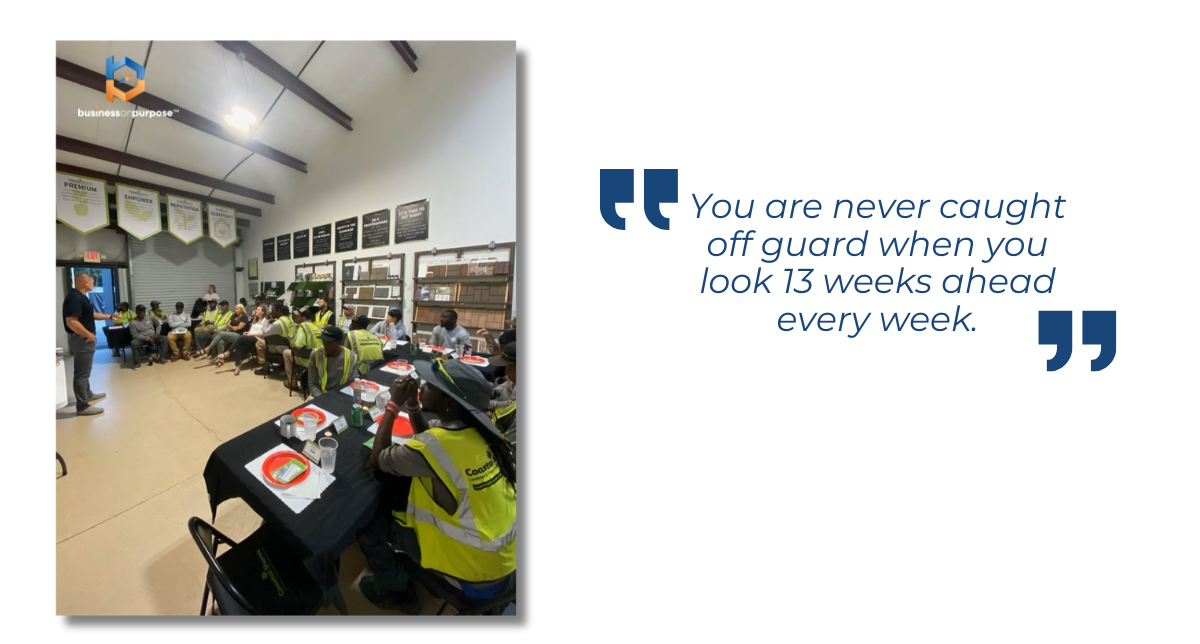
“You are never caught off guard when you look 13 weeks ahead every week.”
Step 3: Organize Subdivided Bank Accounts
Most businesses run out of one, two, or maybe three bank accounts. That is a recipe for cash flow chaos. When all your money lands in one bucket, your brain assumes all of it is available to spend, and it is not. Does that money go to labor? Equipment? Taxes? Profit? Operating expenses? You simply cannot tell.
The solution is to subdivide your bank accounts. We are talking seven, eight, nine, even ten separate accounts: one for profit, one for operating expenses, one for taxes, one for capital expenses, one for cost of goods. When receivables come in, you physically cut those dollars up and distribute them into their proper accounts.
This is a psychological game as much as a financial one. Keeping it on a spreadsheet does not feel real to your brain. But when money is sitting in a dedicated tax account, you are not spending it on labor. Real accounts create real clarity. Stop letting one big pile of money trick you into thinking you are doing better than you are.
Step 4: Inspect Your Dashboard Weekly
Your 13-week forecast and subdivided bank accounts only work if you are actually reviewing them consistently. Set up a dashboard and inspect it every single week. Your dashboard should include the balance of every bank account, a weekly update on accounts receivable and accounts payable, and what we call the “slim pants” metrics.
These are the major drivers that directly affect your cash flow: your schedule, your labor costs, your inventory levels, and your mistakes, callbacks, and warranty claims. Statistically, most businesses are not tracking all four of these, and even fewer are reviewing them on a weekly rolling basis. Start now.
Your dashboard should also keep you accountable to your pricing strategy, your terms with customers, your capital reinvestment plan, your tax reserves, and your debt servicing plan. Speaking of debt, you do not have to carry debt to run a profitable business. I do not care what the MBA textbooks say. There are plenty of thriving businesses with zero debt. Make eliminating debt part of your plan.
Step 5: Dictate Your Terms and Get Creative
You are the one in charge of the terms under which you receive money. So use that power. Do your customers pay in 30 days? Try offering a 2% rebate if they pay within 7. Get creative. The goal is to keep your revenue arriving ahead of your expenses going out, not the other way around.
When you build smart terms into your receivables, forecast them accurately on your 13-week timeline, and have those funds landing in the right bank accounts automatically, you are steering your business instead of just holding on for the ride.
“You are in charge of the terms. Use that power to make money come in faster.”

The Summary: Three Actions That Change Everything
If you want to steer yourself out of a cash flow crisis or avoid one entirely, here is what to do:
First, subdivide your bank accounts so every dollar has a home the moment it arrives.
Second, track your ABCs: accounts, subdivided bank accounts, bookkeeping, accounts receivable, accounts payable, and customer metrics. Whatever your core numbers are, track them.
Third, review your dashboard every single week on a rolling 13-week period without exception.
When you do these three things consistently, you create what we call the RPMs of great leadership: Repetition, Predictability, and Meaning. You stop being a firefighter and start being a leader who can actually see what is coming.
Your Next Step Starts Here
You do not have to keep living inside a cash flow crisis. You do not have to be surprised, stressed, or stuck. The system exists. You just have to put it in place.
If you are ready to stop reacting and start leading your finances with confidence, visit http://solvecashflow.com/ to get the tools and guidance your business needs to run with clarity, profit, and purpose.
You deserve to be liberated from cash flow chaos so you can make time for the things that matter most.
Scott Beebe is the founder of Business On Purpose, author of Let Your Business Burn: Stop Putting Out Fires, Discover Purpose, And Build A Business That Matters. Scott also hosts The Business On Purpose Podcast and can be found at mybusinessonpurpose.com.