Most small business owners don’t see a cash flow crisis coming until it’s already at their door. The truth is, the warning signs show up months in advance, and if you know what to look for, you can stop the bleeding before it starts.
Here are the key signals that predict cash flow failure, why most owners miss them, and a practical framework to steer your business back toward financial clarity and freedom.
Why So Many Business Owners Are Caught Off Guard
When we travel and speak to business owners, especially in the contractor, architecture, engineering, and design space, we hear a consistent pattern. Owners are proud of what they’ve built. They’ll tell you they’ve got 18 employees, a full pipeline, and a profitable P&L. But the moment we ask, “What’s your cost of goods percentage?” the room goes quiet.
It’s not that these owners aren’t smart. It’s that most of them have handed off the financial thinking entirely to their CPA, bookkeeper, or accountant. And while there’s nothing wrong with having those people handle the transactional work, it is your responsibility as the owner to have a working awareness of your numbers. When you abdicate that responsibility, you set yourself up for cash flow problems you never saw coming.
“It’s your responsibility as the owner to rage over your numbers.”
Lead Well.
If you're looking for more resources to work ON your business, we have them.

Signal #1: You’re Asking “Where’s the Money?”
This is the first and most telling signal. Your CPA calls to congratulate you on a profitable P&L. Your balance sheet looks great. But when you open your bank account, there’s almost nothing there. You might be showing $150,000 in net income but only have $8,000 in cash. That gap between profit on paper and cash in the account is a loud alarm bell.
When you find yourself asking “where did the money go?” on a regular basis, that is a signal that cash flow problems are either already here or right around the corner.
Signal #2: You’re Addicted to a Revolving Line of Credit
Lines of credit are not inherently bad. They can be a useful tool for timing and unique cash needs. But when your line of credit just keeps cycling, never getting paid off, that tells a very specific story: your business is likely not profitable without it.
If you removed the line of credit tomorrow, would your expenses still be covered by your revenue? For a lot of business owners, the honest answer is no. That’s why we talk about “raging over your money.” Not idolizing it. Not stressing over it. Simply understanding your revenue, your cost of goods sold (COGS), your gross margin, and what that leaves you for operating expenses.
Most owners, when asked their COGS, will say something like “I think it’s around 30%.” Then we look at the actual numbers and find it’s closer to 60%. That gap is exactly why you can’t sleep at night, and exactly why you keep running back to the bank.
Signal #3: You’re Guessing on Price and Profit
Here’s a question most business owners have never seriously asked: Is this specific product, service, or unit actually profitable? Not “is the business profitable overall?” but “did that transaction make money?”
Most of us price our products or services by looking at what competitors charge and landing somewhere in that range. That’s guessing, and guessing leads to cash crunches.
A simple way to fix this is to take your P&L, run it through an AI tool, and ask it to calculate your profitability per unit. It will ask you a few clarifying questions, but the result will give you a much clearer picture of whether your pricing actually supports your business model. Sometimes you’ll discover you need to raise prices. Other times, you’ll realize your expenses were bloated and you can become more competitive. Either way, you stop guessing and start leading.
“Guessing on price leads to cash crunches with no margin for generosity.”

Signal #4: You’re Using Tomorrow’s Money to Pay Yesterday’s Bills
This one has become almost a badge of honor in small business, but it’s a serious warning sign. If you’re waiting on the next customer deposit to pay last month’s invoices, your back is already against the wall. This habit slows down your payables cycle, forces you toward hard lending, and makes you desperate for receivables in a way that damages customer relationships.
Some people call it “robbing Peter to pay Paul.” The IRS has a different name for it. The point is that this cycle is a sign you’ve lost awareness of your cash, and without that awareness, you lose the ability to make proactive decisions before things spiral.
Cash flow problems don’t just squeeze your bank account. They squeeze your time and your generosity. When you’re constantly scrambling, you don’t have the margin to invest in your team, give back to your community, or even show up fully for your family. Most people got into business because they wanted to build something that creates freedom, and a cash flow crisis is the fastest way to lose it.
Signal #5: A Tax Bill That Surprises You
If your year-end tax bill catches you off guard, that is a clear signal that you are either already in cash flow trouble or heading there fast. It means you haven’t been tracking your tax liability throughout the year, and that’s a piece of the financial picture you simply cannot afford to ignore.
At Business On Purpose, we use a framework called the Slim Pants Framework. Every single week, we review a defined set of financial indicators: schedule, labor cost, inventory, mistakes, warranties, pricing, accounts receivable, accounts payable, new equipment investment, capital expenditures, tax liability, and debt service. Reviewing all of this weekly creates the kind of clarity that turns anxiety into action.
How to Steer Out of Cash Flow Chaos
Once you start seeing these signals, the next step is to act. Here’s the practical framework we teach business owners to build a wall against cash flow crises.
Step 1: Subdivide Your Bank Accounts
Instead of running your entire business through one, two, or three accounts, go to your bank and open seven, eight, or ten separate accounts. When revenue comes in, you immediately allocate it by percentage: cost of goods goes here, profit goes here, taxes go here, operating expenses go here.
This is not a spreadsheet exercise. These are real, physical bank accounts. The psychological impact of seeing money separated and designated is powerful. You stop wondering where the money went because you’ve already told it where to go.
Step 2: Track the ABCs Every Week
Once your accounts are subdivided, you set up a simple weekly dashboard to track three things:
- Cash accounts (your subdivided bank balances)
- Bookkeeping (accounts receivable and accounts payable)
- Customer metrics (your lead pipeline and customer tracking)
Review this every single week without exception. Subdivide the accounts, build the dashboard, and track it weekly. That rhythm creates the clarity that breaks the cycle of cash flow anxiety.
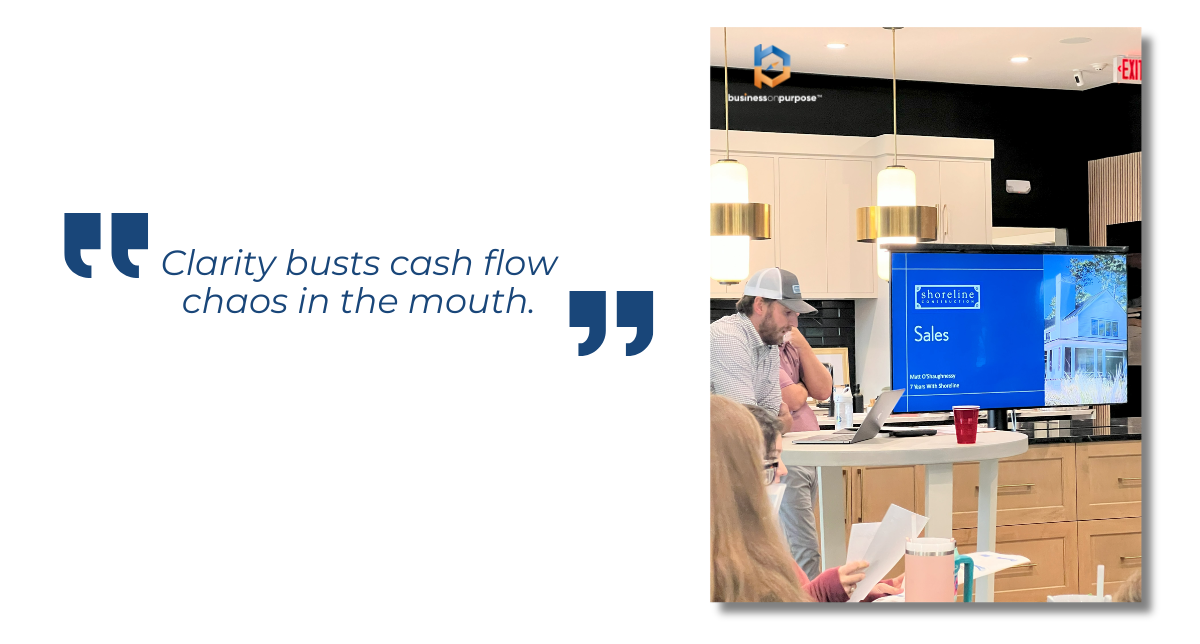
“Clarity busts cash flow chaos in the mouth.”
You Don’t Have to Do This Alone
Cash flow problems are common, but they are not inevitable. When you start recognizing the signals early, when you understand your numbers, when you stop guessing and start tracking, you can build a business that is not only profitable but one that gives you the freedom and margin to be generous with your time, your money, and your relationships.
That’s why you started this thing in the first place.
If you’re ready to stop surviving and start building a business that actually works for you, visit http://solvecashflow.com/ to access tools and resources built specifically to help small business owners like you get financially healthy and stay that way.
Scott Beebe is the founder of Business On Purpose, author of Let Your Business Burn: Stop Putting Out Fires, Discover Purpose, And Build A Business That Matters. Scott also hosts The Business On Purpose Podcast and can be found at mybusinessonpurpose.com.