What if your cash position could grow by 15% even while your revenue dropped by $5 million? It happened for one of our clients this year, and it was not magic. It was method. If cash flow is keeping you up at night, stop looking for more sales and start building a system that actually works.
The Real Problem Is Not What You Think
When we sit down with business owners, it never takes long to get to the real stuff. Within 10 or 15 minutes of talking about their business, the deeper challenges start to surface. And almost every time, we hear the same refrain: “I’ve tried spreadsheets. I’ve tried different software. Nothing sticks.”
Here is the thing: it is almost never about the software. It is about the person using it. When we ask owners what their favorite financial software is, our answer is always the same: whichever one you will actually use. They are all pretty good. The gap is not the tool. It is the consistency.
We also hear a lot of owners say things like, “I didn’t go to college. I’m not great with money. I just hand everything to my CPA.” But here is what we know to be true: you would not have started a business without tenacity, grit, and intelligence. When you tell yourself you are not smart enough to manage your finances, what you are really saying is you have not yet committed to the repetition required. Everything in the IMPROVE system is built for regular people who are willing to show up consistently, not financial geniuses.
“It’s less about knowing what to do and more about doing it regularly.”
Lead Well.
If you're looking for more resources to work ON your business, we have them.

The IMPROVE System: Step by Step
I: Install Subdivided Bank Accounts
Most businesses run out of one, two, or three bank accounts. Think of it like a giant bucket of popcorn at the movie theater. If someone hands you a huge bucket, you are going to eat all of it. But if that same amount of popcorn is divided into eight or nine smaller cups, you will not come close to finishing them all, even though it is the exact same volume.
Your money works the same way. When everything sits in one or two accounts, your brain tells you it is all available. But when you divide that money into seven, eight, or even ten separate accounts, each one labeled with a specific purpose, everything changes. You start saying: “That is my tax account. That is for operating expenses. That is my profit.” The money stops controlling you, and you start controlling it.
You might be thinking, “I can do that on a spreadsheet.” You probably will not. And even if you do, a spreadsheet does not give you the psychological shift that comes from seeing real account balances assigned to real purposes. We have run our business this way for nine years. On any given day, I can tell you to the penny how much profit we have in the bank. That is a powerful feeling, and it starts with this one step.
M: Map Out a 13-Week Forecast
Once you stop guessing with subdivided bank accounts, you are ready to map out a 13-week cash flow forecast. This is your forward-looking view. You are going to look ahead at your sales pipeline, your accounts receivable, your accounts payable, and any future opportunities to generate revenue in the next quarter.
Every week, you check your subdivided bank accounts against that forecast. Now you have a real picture of your cash position. You know what you are owed and what you owe, and you are not flying blind anymore.
P: Prioritize Profit
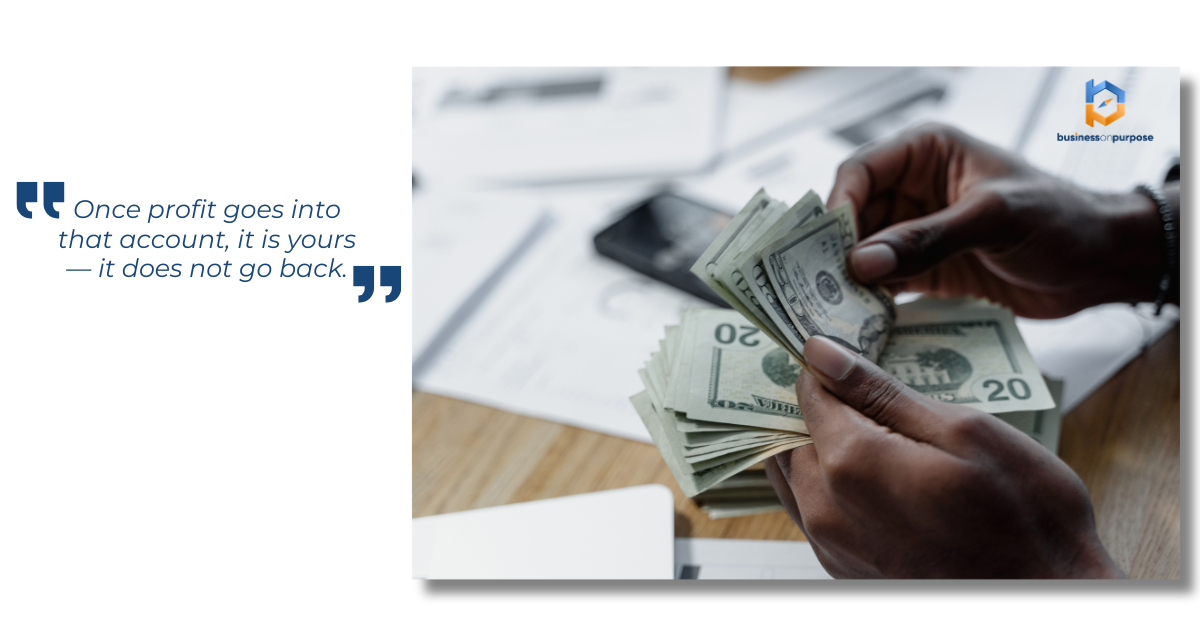
This step has very little to do with your profit and loss statement. Here is how it works: every single time a receivable comes in, you immediately take a percentage off the top and move it into your dedicated profit account. Once money goes into that account, it is yours. It does not go back into the business.
If you find yourself pulling profit money back into operations to cover expenses, your business is telling you something important: you are not as profitable as your P&L suggests. And that is a message worth hearing early, before it becomes a crisis.
Think about money in three phases. Past money is your balance sheet, your P&L, your cash flow statements. Those are useful for understanding history and tax obligations. Present money is your cash accounts right now. Future money is your budgets and forecasts. Too many accountants and bookkeepers are stuck in the past, pulling historical reports that do not help you make decisions today. Your subdivided accounts keep you rooted in the present, which is exactly where day-to-day business decisions get made.
“Once profit goes into that account, it is yours — it does not go back.”
R: Review the ABC Dashboard
The R in IMPROVE stands for reviewing your ABC dashboard. This is a simple spreadsheet where you track three categories every single week: your Accounts (bookkeeping balances), your receivables and payables (what you are owed and what you owe), and your Customer metrics (leads, pipeline activity, sales data, website traffic, whatever you track).
Every week, you take a snapshot of each of those things and drop it into the spreadsheet. Do it for 52 weeks a year. It is not complicated, but the clarity it creates is enormous. When you can see your revenue, your cost of goods, your gross margin, and your expenses all in one place, you stop guessing. And when you stop guessing, you stop inviting cash flow crunches into your business.
This also leads to something we call “real revenue.” Raw revenue numbers at the top line can be misleading. A $20 million homebuilding company and a $3 million law firm might actually be the same size when you look at gross margin. Why? Because homebuilders carry 80 to 90 percent cost of goods sold. Strip that out and both businesses are working with roughly the same dollars. Stop obsessing over the top line and start obsessing over gross margin. That is the number that actually runs your business.
O: Establish Hard Payment Terms
One of the fastest ways to fall into a cash flow crisis is being too relaxed about invoicing and collections. Here is something worth remembering: most people do not pay late because they do not want to pay. Most people pay late because they forget.
That means it is your job to not just send the bill, but to establish clear terms, communicate them upfront, and send consistent, predictable follow-up reminders. Your customers should never be surprised when they get a late notice, because they have already received multiple reminders leading up to it.
Get creative with your terms too. Consider offering early payment rebates. If a customer pays within 7 days instead of 30, you might offer a 1 or 2 percent discount. Cash in hand gives you options. It lets you run your business more fluidly, cover payroll with confidence, and make investments without stress. Make sure any terms you offer still make sense when you factor in your expenses and cost of goods, but do not be afraid to incentivize speed.
“Cash gives you options and lets you run the business more fluidly.”

V and E: View Real Revenue and Establish Consistency
The final layers of the IMPROVE system are about establishing consistency in how you view your numbers and how you show up to manage them. View your gross margin as your real revenue, not just the top-line number. And establish a regular rhythm for reviewing all of it, week after week, so the system runs predictably.
When you combine all of these steps, subdivided accounts, a 13-week forecast, profit prioritization, a weekly ABC dashboard, hard payment terms, and a commitment to viewing real revenue, you stop reacting to cash flow problems and start preventing them entirely.
You Don’t Have to Stay in Cash Flow Chaos
The goal is not just financial clarity. The goal is freedom. When you know exactly where your money is, where it is going, and what you can count on, you stop making decisions from fear. You start making them from strength. And that is when your business can really start working for you instead of the other way around.
You do not need to be a financial expert. You just need a system and the discipline to use it. That is what the IMPROVE model is built for.
Ready to put this into practice? We have built a complete Cash Flow Handbook that walks you through setting up subdivided bank accounts, building your ABC dashboard, creating your 13-week forecast, and establishing payment terms that work. Visit http://solvecashflow.com/ to get the tools you need and build a business that is financially healthy from the inside out.
Scott Beebe is the founder of Business On Purpose, author of Let Your Business Burn: Stop Putting Out Fires, Discover Purpose, And Build A Business That Matters. Scott also hosts The Business On Purpose Podcast and can be found at mybusinessonpurpose.com.