
Effective delegation is not about working less. It is about working on what only you should be working on and handing off the rest. Here is a proven, step-by-step process to help you figure out exactly what to delegate and how to do it well.
The Business Owner Who Worked 70 Hours a Week
When we work with business owners, we hear a lot of the same phrases. We once worked with a contractor who was almost proud of the fact that he worked 70 hours a week. He said it with his chest puffed out. Then we talked to his wife. She did not share his enthusiasm. She barely saw him. His kids barely knew him.
We had to have a direct conversation with him: “Keep going the way you are going, and you will have a wife who has checked out and kids who do not know their dad.”
To his credit, he made the decision to change. At the time, he was doing everything himself. Outreach. Marketing. Bidding. Estimating. Project scheduling. Material ordering. Selections coordination. Site management. Front to back, he owned every single task. And here is the wild part: he had employees. He just never let them actually do anything.
That story is not unique. It might be your story too.
Above the Line vs. Below the Line Leadership
Before we get into the tactics of delegation, we need to talk about your leadership posture. Brené Brown describes a concept called above-the-line and below-the-line thinking, and it is one of the most important leadership principles you can apply as a business owner.
Picture a simple horizontal line. Every day, in every situation, you have a choice: go above the line or go below it.
Ed Friedman, in his book A Failure of Nerve, talks about being a well-differentiated leader. Think about the Peanuts character Linus and the cloud of dirt that follows him everywhere. A lot of people we lead carry their own cloud of anxiety and chaos. The question is whether you stay outside that cloud and help them work through it, or whether you jump right in and make it worse.
Below-the-line behavior looks like this:
- The Hero: You jump in and take back authority you already gave to someone else.
- The Victim: You tell yourself nobody understands how hard you work and you have to do everything yourself.
- The Villain: You become a jerk to work with.
Above-the-line behavior looks like this:
- Co-create instead of being the hero.
- Coach instead of playing the victim.
- Challenge instead of being the villain.
Ask yourself honestly: when someone brings their ball of anxiety into your space, do you stay outside of it and lead them well, or do you dive in and stir the chaos up even more? Good delegation requires you to lead from above the line, consistently.
Delegation is not just giving the task. It is giving the authority.
Lead Well.
If you're looking for more resources to work ON your business, we have them.

Step One: Map Every Process in Your Business
You cannot delegate what is not mapped. The first step is to create what we call a Master Process Roadmap, which is simply a written-out list of every process that currently exists in your business.
Every business, no matter the size or industry, runs on four core systems:
- Marketing
- Sales
- Operations
- Administration and Accounting
Set a timer for 15 minutes. Go left to right through those four systems and write down every single process you can think of. Your website update process. Your social media posting. Your sales scripts. Your customer follow-up. How you build and deliver your product. Accounts payable. Accounts receivable. Payroll. Insurance certificates.
Within 15 minutes, most business owners end up with 50 to 70 different processes mapped out. That list is your foundation for everything that follows.
Step Two: Build Your Delegation Roadmap
Now that you have your master list, it is time to get honest about what you are currently doing yourself. Take that list and identify the processes you personally handle on a regular basis. Some of you are going to write down almost every single one. That is okay. Write them all down.
Next, rank each task across three categories:
Time: How many minutes per week does this task take? If you do it monthly or quarterly, divide the total time by the number of weeks in that period to get a weekly average.
Energy: Does the task give you energy, drain you completely, or feel neutral? Rate it as up, sideways, or down.
Delegatability: Rate it on a scale of one to three. A one means you are genuinely the only person who can do this. Most owners should have only two or three tasks in this category. A two means you thought you were the only one who could do it, but you probably could hand it off. A three means it is easily delegatable and you just have not done it yet.
Once you have ranked everything, look for tasks that take the most time, drain your energy or feel neutral, and score a two or three on delegatability. Those tasks make up your delegation list. In many cases, you will also find that this list essentially defines a new job role you could hire for.
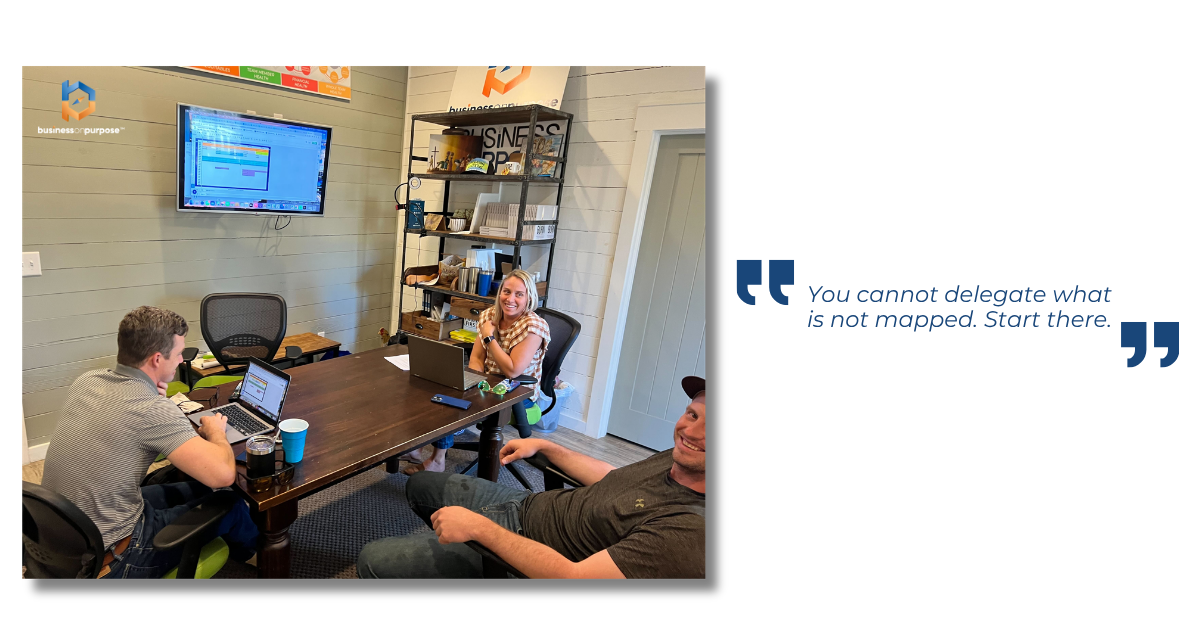
You cannot delegate what is not mapped. Start there.
Step Three: Use the PTA Model to Hand Off Work
Identifying what to delegate is only half the battle. The other half is actually making the handoff stick. We use a simple three-part model called PTA:
- Process the task — Document how the task gets done.
- Train the task — Teach your team member how to do it.
- Accountability — Hold them to the standard consistently.
You will likely need to train the same processes more than once. That is completely normal. We use a tool called the Anchor, which is a simple spreadsheet built across 52 weeks with columns for marketing, sales, operations, and admin. Each week, train one process per system. Over time, your team builds competency and ownership across all four areas.
When someone on your team does not hold to the standard, that is your moment to choose above-the-line behavior. Do not jump in and do the work for them (hero). Do not complain about how hard you have to work (victim). Do not blow up at them (villain). Instead, co-create a solution with them, coach them through what went wrong, or challenge them to do better.
Here is the critical truth about delegation: when you heroically jump back in and take over a task you already delegated, you do not just solve the problem in front of you. You take back all the authority you gave away and put the task right back on your own plate. Every time you go below the line, you undo your own delegation.
Step Four: Build the Right Team
All of this only works if you have the right people around you. Delegation without the right team members is just frustration with extra steps. Finding, hiring, onboarding, and retaining great talent is its own process, and it is one worth investing in seriously.
We have seen far too many business owners spend their entire careers and lives buried in chaos. Working nights and weekends. Missing dinners. Missing games. Missing the moments that actually matter. That is not why you started a business.
Our mission at Business On Purpose is to liberate business owners from chaos and make time for what matters most. The framework above is one of the most powerful tools we have seen owners use to start getting their time and their lives back.
Our mission is to liberate owners from chaos and make time for what matters most.

Start Delegating. Start Living.
You did not build your business to be its most exhausted employee. You built it for freedom, for impact, and for the people who matter most to you. Delegation, done right, is how you get there.
Map your processes. Build your delegation roadmap. Use the PTA model. Lead from above the line. And watch what happens when your business starts running without you having to be everywhere at once.
Ready to take the next step toward a healthier business and a healthier life?
Visit businessonpurpose.com/healthy to get the tools and resources you need to build a business that actually works for you.