Your business is running on high-octane chaos, and deep down, you already know why: you have never built the systems. The good news is that setting up business systems is not nearly as complicated as you think. It just has not been done yet.
Here is a step-by-step walkthrough of exactly how to set up any business system so that your team can run things the right way, even when you are not in the room.
The Lego Lesson Every Business Owner Needs to Hear
Growing up, Legos were a casual thing for me. I enjoyed them, but nothing like my youngest son. That kid is a Lego fanatic. I remember walking past a Lego store one day and he stopped dead in his tracks and said, “I have to be in there. I was built to be in there.” And in we went.
One Christmas, my wife and I got him a massive Lego set. We are talking bigger than his age kind of massive. Christmas morning came and went, and within two hours, he had disappeared upstairs. When he came back down, he told us he was done. We did not believe him. We walked up to his room and there it was, completely finished.
I asked him, “How did you do this so fast?”
He held up the instruction manual and said, “I just followed the instructions.”
That moment hit me like a freight train. How many times do we as business owners get frustrated with our team for not doing things the right way, when we never built them an instruction manual in the first place? We never gave them the steps. We never showed them the process.
A good question to write down and revisit every single week is this: Where is the instruction manual? Ask it over and over throughout the year. It will keep you honest and keep you building.
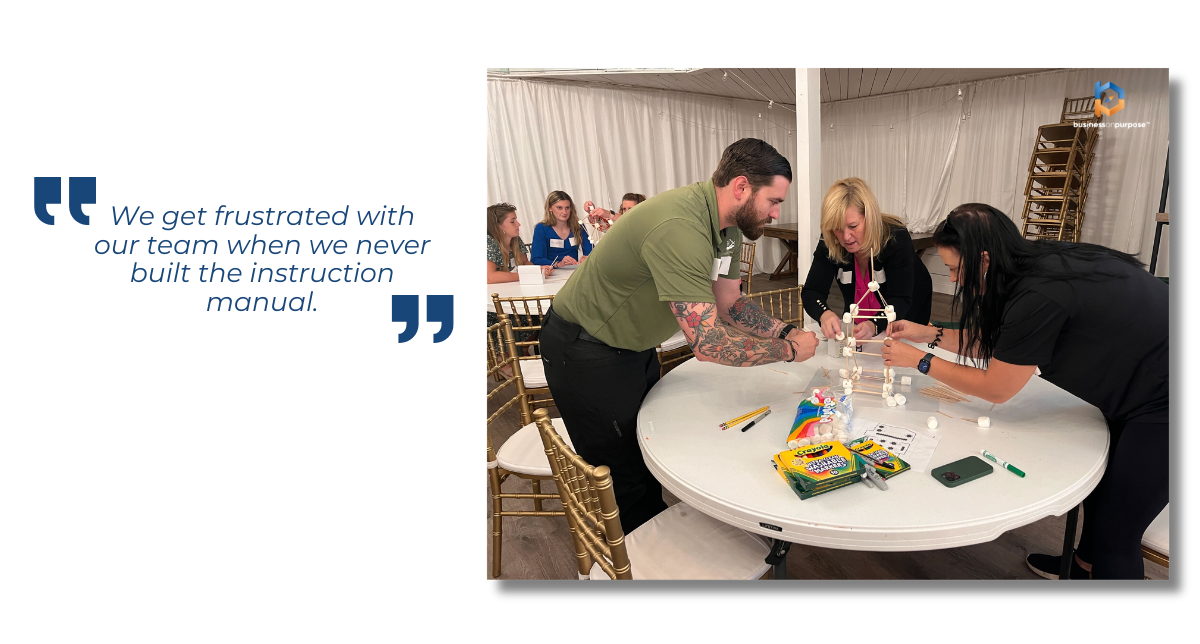
“We get frustrated with our team when we never built the instruction manual.”
Lead Well.
If you're looking for more resources to work ON your business, we have them.
Step 1: Build Your Master Process Roadmap
Every business, no matter how complex it feels, is built on four core systems. At Business On Purpose, we call them the four cores:
- Marketing
- Sales
- Operations
- Administration
Here is an important distinction to understand before you go any further. Systems and processes are not the same thing. A system is the big picture. A process is a small, individual step inside that system.
Think about the electrical system in your home. That one system includes the lights, the fixtures, the switches, the wiring, the circuit breakers. Each of those is a process inside the larger system. Your business works the same way.
Your marketing system is made up of multiple marketing processes. Your sales system is made up of multiple sales processes. Start at the macro level first. Map out your four core systems and then work your way down into the individual processes underneath each one.
You might think your business is too complex to fit into four categories. But simplicity is what makes delegation work. We have a tendency to overcomplicate things, and that complication is exactly what keeps you stuck.
Step 2: Brain Dump Every Process
Grab a scratch sheet of paper. Set a timer for 15 minutes. Then do a full brain dump of every single process you can think of inside each of the four core systems.
For marketing alone, you might write down things like:
- Social media posting
- Website updates
- Print advertising
- Networking events
- Door knocking
- Email campaigns
Do not worry about the details yet. You are not writing the instruction manual right now. You are just getting everything out of your head and onto paper so you can see what actually lives inside your business. Just write the process name down and keep moving.
Do this for all four systems. When the timer goes off, you will probably be shocked by how many processes your business actually runs on, and how few of them have any documentation behind them.
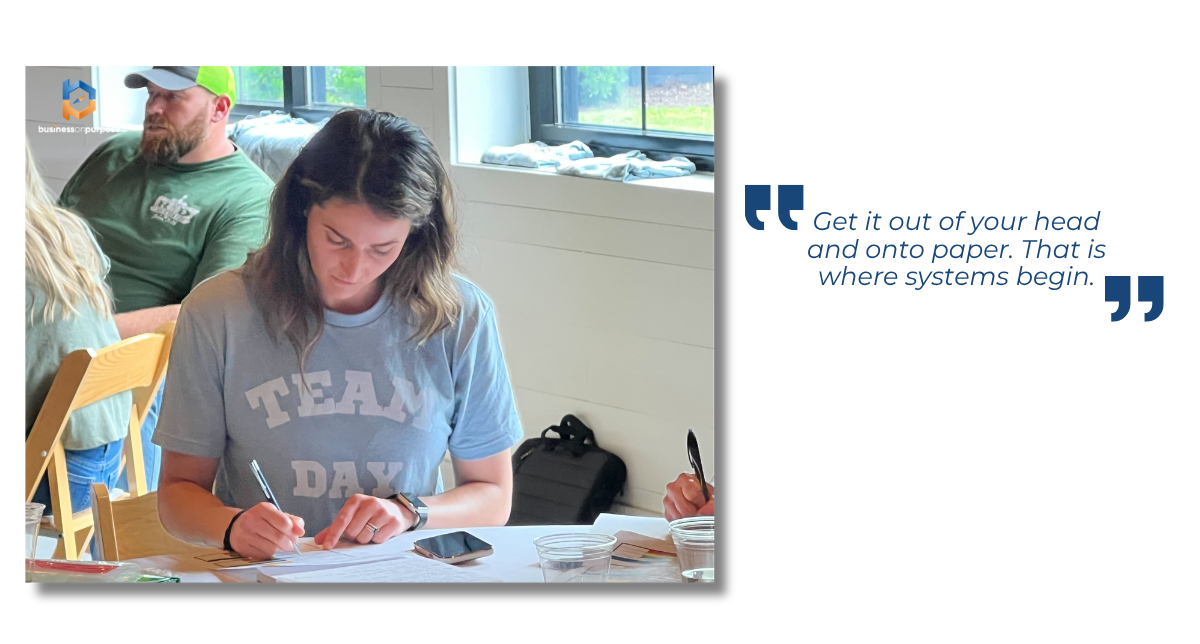
“Get it out of your head and onto paper. That is where systems begin.”
Step 3: Use the PTA Model to Document and Distribute
Once you have your brain dump complete, it is time to start building out actual processes. The framework we use for this is called the PTA Model:
- Process
- Train
- Accountability
Here is how it works in practice. Pick one process to start with. Let’s say it is your sales script. The next time you do a sales call, record it like it is the last sales call you will ever make. Use a voice memo app, an AI recorder, or any digital tool that works for you. Just make sure you acknowledge the recording to the other party when appropriate.
Once you have that recording, use AI to help you outline the step-by-step workflow from that call. What did you say first? What questions did you ask? How did you handle objections? What was your close? That becomes your instruction manual.
But here is where most business owners stop short. They build the process and then walk away. Building the system is only one third of the equation. You must also train your team on it regularly and hold them accountable to it. A system that lives in a folder and never gets taught is just an expensive document.
Step 4: Create a Weekly Training and Accountability System
Here is a simple structure that works well for keeping your systems alive inside your business:
Build a spreadsheet with your four core systems as the rows: Marketing, Sales, Operations, and Admin. Then create 52 columns across the top, one for each week of the year. The first column should note the theme of the system. The second column should be reserved for your team meeting.
Each week, record one process. Add it to the spreadsheet. Then review it and train on it in your team meeting. Depending on the size of your business, you might run one combined meeting or separate department meetings. Either way, avoid creating silos. Cross-training helps everyone understand how the whole system fits together, not just their piece of it.
Over the course of a year, you will have documented and trained 52 processes. That is 52 more instruction manuals than most small businesses have right now.
Step 5: Build a Delegation Roadmap
Systems are ultimately built so you can get work off your plate and onto someone else’s. That is the goal. But delegation done poorly is just abdication in disguise.
Here is the difference:
Abdication sounds like this: “Hey, can you send customer updates from now on?” And then you walk away and hope for the best.
Delegation looks like this: You document the process, you train the person repeatedly, and then you spot-check accountability over time.
To build your delegation roadmap, take your list of processes and rank each one by three factors: the time it takes, the energy it drains from you, and how easily it could be handed off. Start by delegating the tasks that are both draining and easy to pass along. Those are your quick wins.
But remember the RPMs of leadership: training must be Repetitive, Predictable, and Meaningful. If you skip the repetitive training and accountability that comes after delegation, the whole thing falls apart. The process exists, but without those follow-through steps, it never actually runs without you.
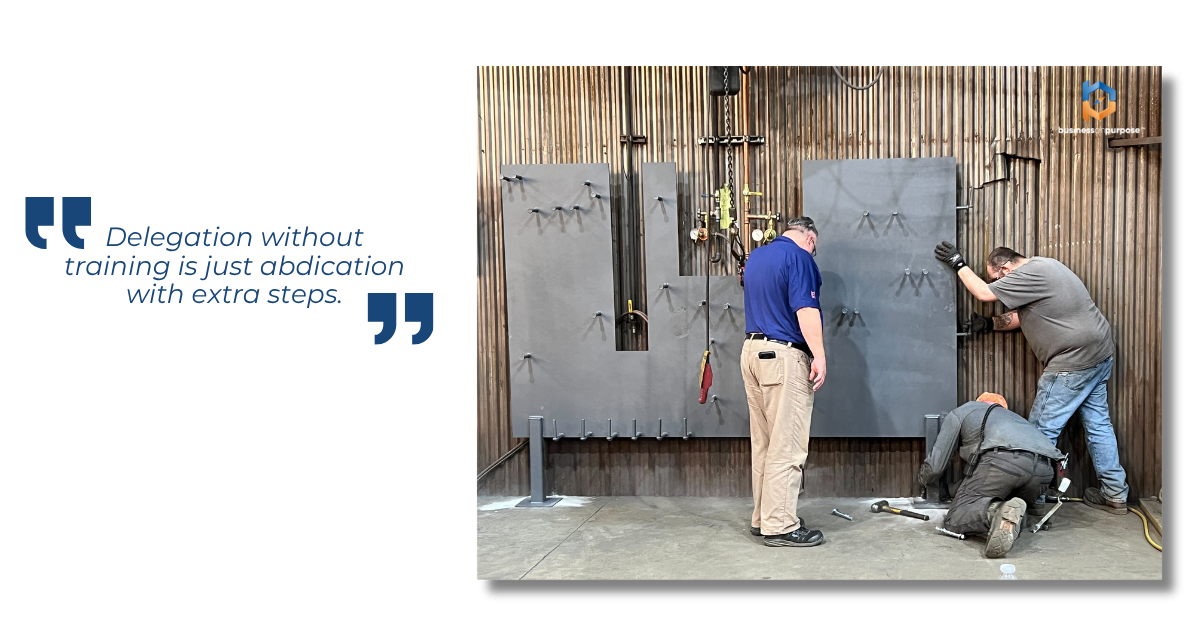
“Delegation without training is just abdication with extra steps.”
Systems Only Work With the Right People
Here is the final piece of the puzzle. Business systems are built for your team. That means none of this works if you do not have the right people in the right seats.
Finding, hiring, onboarding, and retaining great talent is its own process, and it deserves the same attention you give to your marketing or operations systems. The mission behind all of this is straightforward: to liberate you from chaos. Systems give you your time back. The right team gives your systems legs.
Start with one process this week. Record it. Write it out. Train your team on it. Then do it again next week. Over time, you will build a business that actually runs the way it is supposed to, whether you are in the room or not.
Ready to Build a Healthier Business?
If you are ready to stop running on chaos and start building a business that works for you instead of the other way around, visit businessonpurpose.com/healthy. You will find free tools, templates, and resources built specifically for small business owners with fewer than 100 employees. The instruction manual for your freedom is waiting for you there.
Scott Beebe is the founder of Business On Purpose (mybusinessonpurpose.com) and speaker for the AEC industry and author of the book Let Your Business Burn: Stop Putting Out Fires, Discover Purpose, and Build a Business That Matters. Business On Purpose works with business owners to articulate purpose, people, process, and profit to liberate owners from chaos and make time for what matters most.