Here is what you actually need: two distinct systems with a clear, intentional handoff between them. Get that right, and your pipeline starts working the way it should.
Think of Your Business Like a BMW Assembly Line
Every year, the Business On Purpose team takes a retreat together. One particular year, we landed in Greenville, South Carolina — a city that has completely transformed itself since the early 90s, largely thanks to BMW setting up a manufacturing plant there. The ripple effect that one company had on the entire region is remarkable.
While we were there, we toured the BMW plant and got to watch a real assembly line in action. That experience gave me a crystal-clear picture of how marketing and sales should work inside a business.
Here is the key insight: marketing is not just the front end of the assembly line. Marketing IS the assembly line. It runs from front to back, touching every single phase of the customer experience. Sales is one important function along that line, but marketing never stops.
Think about it this way. When you are actively selling someone, you are still marketing. When you are fulfilling on a promise you made to a customer, you are still marketing. When you are on the phone handling collections or invoices, you are still marketing. That is why even administrative interactions matter. The way you show up in every touchpoint reflects your values, and your values are your brand.
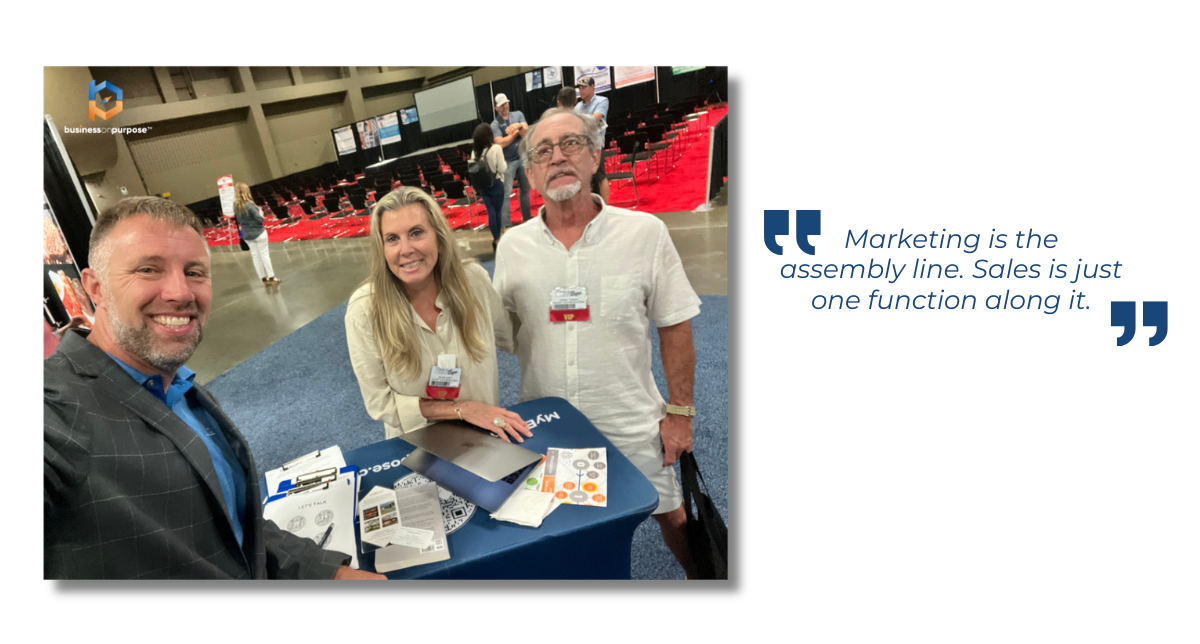
“Marketing is the assembly line. Sales is just one function along it.”
Lead Well.
If you're looking for more resources to work ON your business, we have them.
Marketing Looks Out. Sales Brings Them In.
When we get asked to speak at events, people are often surprised when we say we would rather address a room of 20 or 30 people than a room of a thousand. The reason is simple: we would rather talk to 10 of the right people than a thousand of the wrong ones. Our ideal audience is business owners with fewer than 100 employees. A room of 10 of those people beats a convention hall full of folks who will never need what we offer.
That is exactly what marketing answers. Who are the 10 qualified people in the room? How do you fill that room with them in the first place?
Once marketing has done that work, sales steps in naturally — and that word “naturally” is intentional. You should not feel weird or pushy. Sales is simply the process of engaging those qualified prospects in a real conversation and moving them toward a decision to become a customer you can genuinely serve.
Here is the directional difference that matters: marketing looks outbound, and sales looks to bring people in. During the pandemic, a lot of businesses in the construction space stopped looking outbound altogether. They got comfortable sitting behind the counter, taking orders as they came in. When that demand dried up, they had forgotten how to go out and shake the bushes. When you shake a tree, acorns fall. You have to actively go out and create movement, and you have to do it in a way that honors the people you are reaching and the product you are offering.
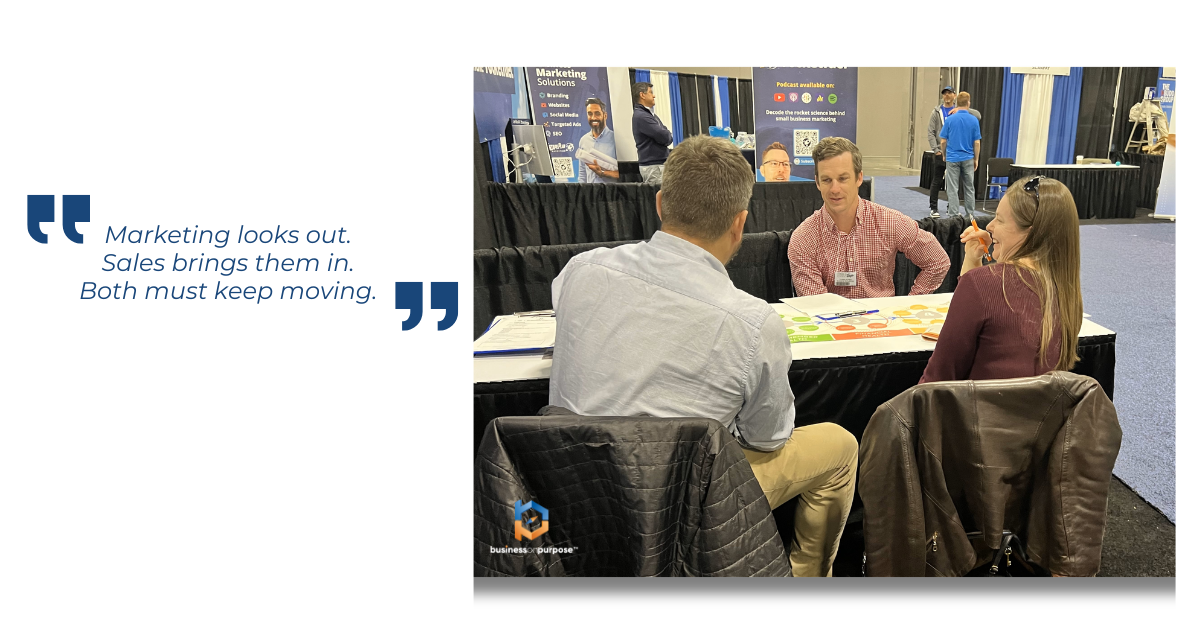
“Marketing looks out. Sales brings them in. Both must keep moving.”
The Handoff: Where Most Businesses Lose the Deal
When marketing and sales operate in separate silos, two painful things happen. First, you waste your ad spend because marketing is doing its own thing with no connection to what sales needs. Second, your leads stop converting because the prospects who show up to a sales conversation were never properly primed. They sit down with you, and when you start walking through your pitch, they are caught off guard. That gap between the marketing message and the sales conversation kills trust fast.
You need continuity between your marketing messaging and your sales script. Both disciplines need a defined process. What does your marketing message say, repetitively and predictably? And what does your sales script look like once that prospect is in front of you?
Here is a real example. At Business On Purpose, we use what we call a Compassionate Conversion — six questions designed to put the prospect in the driver’s seat:
- Tell me about your business.
- What do you want?
- What are the roadblocks keeping you from what you want?
- What would life look like three years from now if you did nothing different?
- What are you willing to invest? (Pause — and note that we are asking about time, not just money.)
- What questions do you have for me?
We ask those questions because we genuinely want to know the answers. We want the prospect to explore and uncover their own challenges. That is what a great sales script does — it serves the person sitting across from you.
Now ask yourself: What is your marketing message that leads into your sales script? Can you recite it from memory? If not, that is the gap you need to close.
One Meeting a Week Changes Everything
Here is a best practice that sounds almost too simple: hold a once-weekly, one-hour, agenda-driven marketing and sales meeting. I know. Groundbreaking stuff. But the truth is, most businesses either skip it entirely or turn it into a gripe session that accomplishes nothing.
A productive marketing and sales meeting covers three things: the mission you are trying to accomplish, the messaging and scripts you are using, and the numbers you are tracking. Pick a handful of metrics for each discipline and start paying attention to them. You can adjust what you measure after a month or two if needed. The discipline of showing up consistently to that meeting is what matters most.
A mentor of mine used to say, “If you’re not paying, you’re not paying attention.” If you are not investing your time in marketing and sales regularly, you will never see the relationship between the two clearly. And if you cannot see that relationship, you will always be grinding to find new customers.
“If you’re not paying with your time, you’re not paying attention.”

Build a Business That Runs Without You
All of this work — the messaging, the scripts, the meetings, the handoff — is in service of one goal: getting you out of the chaos and back to what matters most. When marketing and sales are working together as a unified system, you stop chasing leads and start attracting the right customers. You stop winging your sales conversations and start having them with confidence and clarity.
You did not start your business to be buried in it. You started it to build something that serves people well and gives you freedom in return.
If you are ready to take a real look at the health of your business — including how your marketing and sales systems are functioning — start with a free Business Health Assessment.
Visit businessonpurpose.com/healthy to take your free assessment today and start building a business that finally works for you.