Your business should not run on chaos.
Yet for many business owners, every day feels reactive. Processes live inside your head, your team depends on you for every answer, and simple tasks become constant interruptions. The problem usually is not a lack of effort. The problem is a lack of systems.
A business system is simply a documented way of doing something repeatedly and consistently. It is the instruction manual for how your business operates.
Once you understand that, building systems becomes much less intimidating.
The Lego Lesson Every Business Owner Needs
A few years ago, my wife and I were raising three kids. Each one had a completely different personality.
One day, we walked past a Lego store at the mall, and I remember thinking, “Who wants to spend time in a store filled with Legos?”
Then our third child came along.
The moment he walked into that store, his imagination exploded. He loved building things.
One Christmas, we gave him a large Lego spaceship set with hundreds of pieces. He was about nine or ten years old at the time. A couple of hours after opening gifts, he came downstairs and said, “I finished it.”
I thought there was no way.
But sure enough, the entire spaceship was assembled perfectly.
I asked him, “How did you do that?”
He looked at me and said, “I just read the instructions.”
That moment became the perfect metaphor for business systems.
If someone can follow instructions and recreate something complex, then your business can operate the same way.
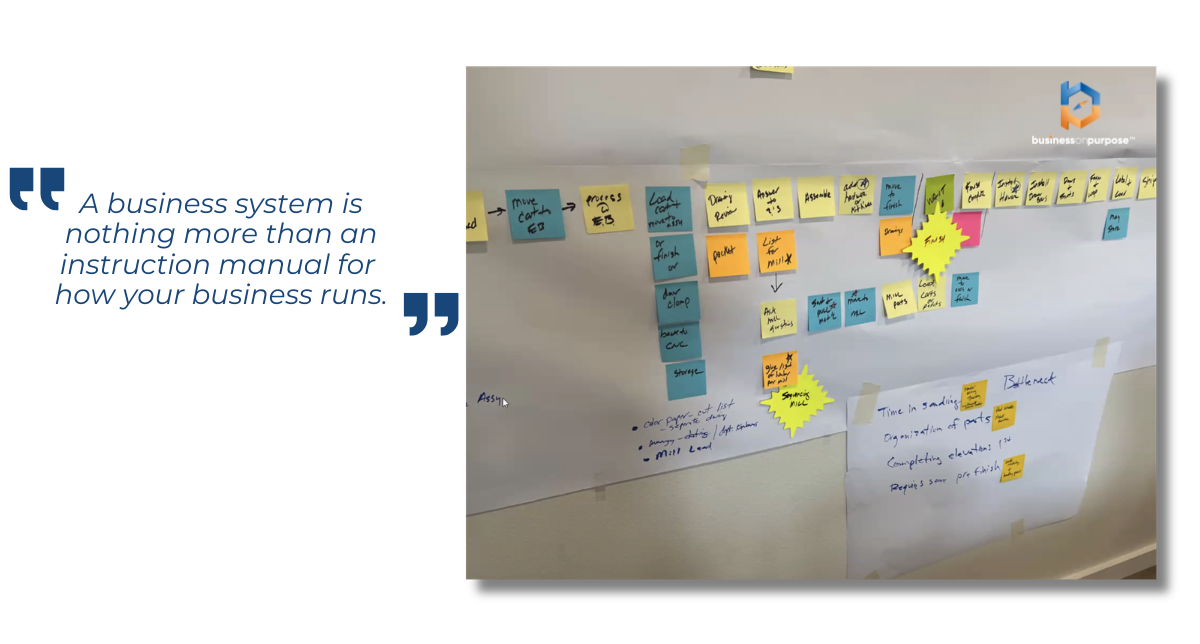
“A business system is nothing more than an instruction manual for how your business runs.”
Lead Well.
If you're looking for more resources to work ON your business, we have them.
What Is a Business System?
A business system is the documentation of the processes required to deliver your product or service.
That is it.
It is taking what already exists in your head and putting it into a format someone else can follow.
That documentation could include:
- Written checklists
- Video walkthroughs
- Screen recordings
- SOPs
- Training guides
- Flowcharts
Most business owners struggle because they assume nobody can do the work as well as they can.
But in many cases, the real issue is this:
You never fully explained the process.
Or you explained it once and assumed it would stick forever.
Training requires repetition.
Dallas Willard once described disciples as students or apprentices. That mindset applies perfectly in business. Your team should not simply complete tasks. They should be trained to understand systems.
When your people are trained properly, consistency follows.
Understanding the Four Pillars of Business Systems
To simplify business systems, think of your company like a human body.
The body functions through systems. Your business works the same way.
There are four foundational pillars that support every healthy business:
1. Purpose
This includes the systems that define who you are and why your business exists.
Examples include:
- Vision
- Mission
- Core values
- Company story
- Culture handbook
These systems shape the identity of the company.
2. People
These are the systems that organize and develop your team.
Examples include:
- Organizational charts
- Job descriptions
- Hiring processes
- Meeting agendas
- Training systems
Without people systems, leadership becomes reactive and inconsistent.
“Nobody does it like I do because you never showed them how.”

3. Process
This is where operational clarity comes alive.
Every business process typically falls into four core categories:
- Marketing
- Sales
- Operations
- Administration
These four categories create the operational backbone of your company.
4. Profit
These systems help manage financial health and decision-making.
Examples include:
- Financial dashboards
- Budget tracking
- Bank account structures
- Reporting systems
Strong profit systems give business owners visibility and control.
The Four Core Systems Every Business Needs
If you want to organize your business quickly, start with these four operational systems:
| System | Purpose |
|---|---|
| Marketing | Creates awareness and generates leads |
| Sales | Converts leads into customers |
| Operations | Delivers the product or service |
| Administration | Manages finances and support functions |
The order matters.
You cannot account for something you have not delivered.
You cannot deliver something you have not sold.
You cannot sell something people do not know about.
That is why marketing comes first.
The Brain Dump Exercise That Creates Clarity
Here is a simple exercise that helps business owners immediately reduce overwhelm.
Take the four operational categories:
- Marketing
- Sales
- Operations
- Administration
Now set a timer for 15 minutes.
Under each category, write down every process you can think of.
For example:
Marketing
- Website updates
- Social media posting
- Email campaigns
- Lead generation
Sales
- Sales scripts
- Follow-up systems
- Objection handling
- Proposal creation
Operations
- Product fulfillment
- Scheduling
- Field work
- Customer delivery
Administration
- Payroll
- Accounts payable
- Accounts receivable
- Reporting
Once you complete this exercise, something powerful happens.
You finally see your business on paper.
And clarity reduces chaos.
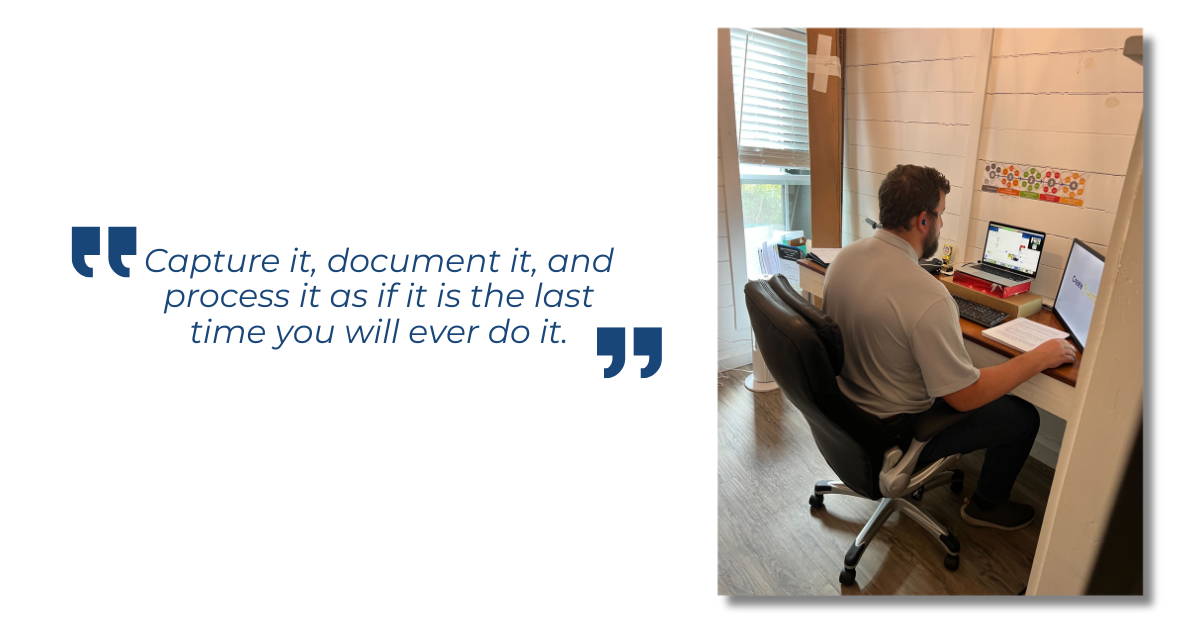
“Capture it, document it, and process it as if it is the last time you will ever do it.”
Start With the Biggest Time Suck
Once your processes are mapped out, identify the task consuming the most time.
For many business owners, it is email.
Author Cal Newport says the average person spends 3.5 hours per day managing email. That is a massive drain on productivity.
The key is not doing more.
The key is building systems and delegating them.
One practical way to document a process is incredibly simple:
- Open the voice memo app on your phone
- Talk through the process step-by-step
- Transcribe the recording
- Use AI or documentation tools to organize it visually
- Train someone else to execute it
That single habit can transform your business over time.
Build One System at a Time
One of the biggest mistakes business owners make is trying to systematize everything at once.
Do not do that.
Focus on one process at a time.
Adopt what many call a systems mindset:
Whatever task you are about to do next, document it as if you never want to do it manually again.
If you are running payroll today, document payroll.
If you are fulfilling orders tomorrow, document fulfillment.
Small systems built consistently create massive operational freedom over time.
Why Systems Create Freedom
Systems are not about removing people.
They are about creating consistency, reducing chaos, and freeing business owners from becoming the bottleneck.
When your processes are documented:
- Training becomes easier
- Delegation becomes possible
- Mistakes decrease
- Productivity increases
- Your business becomes scalable
Most importantly, you gain time back to focus on what matters most.
Final Thoughts
Every successful business runs on systems.
The difference between overwhelmed business owners and scalable companies often comes down to documentation, training, and consistency.
You already have systems.
They are just trapped inside your head.
Now it is time to get them out, document them clearly, and build a business that operates with structure instead of chaos.
If you are ready to create systems that help your business run smoother, start today with one simple process.
Document it. Train it. Delegate it.
Then repeat.
That is how scalable businesses are built.
Scott Beebe is the founder of Business On Purpose (mybusinessonpurpose.com) and speaker for the AEC industry and author of the book Let Your Business Burn: Stop Putting Out Fires, Discover Purpose, and Build a Business That Matters. Business On Purpose works with business owners to articulate purpose, people, process, and profit to liberate owners from chaos and make time for what matters most.