If you are constantly rebuilding the same processes from scratch, answering the same questions, and doing the same tasks over and over again, the problem is not your work ethic. The problem is that everything lives in your head. Building systems is the single most powerful move you can make to get your time back and grow a business that does not depend entirely on you.
Systems Are Not Just for Big Companies
Most small business owners believe that systems and processes are something only large corporations worry about. That belief is exactly what keeps those same owners small and exhausted. When your processes live only in your head, you become the bottleneck for everything. Every new hire, every client interaction, every task runs through you because there is no documented path for anyone else to follow.
Here is a real example. A contractor in Texas was spending between 18 and 30 hours per estimate. That is a staggering amount of time on a single process. After working through the problem together, we applied what is called the 10-80-10 policy. He handled the first 10 percent on the front end, a documented process handled the heavy lifting in the middle 80 percent, and he came back in for the final 10 percent to refine the output. The result? His estimating time dropped from up to 30 hours down to just one or two hours per estimate.
That kind of shift is available to you, too. It starts with documenting what you do and delegating what you can.
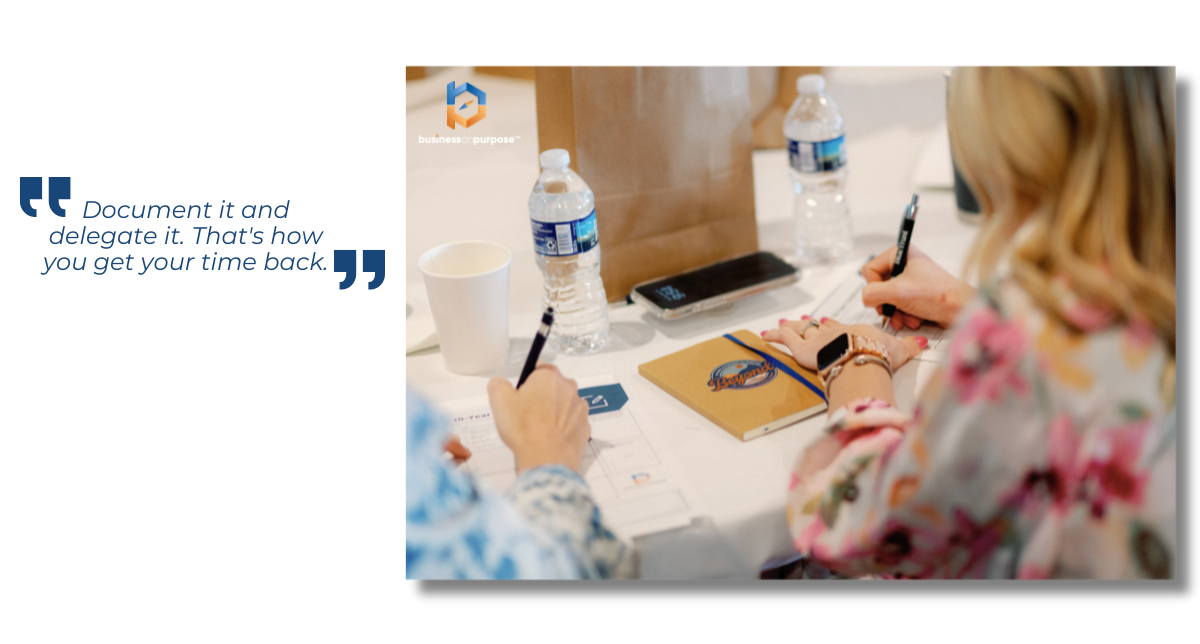
“Document it and delegate it. That’s how you get your time back.”
Lead Well.
If you're looking for more resources to work ON your business, we have them.
The RPM Framework: Repetition, Predictability, and Meaning
When thinking about how to build great systems, it helps to think about what makes a system actually work for your team. We use a framework called RPM, which stands for Repetition, Predictability, and Meaning.
This idea actually comes from the story of Ernest Shackleton, who led 28 men on an expedition toward Antarctica. Their ship, the Endurance, became trapped in the Weddell Sea, and the crew spent over two years stranded on a frozen tundra. Not a single man died. Shackleton kept them alive and cohesive by leveraging the power of RPM in his leadership.
Repetition is something your team members actually crave. As owners, we often feel pressure to keep things fresh and exciting, but the truth is that people want to know what to expect when they show up for work. Repetition creates the foundation.
That repetition then leads to Predictability. Think about payroll as an example. You would never want to run payroll differently every two weeks. Doing it the same way every time is not boring. It is reliable, and reliable is valuable. People are not waking up hoping for a chaotic day. Most of us genuinely love routine.
But repetition and predictability alone are not enough. Without Meaning, your team will check out. Meaning is what keeps people engaged inside the routine. For payroll, that might look like tying the process to a real story about how a team member’s paycheck changed their life. When people understand the why behind the what, the process becomes something they care about.
“Repetition without meaning just creates a team that checks out.”
The IPO Process: Input, Process, Output
Once you understand why systems matter, the next step is learning how to actually build one. We use a framework called IPO: Input, Process, Output.
It starts with a mindset shift. Whatever the next task is that you are about to do, capture it. Record it like it is the last time you will ever do that thing. That is the systems mindset in action.
- Input: What information, resources, or starting conditions are needed to begin this task?
- Process: What are the step-by-step actions required to complete the task?
- Output: What does success look like when the task is done?
Apply this to a sales conversation. Think about the input: what makes a great sales script for your specific business? Work through the process step by step. Then define the output: what are you trying to achieve by the end of that conversation? When you think in those three parts, the task becomes repeatable and trainable for anyone on your team.
The same logic applies to your website. Too many businesses treat their website like a digital brochure. Your website should be a 24-hour salesperson. Think through the input of what makes a great website experience, process how you build and refine it, and measure the output through leads captured and conversations started.
Build It Once, Train Others to Run It
Here is where the real leverage kicks in. Once you have documented a process using the IPO framework, you do not just let it sit in a folder. You train other people to do it.
John Maxwell said it well: if someone can do something 80 percent as well as you, go ahead and delegate it. As owners, we tend to focus on the 20 percent that is not quite right. That is natural. But here is what happens when you trust the process and delegate anyway. The next time they do it, they reach 90 percent. Then 100 percent. Then 110 percent.
That is actually what we want. We want to be outpaced by the people we train. That is the whole point.
Here is a practical way to build your training calendar. Take a spreadsheet and lay out all 52 weeks of the year. Then list your core process categories: marketing, sales, operations, and admin. Each week, train on one specific process. Then move to the next. Rinse and repeat.
The math is remarkable. Four training sessions per week multiplied by 52 weeks equals over 200 trainings in a single year. All because you captured the input, built the process, and defined the output. You made it repetitive, predictable, and meaningful. And then you handed it off.
“Four trainings a week times 52 weeks equals over 200 trainings in a year.”
The Freedom on the Other Side
The reason to do all of this work is not just efficiency. It is liberation. When your processes are documented, repeatable, and being run by capable team members, you get to stop being the ceiling of your own business. You get time back for the things that matter most, whether that is leading your company strategically, investing in your family, or simply having margin in your days again.
Start small. Pick one process you do repeatedly. Capture it using the systems mindset. Define the input, walk through the process step by step, and describe what a successful output looks like. Then start training someone to take it off your plate.
That is how you build a business that runs without you.
Ready to Take the Next Step?
If you are serious about building systems that set your team and your business free, visit businessonpurpose.com/healthy. You will find tools, templates, and resources designed specifically to help small business owners like you move from chaos to clarity. Do not wait for things to slow down before you start. Start now, and build the business you actually wanted when you first started it.
Scott Beebe is the founder of Business On Purpose (mybusinessonpurpose.com) and speaker for the AEC industry and author of the book Let Your Business Burn: Stop Putting Out Fires, Discover Purpose, and Build a Business That Matters. Business On Purpose works with business owners to articulate purpose, people, process, and profit to liberate owners from chaos and make time for what matters most.