Most small business owners think building systems is complicated, time-consuming, and honestly a little overwhelming. It does not have to be. Once you know the formula, you can build your first real business system faster than you think.
Your Business Is Not as Unique as You Think
We once worked with a subcontractor out of Austin, Texas. She had some swagger, as Texans tend to do, and when we asked her to walk us through how she handled estimating, she told us the same thing we hear from almost every business owner: “Every estimate is different.”
Her reasoning was that because each job was unique, there was no way to build a system around it. We pushed back a little. We asked, “Is that really true?”
Here is what we found. The details of each estimate were different, sure. But the structure used to build every estimate followed the exact same pattern every single time. That is the misnomer so many business owners fall into. They confuse the uniqueness of the final product with the process used to deliver it. Those are two very different things.
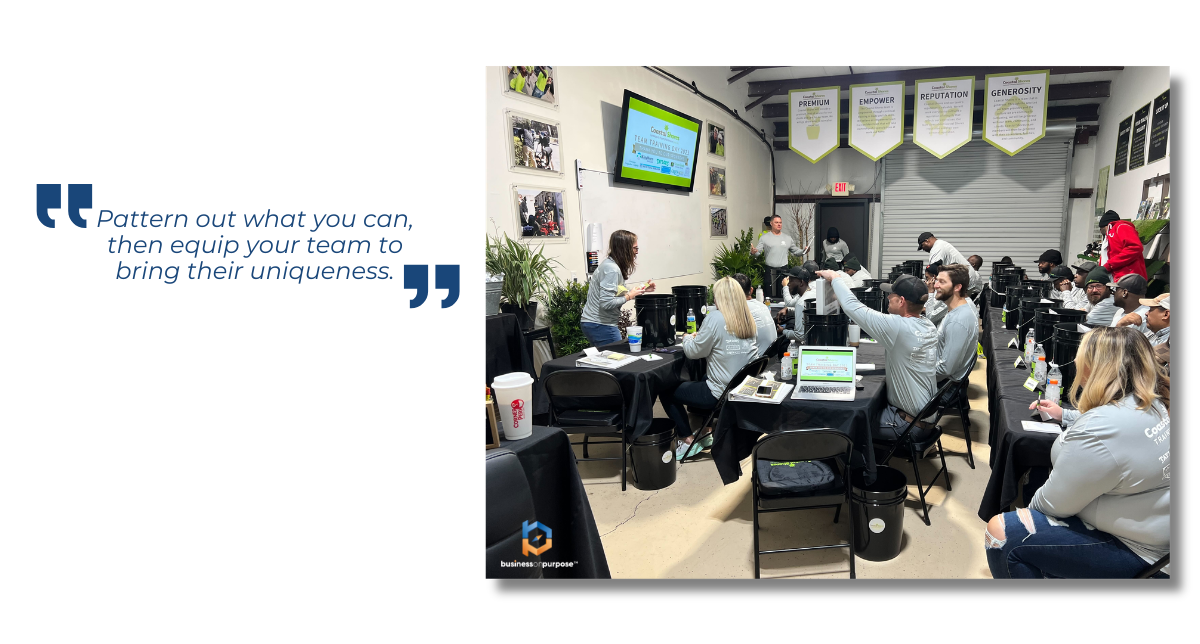
The goal is not to remove all human judgment. The goal is to pattern out what can be patterned, and then equip your team to bring their own skill and personality to the parts that require it.
“Pattern out what you can, then equip your team to bring their uniqueness.”
Lead Well.
If you're looking for more resources to work ON your business, we have them.
At Business on Purpose, we call this the 85/15 principle. We give you 85 percent of what is needed through structure and documentation. The other 15 percent is the human element your team brings to the table. This article is about helping you create that 85 so your team can own the 15.
By the way, that subcontractor in Austin? What used to take her hours, days, and sometimes weeks now takes about 30 minutes. She handles 10 minutes of upfront work, her team handles 80 percent of the middle, and she does a final 10 percent review at the end. Her time collapsed. Her team stepped up. And she finally got to focus on the strategic work the business actually needed from her.
Step One: Pick One Process
Before you can build a system, you need to understand the difference between a system and a process. A system is the big category. A process is one of many steps that lives inside that system.
There are really only four core systems in any business you need to worry about. We call it MSOA:
- Marketing tells the world you exist.
- Sales converts interested people into paying customers.
- Operations is where you actually do the work and deliver your product or service.
- Administration holds everything together financially and organizationally.
Start by asking yourself: which one of these four feels the most chaotic right now? Maybe it is sales. Maybe you are exhausted from being the only person who can close a deal. Great. Sales is your system.
Now go one level deeper. Within sales, what specific process do you want to get off your plate? There is appointment setting, the sales pitch, the follow-up sequence, new client onboarding, and more. Pick one. Let us say you pick the sales pitch because you want someone else to be able to walk into a meeting and do what you do.
That is your starting point.
Step Two: Document It (Without Overthinking It)
Here is a tip that will save you hours of frustration. Do not sit down and try to write out your process from memory. Instead, grab your phone, open the voice recorder, and the next time you go into a sales meeting, tell the client you are going to record the conversation to help train your team.
Most people respond with respect. They appreciate that you are investing in training your people properly. Give it a shot before you assume it will feel awkward.
After the meeting, hit the transcription button, drop the transcript into an AI tool, and ask it to build out a sales pitch process with four to six core questions your team can follow. What used to feel impossibly complex suddenly becomes a clean, repeatable document.
“If it’s not written down, it doesn’t exist.”
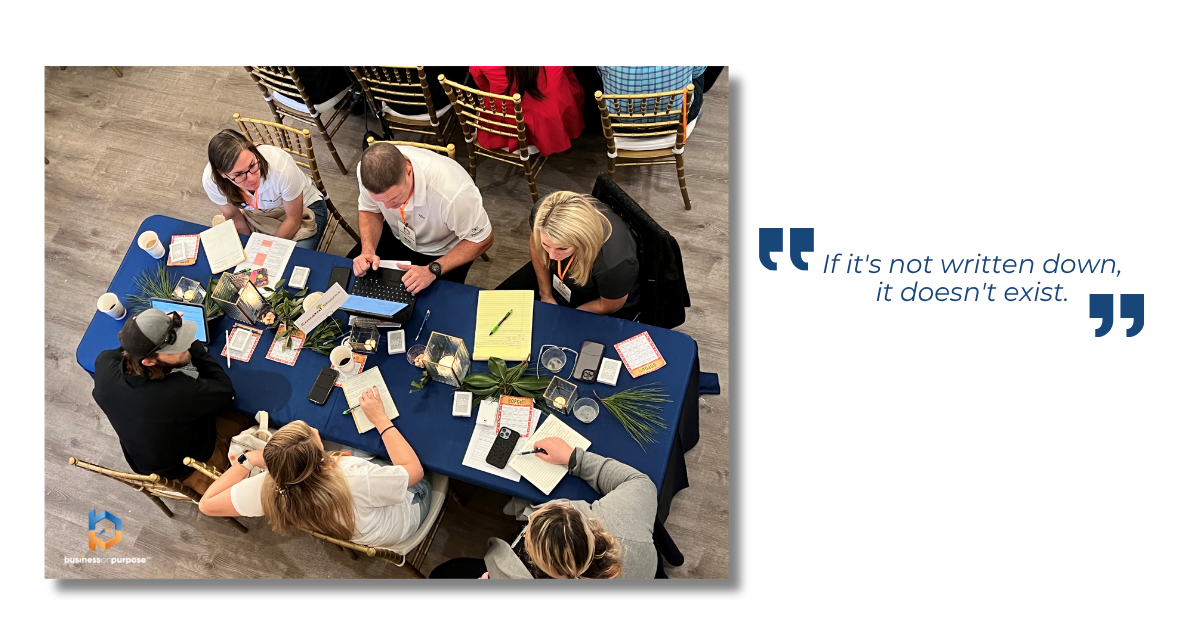
Michael Gerber famously said, “If it is not written down, you do not own it.” We take it a step further at Business on Purpose: if it is not written down, it simply does not exist. Once you document that first process and train someone on it, something clicks. You start thinking, “If we can do this with the sales pitch, we can do it with everything.” That is the bug. And it is a good one to catch.
Step Three: Build Your Master Process Roadmap
Once you have documented one process and gotten a feel for how this works, it is time to zoom out. Set a timer for 15 minutes. Write down every process you can think of across all four systems: marketing, sales, operations, and administration. Do not filter yourself. Just go.
You will likely end up with 50, 60, 70, or even more processes by the time the timer goes off. That is completely normal. Most businesses run on hundreds of processes, not just a handful. What you are creating is your Master Process Roadmap, a living, visual inventory of everything that makes your business run.
You do not have to document all of them at once. But now you can see them. And seeing them is incredibly freeing. It is one of the most cathartic exercises a business owner can do.
Step Four: Train Your Team With RPM
Having documented processes is great. Getting them into your team is where the real transformation happens. We call this the RPM methodology: Repetition, Predictability, Meaning.
Here is the practical tool that makes it work: a simple spreadsheet with 52 columns, one for each week of the year, and at least five rows: marketing, sales, operations, administration, and meetings.
In week one under the sales row, you train on the sales pitch process. In the marketing row, maybe you train on how to update the website. In operations, you cover a fulfillment process. In admin, you cover a financial process. Each training session takes two to five minutes. Short and consistent.
In the meetings row, mark whether a team meeting is happening that week. And here is a key detail: you should not be the one running the meeting. Hand that over to a team member. As a visionary owner, you know how easy it is to get off topic and start talking about things that have nothing to do with the agenda. Give that facilitation role to someone on your team and they will keep things on track every single time.
Train once a week and unlock 200 training opportunities every single year.
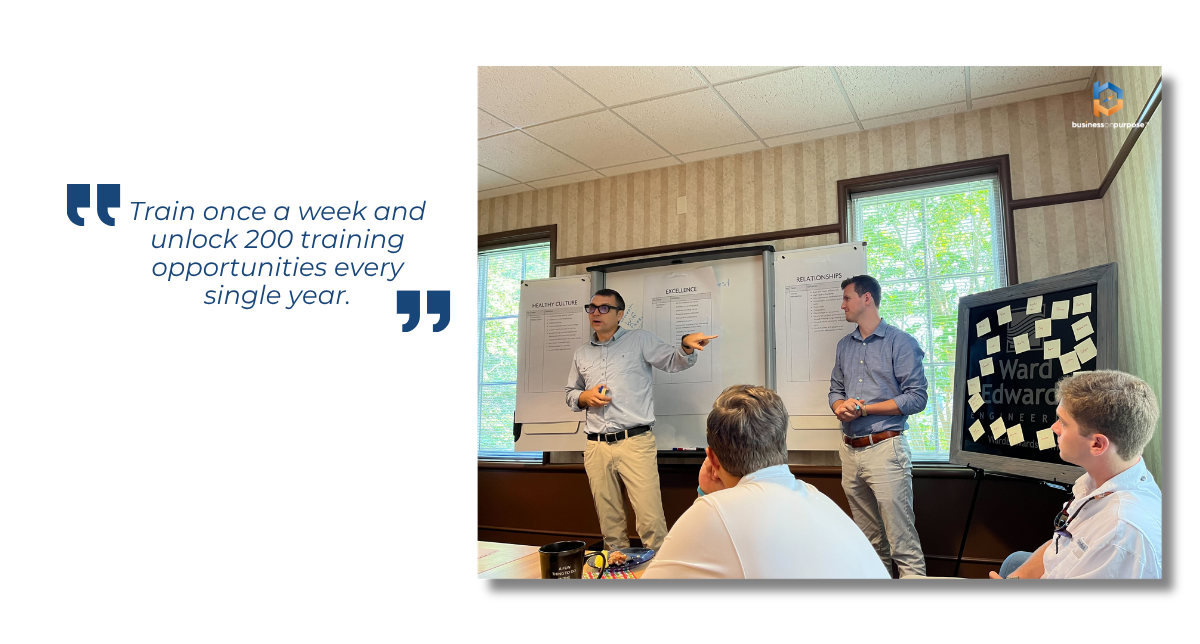
If you train just once per week across those five categories, that is over 200 training moments per year, spread across 50 team meetings. Do you think someone cannot be fully trained with that kind of repetition, predictability, and meaning behind it? They absolutely can.
The Four-Step System in Review
Let us bring it all together. Here are the four steps to building your first business system:
- Pick the process. Choose one system, then go one level deeper to a specific process.
- Document it. Record yourself doing it, transcribe it, and use AI to clean it up into something teachable.
- Map all your processes. Spend 15 minutes building your Master Process Roadmap so you can see everything.
- Train with RPM. Build repetition, predictability, and meaning into your weekly team meetings using a simple spreadsheet.
You can absolutely do the first three steps on your own. The fourth step, though, requires having the right people on your team to train in the first place. And that is where most owners get stuck.
Ready to Build a Business That Runs Without You?
Building systems is only one piece of the puzzle. You also need the right team in place to run them. If you want help finding, hiring, onboarding, and keeping the right people, along with the exact templates and training workbooks we use with our clients, head over to businessonpurpose.com/healthy.
Our mission at Business on Purpose is simple: to liberate you from chaos so you can make time for the things that matter most. Your business should work for you. Let us help you make that happen.
Visit businessonpurpose.com/healthy to get the tools you need today.
Scott Beebe is the founder of Business On Purpose (mybusinessonpurpose.com) and speaker for the AEC industry and author of the book Let Your Business Burn: Stop Putting Out Fires, Discover Purpose, and Build a Business That Matters. Business On Purpose works with business owners to articulate purpose, people, process, and profit to liberate owners from chaos and make time for what matters most.