Most contractors and small business owners hit a wall and immediately think, “I just need to hire someone.” But what if the chaos you’re trying to solve isn’t a people problem at all? What if the real issue is that everything your business runs on is locked inside your head?
Here’s how to get more done in your business, reduce the chaos, and actually build something that runs without you — without necessarily adding a single person to your payroll.
Hiring More People Can Spread the Chaos
When we spend time with contractors at expos, home builder associations, and events around the country, we ask them how their business is really going. Once the rapport builds and the honest conversation starts, we hear the same thing over and over: “We’ve got all these people, but they’ve just added to the chaos instead of taking it away from me.”
That’s a brutal realization, especially when you’ve invested real money in growing your team. But it makes complete sense when you understand what’s actually happening. If you bring people into a system that doesn’t exist on paper, you’re not solving the problem. You’re multiplying it.
The good news? When you start getting processes out of your head and into a documented structure, the chaos begins to subside. Add training, repetition, and predictability to that structure, and your team becomes genuinely empowered.
Every time you hire into chaos, you just spread the chaos further.
Lead Well.
If you're looking for more resources to work ON your business, we have them.

If It’s Not Written Down, It Doesn’t Exist
Michael Gerber has said, “If it’s not written down, you don’t own it.” We take that a step further: if it’s not written down, it doesn’t exist.
Think about what that means for your business. Every process you run — estimating, hiring, billing, job closeout — is only as accessible as your own brain. Your team can’t use it. You can’t train on it. And if you ever want to sell or exit your business, a buyer isn’t going to pay top dollar for what’s trapped in your head. They want to buy an asset. Something documented, something tangible, something they can actually operate.
We call processes that are locked in the owner’s mind captive processes. Not “captivating” in the exciting sense — captive as in behind bars, inaccessible to everyone except you. And here’s something worth sitting with: every single business owner will eventually exit their business. There are three certainties in life — death, taxes, and exiting your business. The only question is whether you’ll exit on your terms.
To do that, you need to get those captive processes out of your head and into a format your team can actually use.
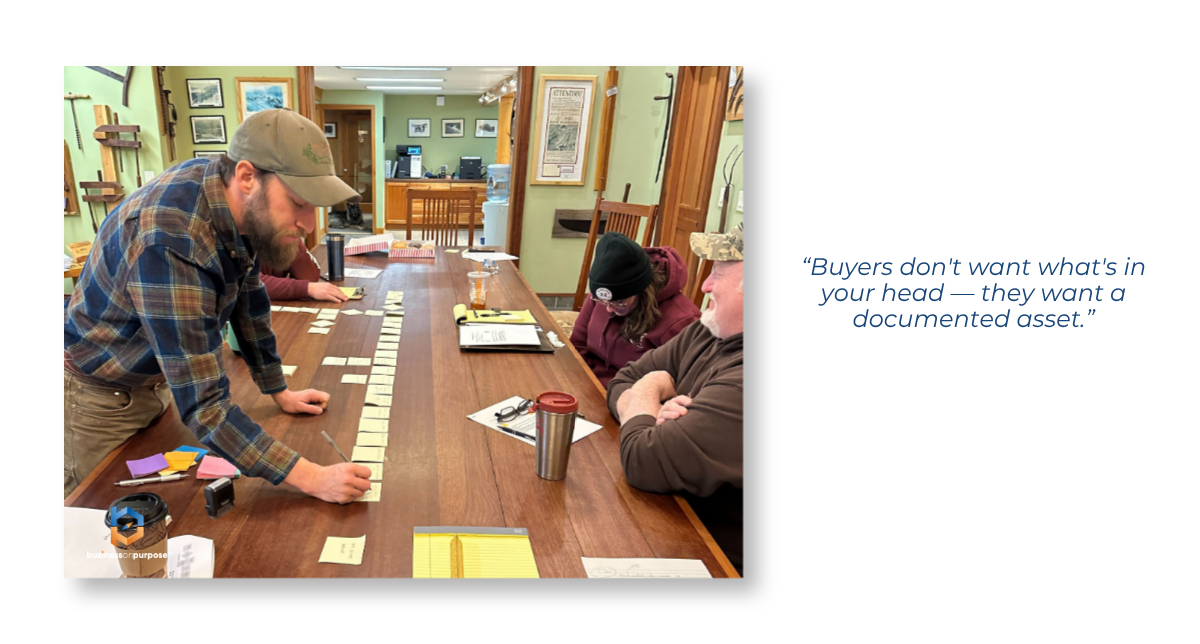
Buyers don’t want what’s in your head — they want a documented asset.
The Master Process Roadmap: Your First Tool
Every business — no matter what industry — runs on four core systems. We call them the four core, and they go in this order:
Marketing. Sales. Operations. Administration.
Work it backwards and it makes perfect sense. You can’t bill for something you haven’t delivered. You can’t deliver something you haven’t sold. And you can’t sell something if nobody knows you exist. That’s why the order matters.
Here’s a simple exercise to get you started. Grab a sheet of paper and write those four words across the top. Set a timer for 15 minutes and do a brain dump of every single process that lives in your head right now. You’re not writing out the full details yet — just the titles. Think of it as flushing the system.
Need a starting point? In your administrative column alone, you’ve probably already got payroll, accounts payable, and accounts receivable. That’s three right there. Now scale that across all four columns and you’ll be amazed at how much was swimming around in your head without you even realizing it.
Once you step back from that sheet of paper, something shifts. It’s genuinely cathartic. That list becomes your master process roadmap — the backbone of how your business actually operates.
The Systems Mindset: Record It Like It’s the Last Time
Once you have your master process roadmap, here’s how you start filling it in. We call it the systems mindset, and it works like this:
Whatever the next process is that you’re about to do — let’s say it’s payroll — record it like it’s the last time you’ll ever do it.
You can use a screen capture tool, your phone pointed at your monitor, an AI assistant — there are no excuses here. Just hit record and walk through the entire process out loud. Every click, every step, every decision. Now you’ve got a training video. The next time someone on your team has a question about payroll, they rewind the recording. That’s it.
Link that video back to the payroll line on your master process roadmap, and then rinse and repeat across every process on that list. This is how you scale operations without necessarily adding headcount. You’re not replacing people — you’re removing yourself as the bottleneck and elevating the skills of the team you already have.
And here’s something worth saying clearly: none of this requires expensive software. It’s all done with spreadsheets, a little time, and your effort.
The Anchor: Building a Culture of Repetition and Predictability
Documenting a process once is a great start. But documentation without consistent reinforcement is just a folder nobody opens. That’s where the third tool comes in — something we call the anchor.
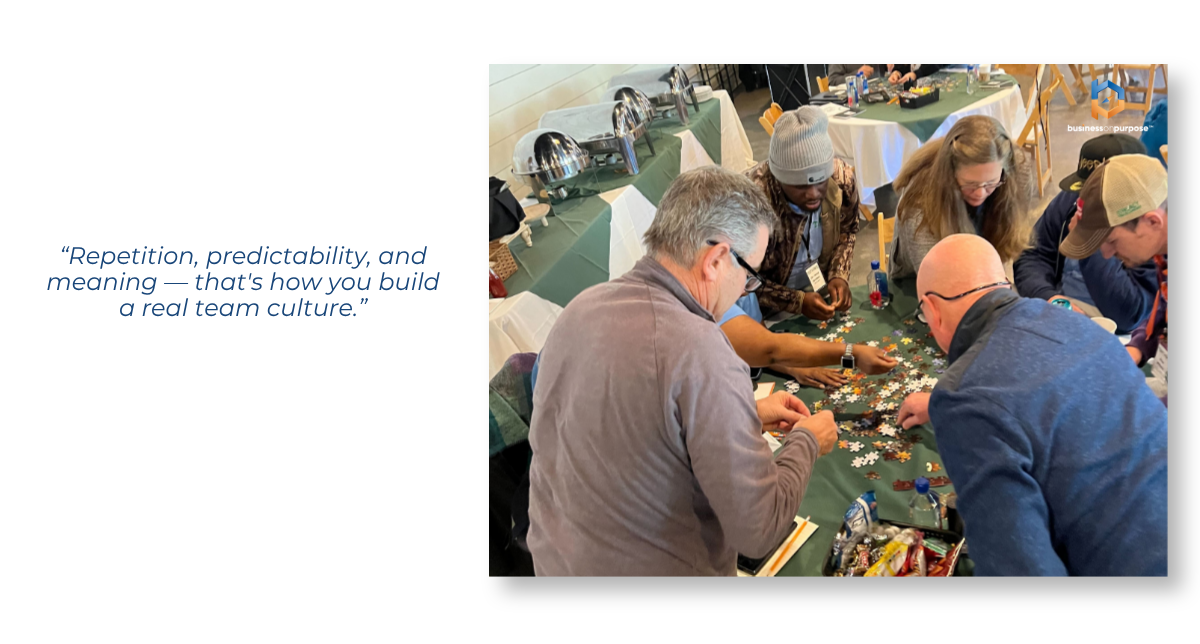
The anchor is a simple spreadsheet: 52 weeks across the top, and all the training ingredients you want to repeat down the left-hand side. The goal is to build what we call an RPM culture — repetition, predictability, and meaning.
Using the payroll example, you might schedule payroll training two or three times a year across those 52 weeks. Does the payroll person already know how to do payroll? Sure. But revisiting the process does two powerful things. First, it catches gaps — things the employee is doing differently than what’s documented. Second, it future-proofs your operation. If your payroll person leaves tomorrow, you have a process. Someone else can step in and do it the same way, without the whole thing falling apart.
That’s what it looks like to build a business that runs without you. Not a business that depends on any one person — including you.
Repetition, predictability, and meaning — that’s how you build a real team culture.
Streamlined Operations Start With You
Here’s the bottom line. You probably don’t need to hire another project manager, another marketing person, or another admin right now. What you need is to get the processes out of your head, document them in a master process roadmap, record them using the systems mindset, and reinforce them with a structured anchor calendar.
When you do that, you remove yourself as the bottleneck. You elevate your existing team. You build something that has real value — something a buyer would actually want to own one day. And most importantly, you liberate yourself from the chaos so you can make time for the things that matter most.
The business you’ve been working so hard to build deserves a structure that actually supports it. And that starts today, with a blank sheet of paper and 15 minutes on a timer.
Ready to Build a Business That Runs Without You?
If this resonated with you, the next step is getting the full framework. Visit businessonpurpose.com/healthy to access the tools and resources you need to start building a business that runs on purpose — not on chaos.
Scott Beebe is the founder of Business On Purpose (mybusinessonpurpose.com) and speaker for the AEC industry and author of the book Let Your Business Burn: Stop Putting Out Fires, Discover Purpose, and Build a Business That Matters. Business On Purpose works with business owners to articulate purpose, people, process, and profit to liberate owners from chaos and make time for what matters most.