You bought the software. Maybe you even invested in AI. And somehow, you ended up busier than before. That is not an automation problem. That is a process problem. Before you automate another thing in your business, there is a right order to follow, and most business owners are skipping straight to step three.
The Farmer Who Watered the Wrong Crops
There is a story about a farmer who heard about a new technology called irrigation. He was an early adopter, got excited, took out a loan, and had the whole system installed before the season started. The timer worked perfectly. The pipes ran exactly as promised. And then half his crops died.
What happened? The system was watering. It just was not watering the right crops.
Nobody had mapped out the appropriate placement of the automation before flipping the switch. The technology worked fine. The planning did not happen.
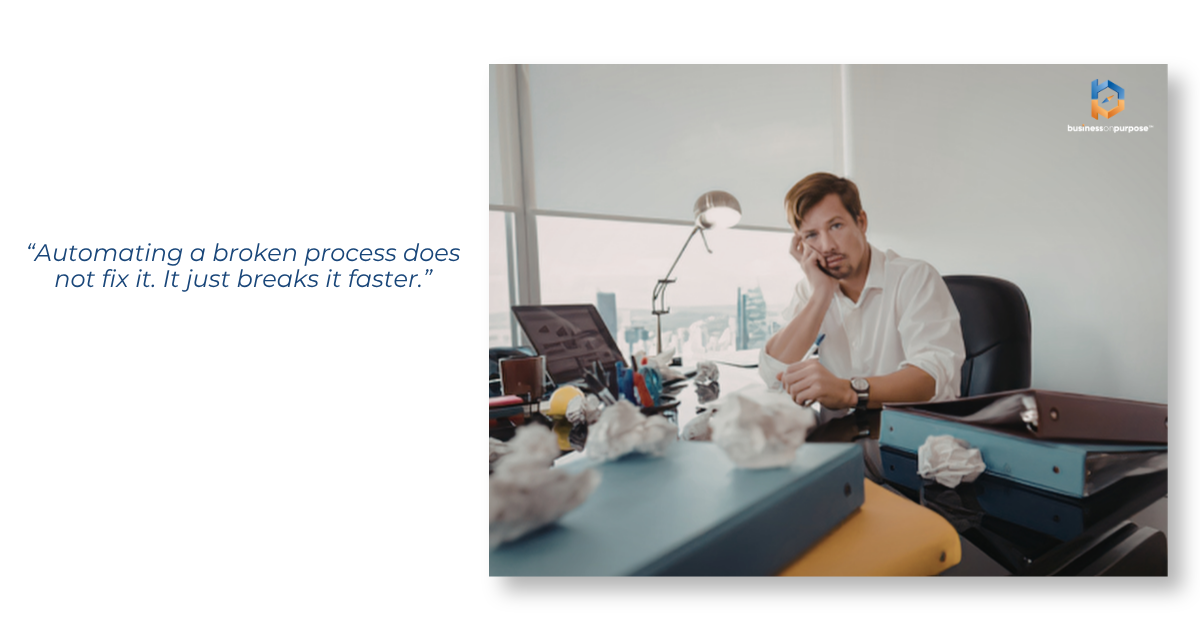
This is exactly what happens in business every single day. Owners buy the CRM, the scheduling tool, or the AI platform, and then they wonder why life got more complicated. Automating a broken process does not fix the process. It just breaks it faster.
And here is something worth sitting with: look at the last 20 or 30 years of your life. Technology availability has exploded. Are you doing less work today than you did back then? Most people are not. We simply gorge ourselves on the available efficiency and pile on more work. That is part of why anxiety has increased across the board.
Automating a broken process does not fix it. It just breaks it faster.
Lead Well.
If you're looking for more resources to work ON your business, we have them.
Your Business Is a Living Organism
Before automating anything, you need a framework for understanding how your business actually works. Think about the human body. It has a skeleton that supports everything else, and it is made up of roughly 11 or 12 distinct systems, including the skeletal system, the cardiovascular system, and the endocrine system. Each one has a role. Each one depends on the others.
Your business works the same way. It is a living organism made up of interconnected systems, and we have broken those down into three major layers:
Layer One: The Four Foundational Cornerstones (what we call the Four Ps): Purpose, People, Process, and Profit. These are the non-negotiables of any functioning business.
Layer Two: The Four Core Systems within the Process vertical: Marketing, Sales, Operations, and Administration. That order matters more than most people realize.
Layer Three: The Repetition Layer, which creates the predictability and meaning that every structure needs to survive. Just like the human body needs water, food, and movement every single day, your business needs a rhythm of repeated actions to stay healthy.
When you understand these layers, you stop reaching for automation tools randomly. You start asking a much smarter question: where exactly in this organism does the automation belong?
Step One: Map Out Your Team First
Inside the People vertical of your operating system, the most underutilized tool is the org chart. You have heard of it. You probably think it is only for big corporations. It is not.
Whether you have two people or two thousand, everyone in your business needs to know where they fit. Am I an elbow? Am I a knee? What body part am I in this organism? An org chart answers that question and creates the foundation for everything that comes next.
Here is a real example. We have a team member in an implementation assistant role. Two days ago in a check-in, the conversation went like this: carry a recording device for the next two weeks, not to be monitored, but to capture every task being done throughout the day. The goal was to identify where her time was actually going, because the hunch was that a significant portion of her work, things like packaging and shipping, could be automated or handed off to a high school intern.
The target? Automate about 60% of her current role so her capacity can be elevated toward higher-level work the business actually needs.
Notice the framing there. The goal was not to find things for her to do. The goal was to identify what the business role needs to accomplish. That is a critical distinction. Build the structure of the business first, then bring people into it. If you build the structure around a specific person and that person leaves, you are left with nothing.
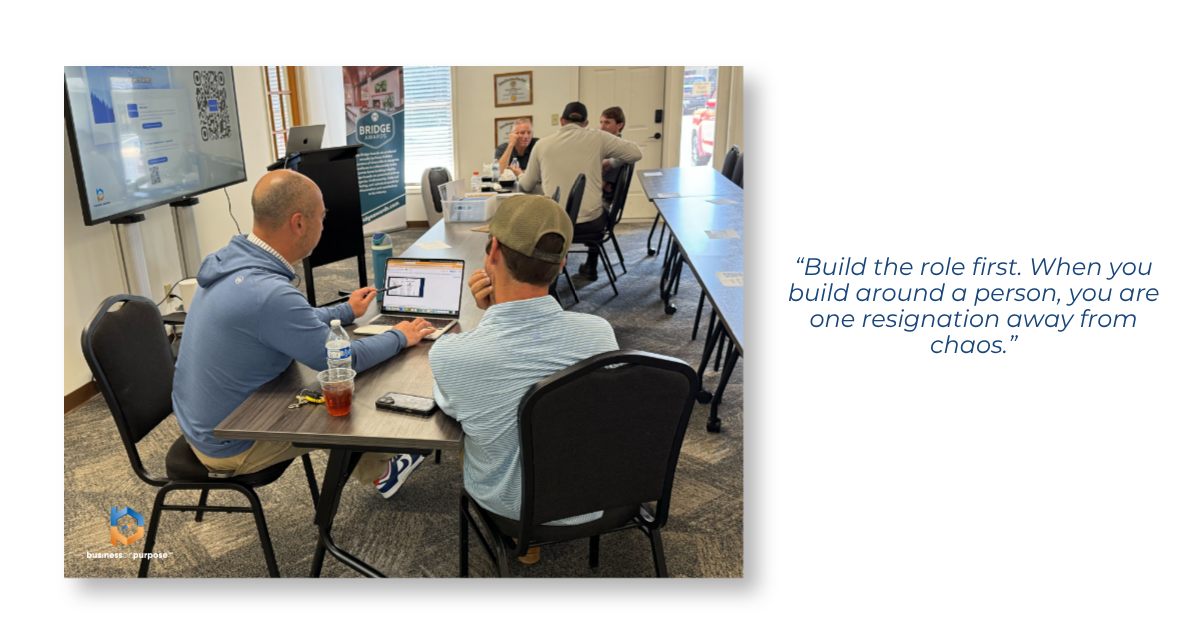
Build the role first. When you build around a person, you are one resignation away from chaos.
Step Two: Document the Process Before You Automate It
Once you know who owns what in your org chart, the next step is mapping the process they run. This is the process roadmap, the second major tool of your business operating system.
Here is a fresh, real-world example. Three days before this was written, a contractor client sat down to build an estimating agent using AI. The conversation started with a simple request: do a brain dump out loud of every single step in your estimating process. No structure required. Just exhaust everything you know.
It took about 20 to 30 minutes. Once every step was documented, the AI agent was built around that process with one clearly stated goal: reduce the time spent on estimating by 80%.
Not eliminate estimating. Reduce it by 80%. That 20% of human judgment and oversight still matters. But the repetitive, time-consuming work? That gets handed to the automation.
Then something unexpected happened. When the existing bid was compared against what the AI produced, the AI flagged items it had missed, but it also flagged items the estimator had missed in his original bid. The automation was not just saving time. It was improving accuracy.
That is what well-placed automation does. It serves the person, not the other way around.
The Question That Changes Everything
Before building any automation, there is one question you need to answer first. It is actually a psychology question, the kind a good counselor might ask:
What do I want to cause?
In the estimating example, the answer was clear: cause a decrease in time spent estimating by 80% for the person in that role. That one sentence drove every decision about how the automation was built, what it needed to do, and how success would be measured.
Without that answer, most automation projects turn into expensive distractions. You end up serving the automation instead of the automation serving you. You spend time feeding the system, updating it, troubleshooting it, and wondering why you are busier than before.
Map out what you want to cause. Then build toward that.
Step Three: Lock It Into Your Anchor
Once the automation is built and running, it needs a home in what we call the anchor. Think of the anchor as a single spreadsheet that holds 52 weeks of your year, including every repeating ingredient your business needs to function: team meetings, departmental reviews, accounting check-ins, marketing training, operations training, and even things like remembering team birthdays.
The estimating process, once automated, gets placed into the anchor and reviewed four to six times per year to make sure it still reflects the right process. That review cycle is what gives your business repetition, predictability, and meaning, the three things every living organism needs to survive.
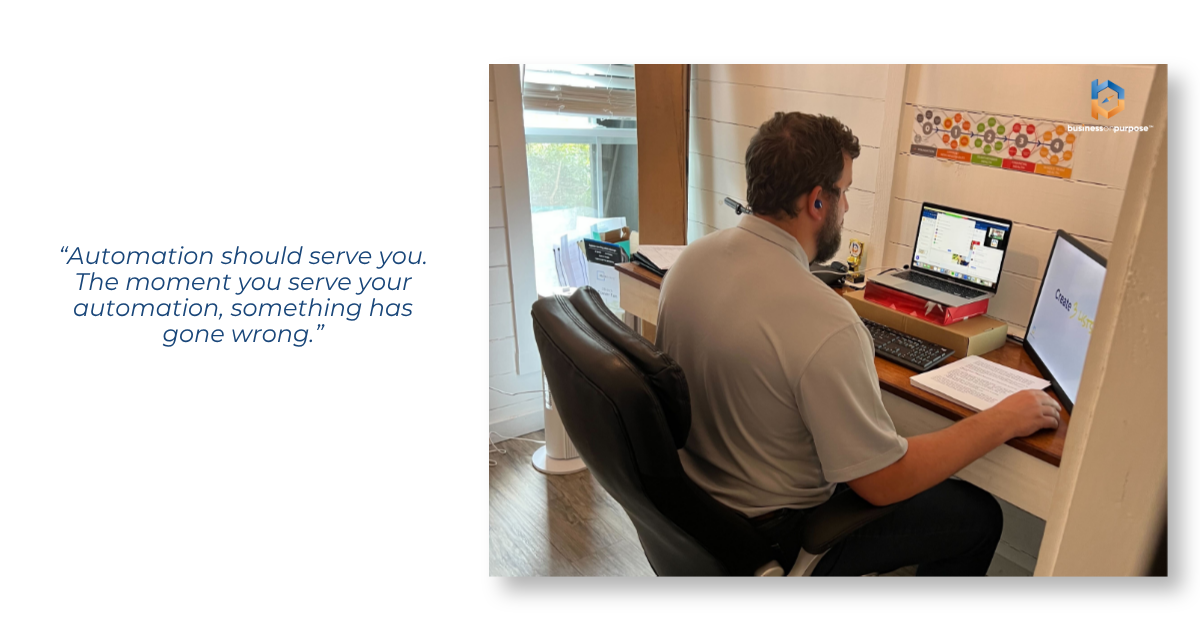
Automation should serve you. The moment you serve your automation, something has gone wrong.
Automation Is Supposed to Free You
Running a business can feel like living inside a chaos machine. There is always another fire, always another task, always something that did not get done. Automation, when applied in the right order and for the right reasons, is one of the most powerful tools available to change that reality.
But it only works when the process is mapped first, the role is defined, and the goal is clearly stated. Skip those steps and you will spend more time managing your tools than running your business.
The goal is simple: more freedom, more time, and more clarity so you can show up for the things and the people that matter most.
Ready to Build a Business That Runs Without You?
If you want to put these ideas into a real framework for your business, including how to build an operating system, map your processes, and use automation the right way, visit businessonpurpose.com/healthy and take the first step toward a business that works for you.
Scott Beebe is the founder of Business On Purpose (mybusinessonpurpose.com) and speaker for the AEC industry and author of the book Let Your Business Burn: Stop Putting Out Fires, Discover Purpose, and Build a Business That Matters. Business On Purpose works with business owners to articulate purpose, people, process, and profit to liberate owners from chaos and make time for what matters most.