Let’s break down every element so you can build systems that actually stick.
Your Process Is Your Product
Think about McDonald’s for a moment. Whether you love it or hate it, there is something undeniably impressive happening there. You can walk into a McDonald’s in Tokyo, Paris, or a small town in Brazil, and the fries taste almost exactly the same. That is not an accident. That is the result of a deeply systematized, highly predictable process.
And here is the thing — travelers who have the whole world available to them still stop at McDonald’s. Why? Because that predictability creates familiarity, and familiarity creates comfort. The people who work in your business and the clients who hire you want that same level of comfort and confidence in what you deliver.
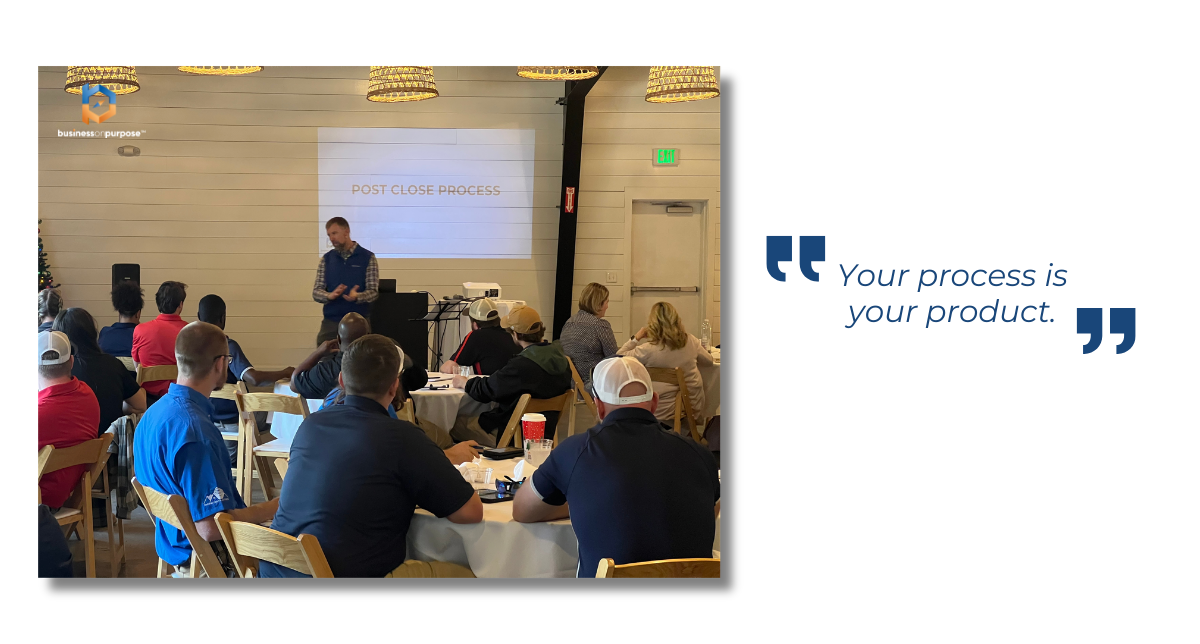
The shift most business owners need to make is this: stop obsessing over the product you offer and start obsessing over the process by which you deliver it. Your process is your product. A system is simply a collection of well-documented processes working together — think of it like the solar system, where planets, stars, and orbits all combine to make up the whole.
If you are doing every task yourself to keep things running, that is not a business. That is a job. The goal is a business that can run and grow with or without you. That requires building a collection of processes and bundling them into systems.
“Your process is your product.”
Lead Well.
If you're looking for more resources to work ON your business, we have them.
Element 1: Documented Process
The first element of any business system is a documented process. This is your step-by-step instruction manual for how a task gets done. Most owners skip this step and jump straight to handing things off — which is not delegation, it is abdication. And abdication always creates chaos.
Here is a simple hack to get started: the next time you do a task, record it like it is the last time you will ever do it. Set up your phone camera, do the work, and capture it. One example: a trade show setup. The first time a team member was brought along to help, a camera was set up to record how the booth and signage came together. Nobody ever had to ask that question again. The video became the process, and the process became part of the marketing system.
Documentation does not have to be complicated. It just has to be done.
Element 2: Trained Personnel
A documented process sitting in a folder no one reads is worthless. That is why the second element is trained personnel. Systems exist so that other people can use them. You cannot separate the conversation about systems from the conversation about delegation.
A helpful framework here is the acronym PTA: Process, Train, and Accountability. The goal is to train your people on the processes you have documented, consistently, 52 weeks a year. When training is baked into the rhythm of your business, your team can execute with confidence and your systems actually get used.
Element 3: Criteria (Your Unique Core Values)
The third element is what is often called the criteria of the system — in plain language, your unique core values. And before you say, “We already have those,” take a beat. A lot of companies have generic values like “excellence,” “integrity,” and “respect.” Those were also Enron’s core values before the whole thing collapsed. True story.
What you actually want are values that are unique to your business — values that serve as boundaries for decision-making. At Business on Purpose, the core values include things like “85/15,” “Four Rs,” and “Work demonstrates faith.” Those phrases mean nothing to an outsider, and that is the point. They are specific, they are owned, and they guide how the team makes decisions every single day.
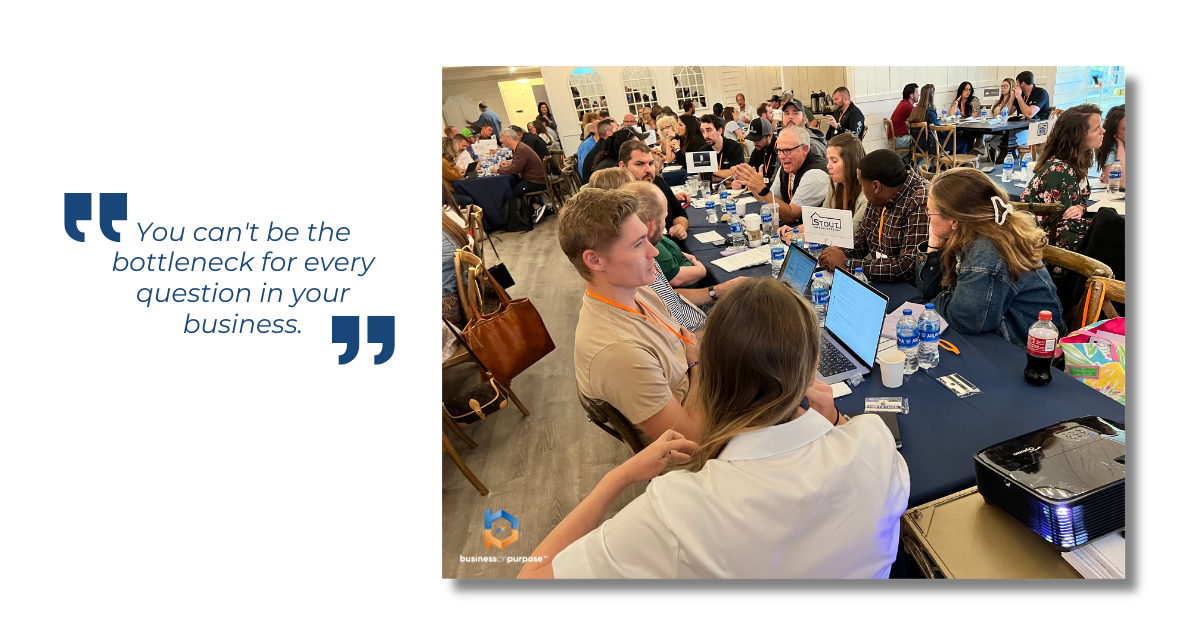
When your team is running systems without you standing over their shoulder, they need to know how to make good autonomous decisions. Core values give them that framework. You cannot be the bottleneck for every question that walks through the door of your business.
“You can’t be the bottleneck for every question in your business.”
Element 4: Measurable Outcome
Here is where a lot of systems fall apart. Owners build out processes and train their teams but never define what success actually looks like. The fourth element is a measurable outcome, and every system needs exactly one.
Every business operates across four major systems: Marketing, Sales, Operations, and Administration (MSOA). Each one has a single primary outcome:
- Marketing System: Lead generation
- Sales System: Conversion
- Operations System: Metrics tied to product or service delivery
- Administrative System: Profitability
A process without a clear outcome creates confusion. Your team members do not know why they are doing what they are doing, and motivation drains fast. But when there is a clear outcome attached to the work, everything sharpens. You can have activity indicators to make sure the right steps are being taken along the way, but the single primary outcome must be front and center.
Do not try to chase 16 outcomes at once. Pick one. Make it clear. Build toward it.
Element 5: The Feedback Loop
The fifth and final element is the feedback loop. This is what keeps everything honest and moving in the right direction. At Business on Purpose, this is called the Big Five feedback loop — five specific meeting structures that create an airtight system for communication inside your business.
Here are the Big Five:
- Once-weekly team meeting — the whole company comes together
- Once-weekly departmental meeting — one for each of the four systems (Marketing, Sales, Operations, Admin), each with an agenda and a leader
- Once-monthly executive meeting — high-level leadership looks at the business from 60,000 feet
- Annual performance review — a 50/50 conversation where the leader evaluates the team member and the team member evaluates themselves
- Monthly one-on-one check-in — every single team member gets dedicated individual time with their leader
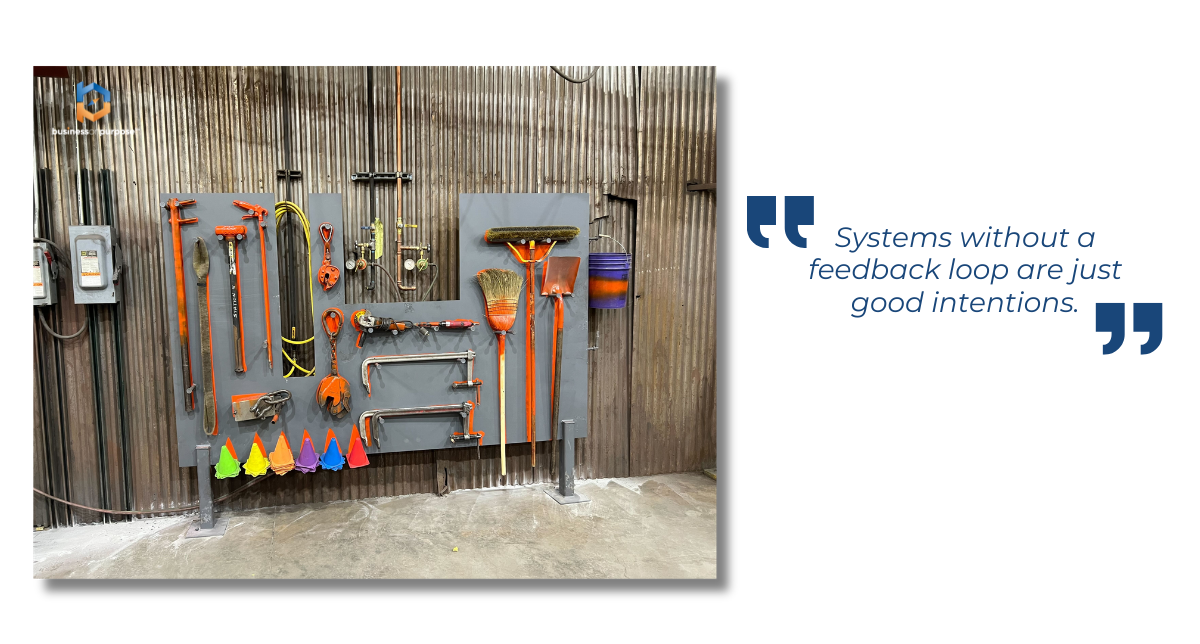
Together, these five touchpoints create a home for information. Nothing leaks. Feedback flows in, gets processed, and drives the team toward the right outcomes within the right values. That is what a functioning feedback loop looks like in practice.
“Systems without a feedback loop are just good intentions.”
All Five Elements Work Together
Here is a quick recap of the five elements every business system must have:
- Documented Process — a step-by-step instruction manual anyone can follow
- Trained Personnel — people consistently equipped to run the process
- Criteria (Unique Core Values) — boundaries that guide autonomous decision-making
- Measurable Outcome — one clear result the system is designed to achieve
- Feedback Loop — structured communication that keeps the system on track
Most business owners are working with only two of these. That is why the systems do not get used. That is why nothing sticks. When all five elements are in place, your business stops depending on you to hold everything together — and that is exactly the goal.
Ready to Build a Business That Runs Without You?
A great system is only as strong as the team running it. If you want to go deeper and learn how to find, hire, onboard, and retain the right people to run your systems, head over to businessonpurpose.com/healthy. There is a free custom handbook and the exact same templates used with clients every day waiting for you there.
You do not have to live in the chaos. There is a better way — and it starts with building the right foundation.
Visit businessonpurpose.com/healthy to get your free resources now.