Let’s break it all the way down so you can walk away with a clear, practical framework you can start using today.
It Is Simpler Than You Think
Business system development is really just a fancy way of saying we are documenting the processes we already do every day. That is it. You already work within systems and processes right now. The problem is you are not writing them down. And because they only exist in your head, your business cannot run or grow without you standing in the middle of everything.
Think about it like software updates. Every time you open an app and see version 10.3.71, that update exists because developers found bugs, fixed them, and improved the product over time. Your business systems work exactly the same way. They are never truly finished. In fact, your vision, mission, values, and processes are never more than 90 to 95 percent complete. There is always a growth stage ahead of you.
A better picture might be your yard. You have grass, shrubs, and trees. They grow, you trim them, and then they grow again. Business system development is the same ongoing cycle of maintaining and improving what you have built.
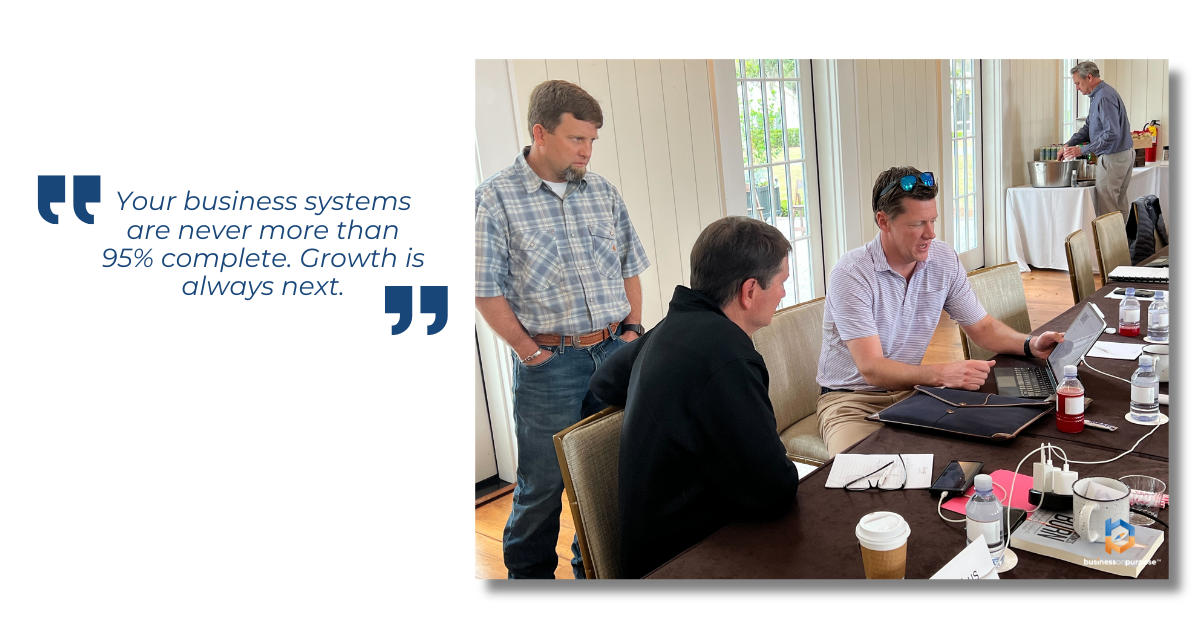
“Your business systems are never more than 95% complete. Growth is always next.”
Lead Well.
If you're looking for more resources to work ON your business, we have them.
The Three-Part Cycle at the Core of Everything
If you want to boil business system development down to its simplest form, here it is: Document. Train. Improve. That is the cycle. You document the process, train your team on it, measure the results, and then improve based on what you learn. Then you do it all over again.
Before we go deeper into the five components, it helps to understand the difference between a system and a process. A process is a specific, step-by-step task. When a group of related processes comes together, it forms a system. There are really only four core systems in any small business:
- Marketing
- Sales
- Operations
- Administration (Accounting and HR)
Think of it like the electrical system in your house. The system is the whole, but the wiring, fixtures, and switches are the individual processes that make it work. Your job is to document those individual processes so anyone on your team can follow them consistently.
The Five Components of Business System Development
1. Document the Processes
Start by writing down what actually happens in your business. Not what you wish happened, but what is happening right now. Work within those four systems and capture the individual processes inside each one. This is the foundation everything else is built on.
2. Train With Repetition, Predictability, and Meaning
Once you have documented your processes, it is time to train your team. The best training follows what we call the RPMs of great leadership: Repetition, Predictability, and Meaning.
Repetition means you train consistently, not just once. A basketball coach does not run sprints one time and call it a season. Predictability means your team knows what to expect. And meaning is where most businesses miss the mark entirely. Your training has to be tied to your “why.” A strong mission statement is not “we want to be the world’s most preeminent seller of HVAC units.” It is “we want to create life in homes.” That is the kind of meaning that makes training stick.
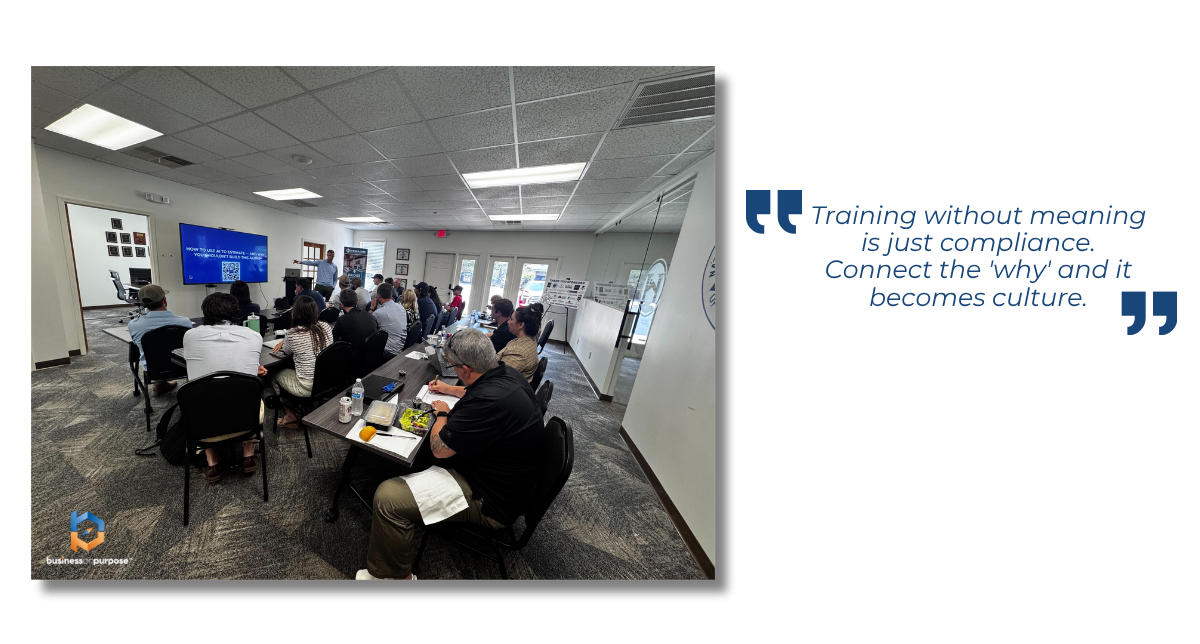
“Training without meaning is just compliance. Connect the ‘why’ and it becomes culture.”
3. Measure the Outcomes
Once your team is trained, you need to measure whether the process is working. This is where KPIs, or key performance indicators, come in. Rather than tracking 20 different metrics, focus on one key outcome per system:
- Marketing: Leads
- Sales: Conversions to new clients
- Operations: Client retention
- Administration: Profitability
These four outcomes work together in a chain: leads feed conversions, conversions build retention, retention drives profitability. You track these consistently through structured weekly meetings, including team meetings, marketing and sales meetings, production meetings, and accounting reviews.
4. Gather the Feedback
Here is where things get interesting. Once you are measuring outcomes, the data starts to speak to you. If your client retention strategy is in place but your churn rate is 70 percent, that number is telling you something important. The key is to stop and actually listen.
When you gather and review your data together, you can hear what your business is telling you, what the market is signaling, and what your customers actually need. That insight is what allows you to adjust your strategy and go back to update your documents with confidence.
5. Improve
This is the step that closes the loop. Everything you have documented, trained, measured, and gathered leads here. You take what you have learned, make targeted improvements, update the process, and begin the cycle again. Document, train, measure, gather, improve. Over time, your business gets sharper, more consistent, and more capable of running without you in the room.
It All Comes Back to People
There is one factor that determines whether this entire framework succeeds or stalls, and that is your people. Every single step in this cycle is about people. You document for your people. You train your people. You measure what your people produce. You gather the outcomes your people create. And you improve by developing your people further.
The systems do not run themselves. The right people, equipped with clear documented processes and consistent training, are what make the whole thing work.
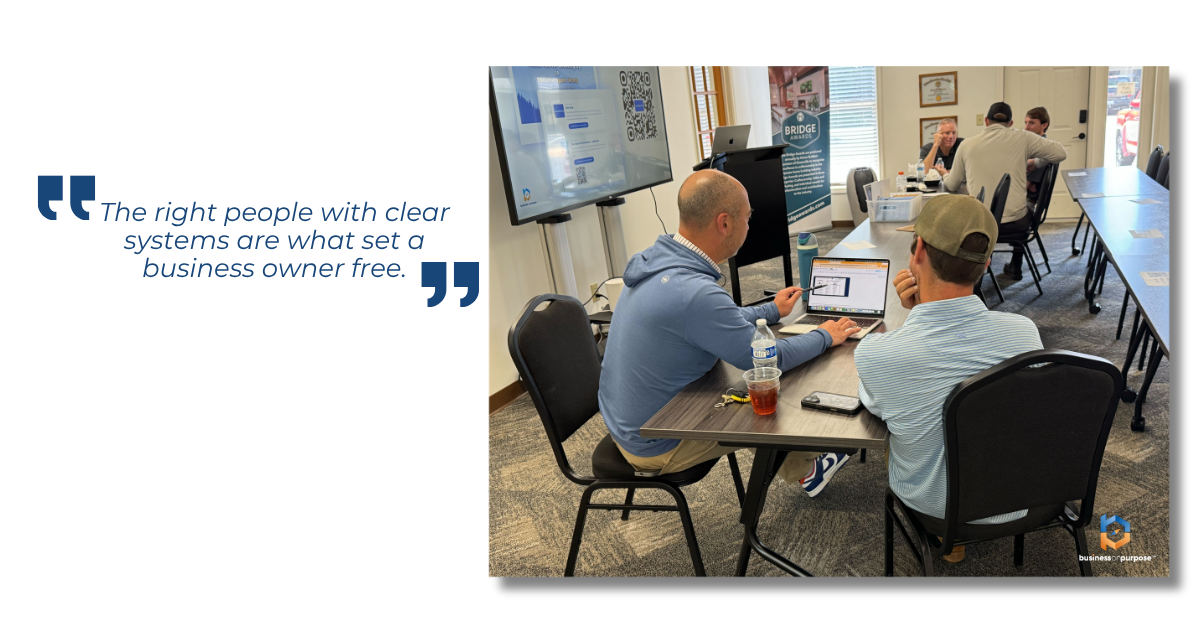
“The right people with clear systems are what set a business owner free.”
You Were Made for More Than Chaos
Too many small business owners are living inside a cycle of chaos, putting out fires every day, unable to step away because everything depends on them. Business system development is the path out of that cycle. It is how you build something that is bigger than your daily involvement. It is how you reclaim your time for the things that matter most.
The goal at Business On Purpose has always been the same: to liberate you from chaos and help you build a business that can run and grow with or without you. This framework is how that happens, one documented process at a time.
Ready to Take the Next Step?
If this gave you clarity and you are ready to start building a healthier, more self-sufficient business, we would love to help you get there. Visit businessonpurpose.com/healthy to access the tools, templates, and resources that will help you build a business that finally works for you instead of the other way around.