Most small business owners do not have a marketing problem or a sales problem. They have a process problem. And until you see that clearly, you will keep spinning your wheels wondering why growth feels so unpredictable.
Here is exactly how to build a simple, repeatable system for marketing and sales that fills your pipeline and keeps it full — no silver bullets required.
The “Word-of-Mouth” Trap
A lot of business owners will proudly tell you that word-of-mouth is their number one marketing strategy. And that works — right up until it stops working. The pandemic made many of us comfortable with customers coming to us. Demand was high, phones were ringing, and business felt easy. But that season is over for most industries, and the owners who never built an intentional marketing system are now feeling the silence.
The mindset shift you need to make is moving from order-taking to business development. Order-taking is standing behind a counter waiting for someone to walk in. Business development is actively going out and creating relationships that turn into revenue. Those are two very different disciplines.
A lead is a perishable item — ignore it and it rots.
Lead Well.
If you're looking for more resources to work ON your business, we have them.

A mentor once told me, “A lead is a perishable item.” Think about that. Just like fruit left on the counter, a lead that does not move through a process will rot. The fix is not a new tactic or a trendy marketing agency. The fix is a process.
Three Marketing Skills Every Business Owner Needs
Marketing always comes before sales. You cannot sell to someone who does not know you exist. Marketing goes out to the world and says, “Hey, we are here.” Here are three foundational skills to build that awareness with intention.
Marketing Skill 1: Ask the 80% Question
Before you try any new tactics, ask this one question: Where have 80% of our customers come from? That is it. Write the answer down. That single answer will inform everything else you do in marketing and sales. Do not skip this step. It seems too simple, but most business owners have never stopped to actually answer it.
Marketing Skill 2: Map Your Last 10 Customers
Open a free spreadsheet and list the last 10 customers you served. Then identify how each one found you. You are looking for patterns. Was it customer referrals? Online marketing? In-person association meetings? These are called channels, and once you know which channel is producing 80% of your customers, you know where to focus your energy. This is not rocket science. It is basic discipline applied consistently over time.
Marketing Skill 3: Build a List of Tactics
Now that you know your channel and have your list of names, write out five to fifteen tactics you will use to nurture those people — or people just like them — over time. Keep it practical. Keep it actionable.
Here is a real example. A builder in Northern California discovered that architects were responsible for the majority of his business. So he made a list of ten architects — seven who had already sent him work and three he had never worked with. He hired a virtual assistant for around ten dollars an hour to call architects in his area and schedule coffee and lunch meetings. Now he meets with two to three architects every week and his pipeline has never been fuller. All he did was ask the right question, build the list, and execute a simple tactic.
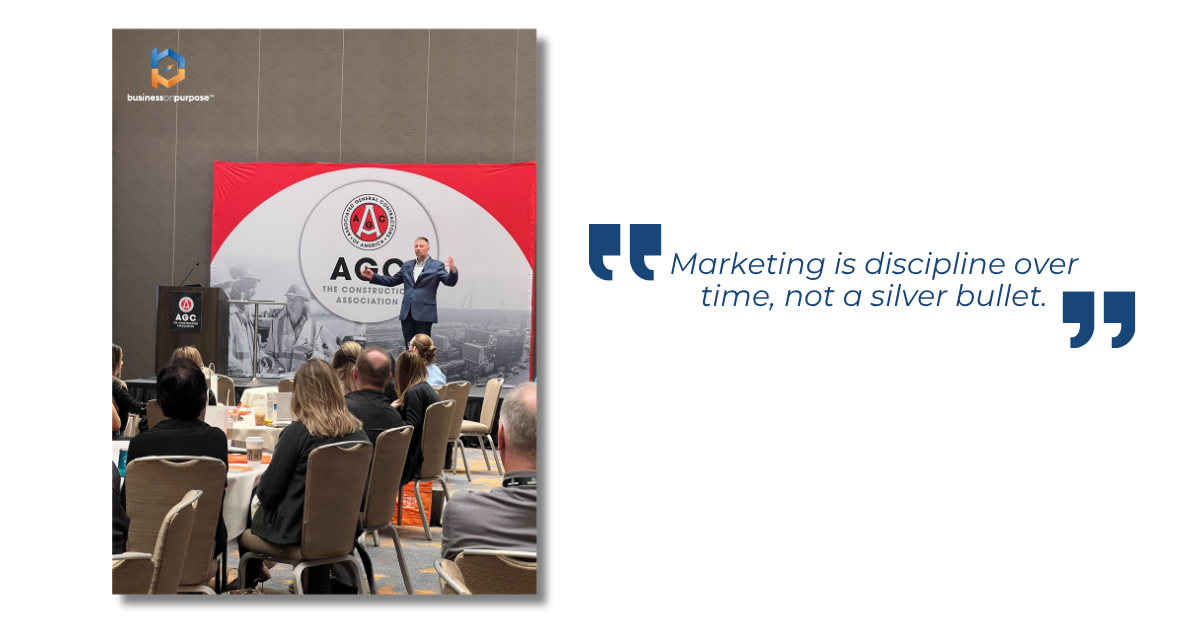
Marketing is discipline over time, not a silver bullet.
Four Sales Skills That Close the Deal
Once your marketing engine is running and people know you exist, sales is where you convert those relationships into customers. Think of it this way: marketing gets you to the altar, and sales is where you get married. Here are four sales skills to sharpen right now.
Sales Skill 1: Answer These Four Core Questions
Before you ever sit down with a prospect, you need to be able to clearly answer these four questions:
- What problems do you solve?
- Why does it matter?
- What is your process?
- What happens when they buy?
That last one is critical. It is easy to get excited about landing a contract, but if you do not have a clear, consistent onboarding experience ready the moment that contract is signed, you are setting yourself up for chaos. Button it up before the ink dries.
Sales Skill 2: Radical Follow-Up
If there is one thing to take away from this entire conversation, it is this: radical follow-up wins deals. Most business owners lose sales not because they are bad at selling, but because they stop following up too soon. Use AI tools and CRM systems to remind you to follow up, but never lose the human touch. As our world becomes more automated, a personal phone call or handwritten note will stand out more than ever.
Sales Skill 3: Rep Your Close
You have to practice closing. That means having a sales script and using it. Here are six questions we recommend asking in every sales conversation:
- Tell me about your business.
- What do you want?
- What are the roadblocks keeping you from getting there?
- If you do nothing different, what does your life look like three years from now?
- How much time are you willing to invest in this each week?
- What questions do you have for me?
The goal is not necessarily to copy these six questions word for word. The goal is to recognize that a system for sales exists and to ask yourself honestly: What is yours?
Sales Skill 4: Build Consistency in the Customer Experience
Here is where a lot of businesses quietly fall apart. Marketing is working. Sales conversations are happening. Contracts are being signed. But once the contract is in hand, customer one has a completely different experience than customer two. That inconsistency damages your reputation and kills referrals. You need a fulfillment system that gives every customer the same high-quality experience from day one.
Without radical follow-up, you will lose deals every time.

You Do Not Have a Marketing Problem
Let this sink in. If you are struggling to grow, it is almost certainly not because marketing does not work or because your product is not good enough. It is because you do not have a documented process for either marketing or sales. The tactics above are not complicated. They require honesty, a spreadsheet, and the discipline to show up consistently over time.
Ask the 80% question. Build the list. Choose your tactics. Answer the four sales questions. Follow up radically. Practice your close. Create a consistent customer experience. Do these things with discipline and the chaos goes away.
Ready to Systematize Your Business?
Marketing and sales are just two pieces of a healthy, well-run business. If you want to build a business that runs with clarity and consistency — and gives you back your time — visit businessonpurpose.com/healthy to take the next step. You will find the tools and resources to help you build a business that works for you, not the other way around.
Scott Beebe is the founder of Business On Purpose (mybusinessonpurpose.com) and speaker for the AEC industry and author of the book Let Your Business Burn: Stop Putting Out Fires, Discover Purpose, and Build a Business That Matters. Business On Purpose works with business owners to articulate purpose, people, process, and profit to liberate owners from chaos and make time for what matters most.