If your marketing and sales feel like two rival gangs constantly pointing fingers at each other, you are leaving real revenue on the table. The good news is that when these two systems work together in the right order, with the right handoff, you get a lead-generating machine built on repetition, predictability, and meaning.
Let’s break down exactly how to make that happen.
First, Get the Order Right: Marketing Comes Before Sales
Here is something most small business owners get backwards. The question is never “how can sales and marketing work together?” The real question is “how can marketing and sales work together?” The order matters. Marketing comes first. Always.
Marketing’s job is to fill the funnel. Whether your business needs 5 prospects a year or 5,000, marketing exists to attract qualified people to your offer in a process-driven, repeatable way. Sales cannot do its job without marketing doing its job first.
Think of your business like a human body. The skeleton has a specific structure: ribs, elbows, knees, all in the right place. Your business works the same way. It is an organism made up of systems. Marketing is first, sales is second, operations is third, and administration is fourth. We call this MSOA, and the order is not optional.
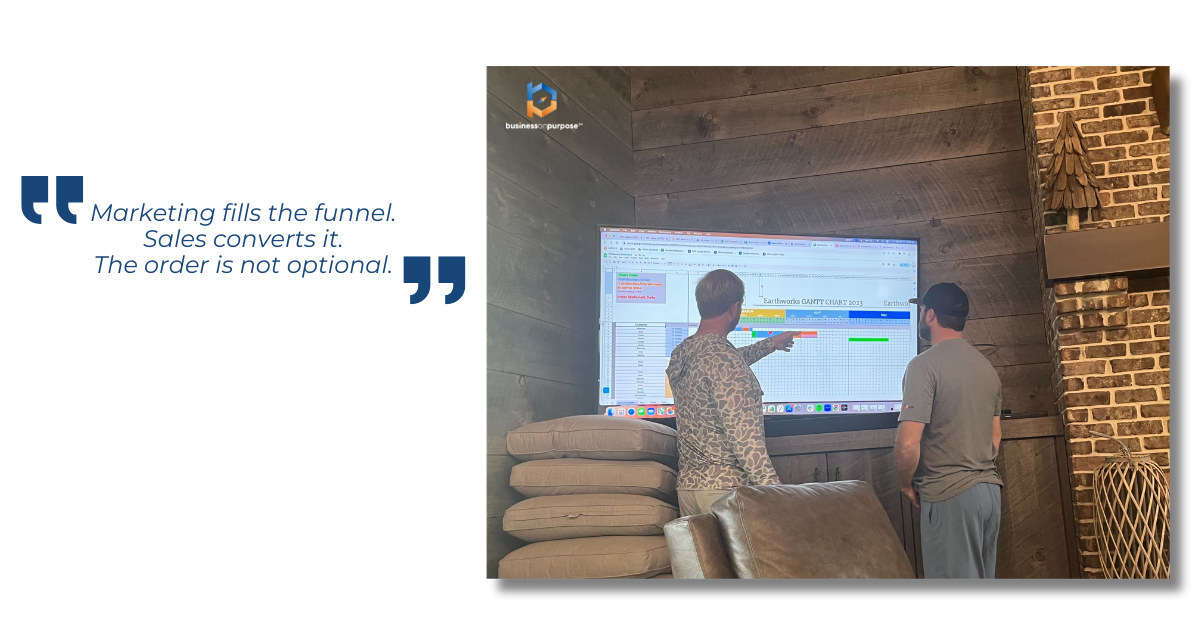
“Marketing fills the funnel. Sales converts it. The order is not optional.”
Lead Well.
If you're looking for more resources to work ON your business, we have them.
The Two Funnels That Must Be Connected
Here is a distinction that changes everything: there is a marketing funnel and there is a sales funnel, and they are two different things. But they are connected and unified by one thing: the mission you are trying to accomplish.
The marketing funnel fills up with prospects. The sales funnel converts those prospects into customers. The sales team needs clear messaging, ideally in a scripted format, and a defined process for following up with radical consistency.
Too many business owners treat marketing like a vague idea rather than a system. The same goes for sales. You are not just selling a service. You are selling a system of marketing and a system of sales. And those systems need to be documented and written down so that others can access them, run them, and scale them without you.
Some of you are reading this and thinking, “Wait, it’s just me doing both.” That is exactly why you need to build these systems as if you had a full team. When you build it right, you can hand it off.
Where It All Falls Apart: The Handoff
In college football, halftime locker rooms can get ugly when things are not going well. Offense blames defense. Defense blames offense. Everyone is so focused on pointing fingers that nobody is talking about what it will take to win. That is exactly what happens between marketing and sales when there is no system for the handoff.
Marketing does the work of getting prospects and then looks over at sales and says, “What did you do with those leads I gave you?” Sales looks back and says, “Where are the leads you were supposed to send me?” Round and round it goes, while revenue bleeds on the sideline.
The fix is not a better argument. The fix is a better handoff process. Your CRM or lead tracking tool should make it crystal clear when a prospect moves from the marketing funnel into the sales funnel. The moment that handoff is fuzzy, leads die.
“The breakdown between marketing and sales almost always happens at the handoff.”

Two Best Practices That Keep Everything Running
Once you have defined your marketing process, your sales process, and your handoff process, two disciplines will keep the whole thing healthy.
Build a Scorecard for Both Systems
Numbers are not everything, but they are a big thing. Build a simple spreadsheet scorecard that tracks the metrics that matter most to your marketing and sales functions. Put both the aspiration and the numerical target on paper.
For example, inside Business On Purpose, we track three things:
- CR less than 5 (Client Retention: lose no more than five clients per year)
- SGC greater than 5 (Self-Generated Closes: coaches generate their own leads, not just wait for the business to provide them)
- FTBE (Full-Time Best Effort: defined by a 40-hour work week locked onto the calendar)
What does your scorecard look like? How many qualified prospects do you need per month? What is your conversion rate goal? How many new customers do you need to grow revenue? Write it down. Make it visible. Review it consistently.
Hold a Weekly Marketing and Sales Meeting
This one is non-negotiable. Marketing and sales need a dedicated meeting every single week. It should be one hour, agenda-driven, and leader-led. If you can cover everything in 45 minutes, great. But it happens every week without exception.
Inside Business On Purpose, our weekly marketing and sales meeting covers goals, vision, what is coming up in the next three to four weeks, outreach metrics, and blind spots. Because we have a tight agenda, we finish in about 45 minutes. The meeting keeps us from letting marketing or sales drift off course.
You cannot afford to let weeks go by without checking the health of both systems. Revenue does not wait, and neither should you.
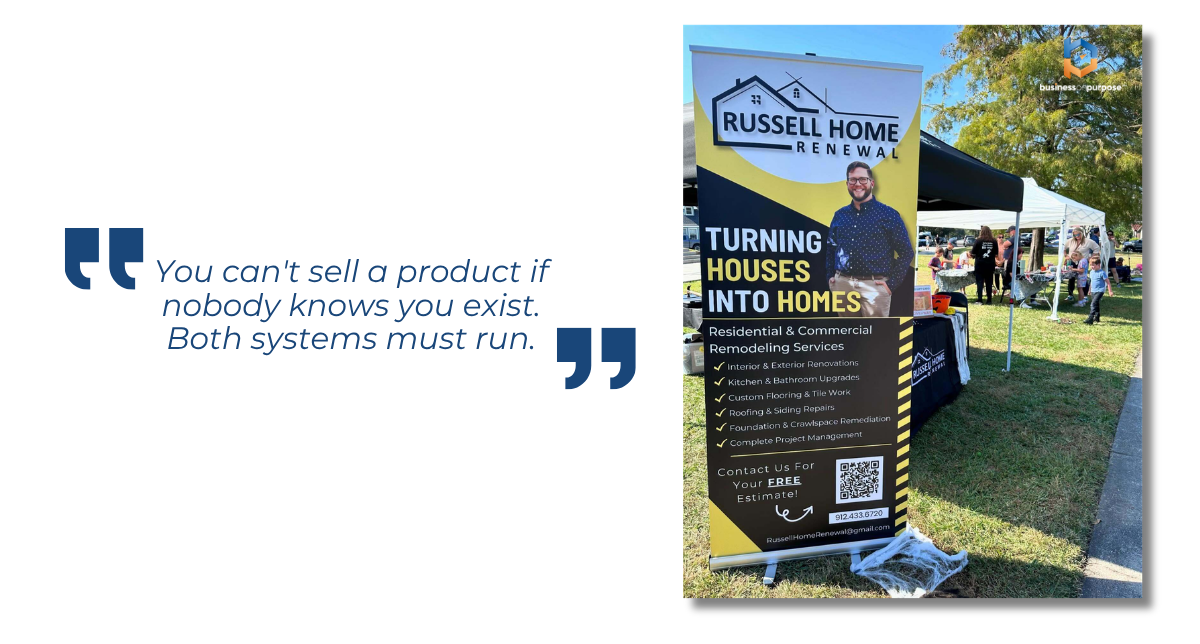
“You can’t sell a product if nobody knows you exist. Both systems must run.”
The System Has to Live Outside Your Head
Here is the truth that holds most small business owners back: the marketing and sales system is locked away in their heads. That means it only works when they are personally in the room. The moment you step away, it falls apart.
The goal is to document everything. Write down your marketing process. Write down your sales scripts. Write down the handoff steps. You want other people to market for you. You want other people to sell for you, so you can focus your energy on the things that actually require you.
That is how you build a business that runs without you. Not by working harder, but by building better systems that other people can follow, execute, and improve.
Ready to Build a Business That Runs Without You?
If you are tired of being the only one who knows how marketing and sales work inside your business, it is time to change that. Start by documenting your systems, building your scorecards, and holding that weekly meeting. And if you need a roadmap to pull it all together, we have built one for you.
Visit businessonpurpose.com/healthy to check the health of your business and take the first step toward a business that gives you your time and freedom back.
Scott Beebe is the founder of Business On Purpose (mybusinessonpurpose.com) and speaker for the AEC industry and author of the book Let Your Business Burn: Stop Putting Out Fires, Discover Purpose, and Build a Business That Matters. Business On Purpose works with business owners to articulate purpose, people, process, and profit to liberate owners from chaos and make time for what matters most.