You built a business, but most mornings it feels like you built yourself a job with a boss you can’t stand. The good news? The chaos you are living in is not a size problem. It is a systems problem, and it is completely fixable.
Here is a simple, practical starting point for building a business that runs and grows with or without you.
The Real Cost of Doing It All Yourself
About six months ago, I was invited to speak to a peer group of contractors in a small Midwestern town. These groups are fascinating to watch. For the first couple of hours, everyone shows their best self. Then around hour three or four, one person cracks and starts to show what is really going on under the hood.
In this particular group, there was a builder who had owned her company for about eight years. She had bought it from her father. When she gave her initial overview, everything sounded great. But about thirty minutes in, the real picture started to emerge.
She was working six and a half days a week. Her business was doing $7 million a year in revenue, and her net income was around $60,000 a year. I pulled her aside and told her honestly: either something has to change, or she might be better off getting a job. She could make more money, work fewer hours, and actually have margin for the things she loves.
It stung. But it also sobered her up.
A few months later, after implementing the strategies I am about to walk you through, she no longer works six and a half days a week. She works a normal five-day workweek. She is not sitting at her kitchen table doing estimates at 11:37 on a Friday night. She is with her family.
How did she do it? She learned to streamline her business with one operating system.
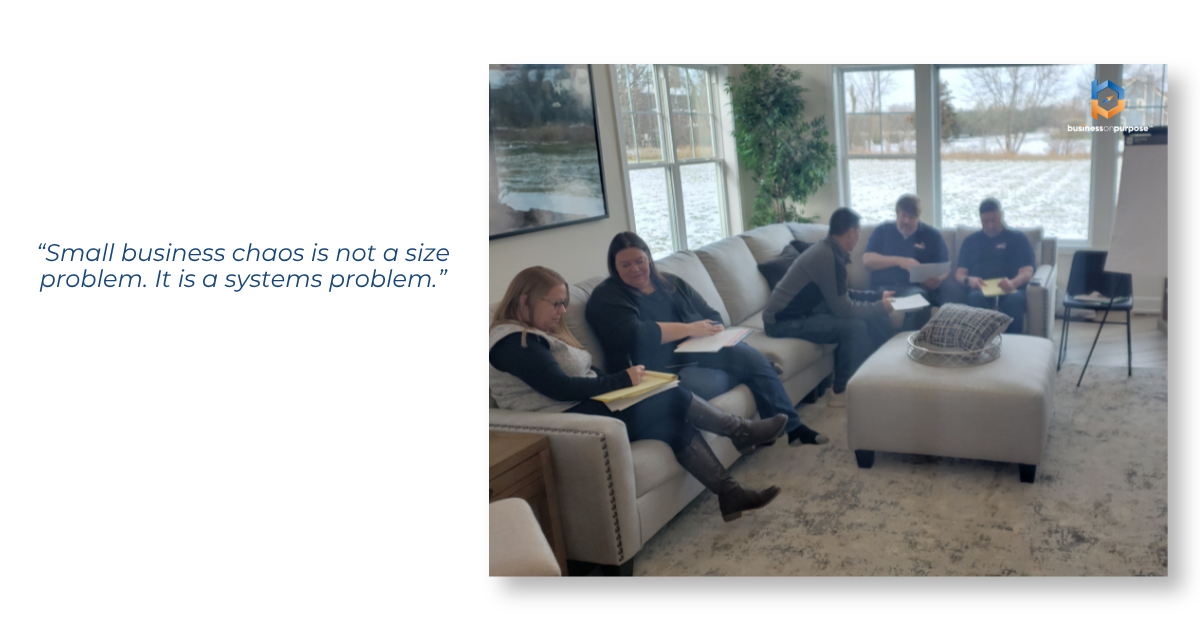
Small business chaos is not a size problem. It is a systems problem.
Lead Well.
If you're looking for more resources to work ON your business, we have them.
Stop Playing Hero, Victim, or Villain
Before we talk about solutions, let’s bust a myth. Most business owners play what I call “hero ball.” Researcher and author Brené Brown talks about above-the-line and below-the-line leadership, and most of us, myself included, tend to operate below the line in one of three ways.
First, we play the hero. We swoop in and save the day every single time.
Second, we play the victim. “Nobody understands how hard this is. They don’t see everything I am doing.” We whine and complain instead of fixing the root issue.
Third, we play the villain. We come in hot, scorch the earth, and declare that nobody can do it like we can and we are about to fire everyone.
All three of those roles keep you stuck below the line. What we need to do as leaders is operate above the line, where we coach, co-create, and challenge our teams in productive ways. But here is the truth: we cannot lead that way unless our business is systematized.
The main reason we fall into those below-the-line patterns is because too many of our business processes are what I call captive processes. These are the processes that live entirely in your head. How to pull a permit. How to clean up a job site. How to handle a certificate of insurance. They exist, but only in your brain, because you have been doing them since day one.
You have probably said it before: “Nobody can do it like I can do it.” The real reason that is true is not because you are uniquely talented. It is because the process is trapped inside your head and you have never shared it with anyone else. And on the rare occasion you did share it, you took it right back before they had a chance to actually do it.
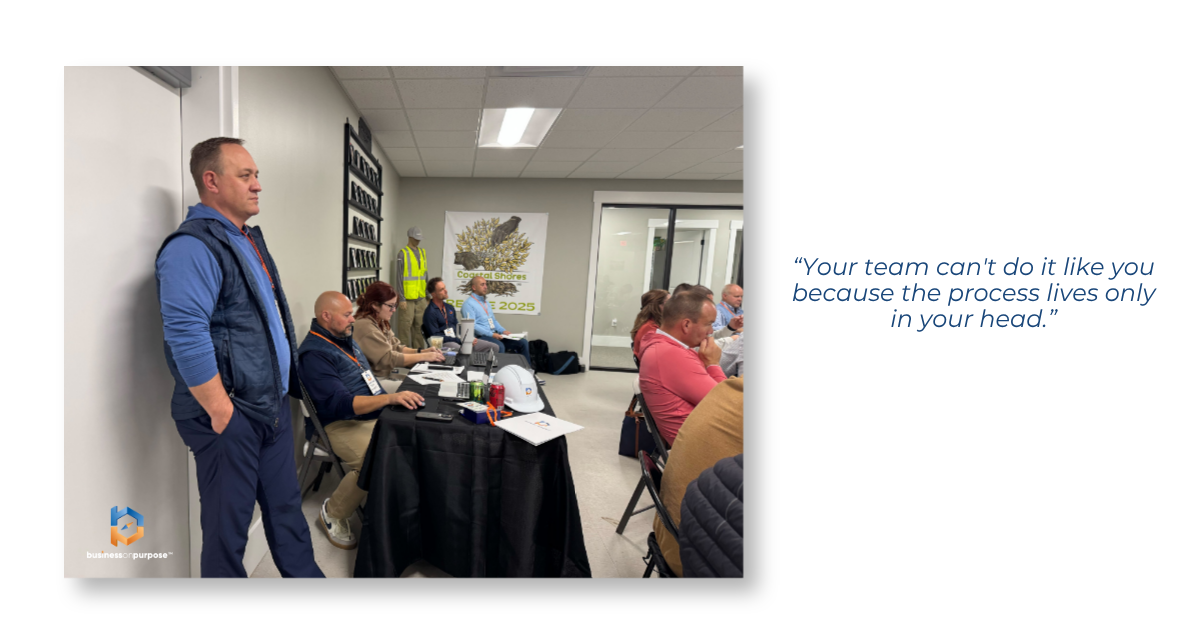
Your team can’t do it like you because the process lives only in your head.
The 80% Rule and the Ego Challenge
You have probably heard the leadership advice often attributed to John Maxwell: “If someone can do a task 80% as well as you, delegate it.” We all cheer for that idea in theory. But as a business owner, when you really sit with it, your brain fires back: “80%? That means 20% of the process could fail.”
That tension is real, and it is hard. Here is the mindset shift that has to happen: it may not be done perfectly at first, but over time it will be done just as well as you do it. And in some cases, here is the real ego check, it will actually be done better than you do it.
In our own business at Business On Purpose, we have a team of twelve full-time professionals, including seven full-time coaches. Those coaches are better coaches than I am today. Why? Because they have far more reps than I do. They are coaching clients right now while I am writing this. I have not taken on a new coaching client in four years. I am genuinely rusty at it.
That only became possible because about three years into our business, I started documenting every single client meeting to identify the patterns in what I was coaching on. I got those patterns into a system. Five years in, we hired our first full-time coach and used that system as his training. We have expanded it dramatically since then, but it started with the discipline of writing things down.
The Three Components of a Streamlined Business
To streamline a business that can run without you, you need to break the business down into three primary components.
Component One: The Operating System
Think about what happens when you hit the power button on your computer. It boots up because of an operating system. Without one, you just have a screen with a blinking cursor waiting for code. Your business needs an operating system in the same way.
At Business On Purpose, we call ours the BOPOS, or the Business On Purpose Operating System. We have identified about 29 to 30 distinct parts of that system, broken into four foundational cornerstones that every business needs: Purpose, People, Process, and Profit.
Under Purpose, for example, you have vision, mission, values, culture, and your employee handbook. Each of those is a module that helps build the operating system of your business. This is what people mean when they talk about working on the business instead of working in it.
Component Two: The Master Process Roadmap
Here is something that will shift your perspective: your product is not actually your product. The remodeling services, the electrical work, the specialty trade you provide, that is a commodity. Plenty of other businesses offer the same thing. What you are actually selling to the market is the process by which you deliver those things. Your process is your real product.
The Master Process Roadmap is simply a spreadsheet with four columns: Marketing, Sales, Operations, and Administration (which includes accounting and HR). Under each column, you write down the name of every process that exists in your business. That is it.
In Operations, you might have an electrical walk process, a job closeout process, a subcontractor onboarding process. In Marketing, you might have a website update process, a social media posting process, and a networking event outreach process. Write them all down. There may be hundreds. Start with tens if you need to.
Here is your homework. Set a timer for 15 minutes. Grab a sheet of paper. Write the four headers: Marketing, Sales, Ops, Admin. Then do a brain dump of just the titles of every process you can think of.
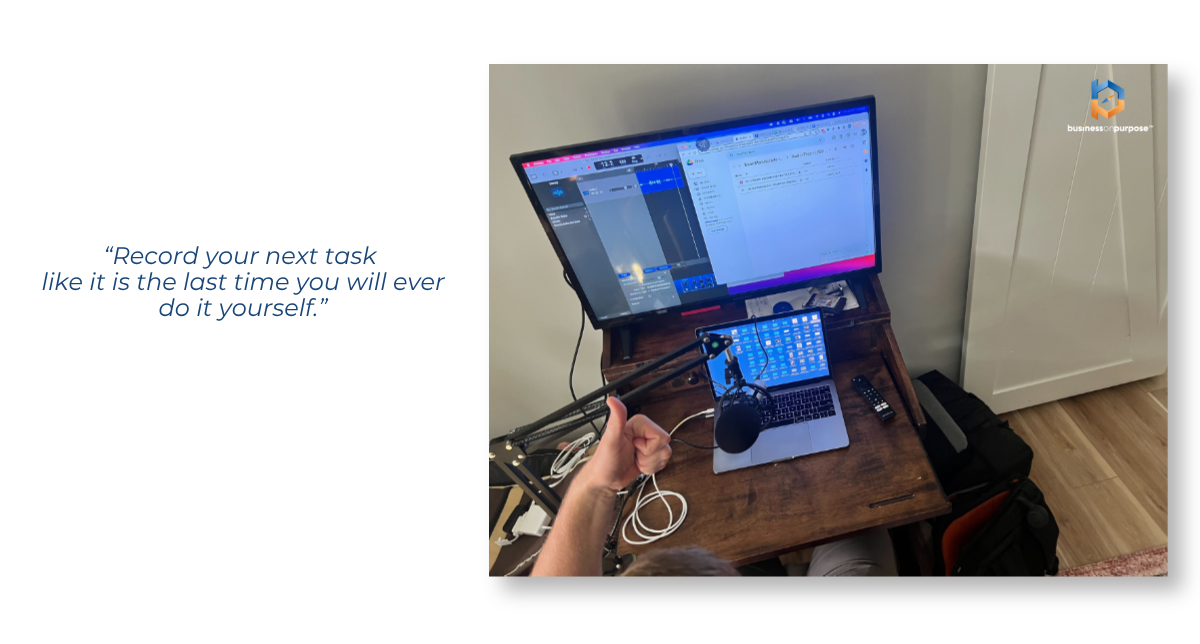
Then pick one. Specifically, pick the next task you are about to do. If you are about to run payroll, pick the payroll process. Then, while you are doing payroll, record yourself using screen capture software, your phone camera, or a voice memo. Talk through every single step like it is the last time you will ever do this task yourself.
From there, take that recording to an AI tool and say something like: “I want to create a process for payroll. Here are my pet peeves and non-negotiables around how this gets done.” Upload the recording, add your brand standards, and ask it to build you a written process, a video version, and an audio version. Then link that finished process back to the payroll box in your process roadmap spreadsheet.
The next time payroll needs to run, your team member opens that box, reads the process or watches the video, and they do it. If they have a question, they rewind the process. They do not need to come ask you, because you already covered everything.
Record your next task like it is the last time you will ever do it yourself.
Component Three: The Anchor
The third and often overlooked component is what we call the Anchor. This is how you give your team repetitive, predictable, and meaningful training around the processes you have built.
If you are not willing to train consistently, your team will not pick up the habits. All those processes you worked hard to document will remain captive, maybe slightly better organized on a sheet of paper, but still not actually being used. We have worked with many business owners who built out a solid process roadmap but never built the discipline to review and train on it regularly. The system sat unused, and nothing changed.
Building the system is step one. Anchoring it into your team through consistent training is what makes it stick.
Your Business Does Not Have to Run Your Life
The builder from that peer group did not transform her business overnight. But she started. She mapped her processes. She documented them one at a time. She built the discipline to train her team on them. And now she has her evenings and her weekends back.
That is what a business built on purpose looks like. Not one that runs you into the ground, but one that runs on systems so that you can show up as the leader your team needs and actually enjoy the life you set out to build.
The chaos is not permanent. It is just a sign that the systems have not been built yet. And that is something you can absolutely fix.
Ready to go deeper? Visit businessonpurpose.com/healthy to get the tools, resources, and support you need to build a business that runs without you.
Scott Beebe is the founder of Business On Purpose (mybusinessonpurpose.com) and speaker for the AEC industry and author of the book Let Your Business Burn: Stop Putting Out Fires, Discover Purpose, and Build a Business That Matters. Business On Purpose works with business owners to articulate purpose, people, process, and profit to liberate owners from chaos and make time for what matters most.