Most small business owners don’t micromanage because they’re control freaks. They micromanage because their team has no clarity. And there’s a big difference. Once you understand that distinction, everything about how you lead your team will change.
The Real Problem Behind Micromanagement
We worked with a client whose team was busy but deeply dissatisfied. When we sat down with their key leaders and asked the hard questions, a clear pattern emerged. The owner was the central nervous system of the entire business — telling everybody what to do, when to do it, and how to do it, over and over again.
The result? The team stopped thinking. They just started doing. And when people stop thinking, they stop growing. We’re human beings. We need to deploy our creative energy, solve problems independently, and contribute meaningfully. When that’s stripped away, people eventually move on.
To his credit, this owner recognized the pattern and began delegating in a way that built accountability instead of dependency. Here’s exactly how he did it — and how you can too.
Unpredictability is the main ingredient in micromanagement.
Lead Well.
If you're looking for more resources to work ON your business, we have them.

The Seesaw Predictability: Micromanagement vs. Healthy Leadership
There is a big myth around micromanagement. Healthy leadership is often misdiagnosed as micromanagement, especially in a culture that has grown a little softer when it comes to holding people to standards. When a leader gives feedback or pushes back, it can feel like micromanaging when it’s actually a tool for growth. We have to be careful not to confuse the two.
Here’s a simple way to think about it. Picture a seesaw. On one side sits a question mark. On the other side sits a clock. The balance point is the right question at the right time.
If you ask the wrong question at the right time, the seesaw tips. For example, walking into a sales meeting and asking for sales reports from 12 years ago. That’s the wrong question. But flip it around — texting a team member at 11:37 on a Friday night asking for last week’s sales report. That’s the right question at the completely wrong time. Both situations create the same result: unpredictability.
When someone feels micromanaged, it’s because something unexpected happened. But here’s what healthy leadership actually looks like. You tell your team in advance that prior month reporting is reviewed in the first week of the following month, and all details are due by the last Friday of the month. If someone doesn’t submit on time, holding them accountable to that is not micromanagement. It’s leadership. The expectation was set, communicated, and agreed upon.
Micromanagement Is the Smoke, Not the Fire
If you think like a doctor or a psychologist, you start to see micromanagement not as the problem itself but as a symptom. It’s someone saying “ouch,” but the real fracture underneath hasn’t been addressed.
Too often, business owners try to solve the emotional discomfort of micromanaging without fixing the root cause. And the root cause is almost always the same thing: a lack of documented, trained, and accountable processes.
Write those three words down. Documented. Trained. Accountable.
You can document a process without training it — and if you haven’t trained it, you can’t hold anyone accountable to it. You can train a process without documenting it — but if it’s not written down or recorded somewhere, accountability is impossible to maintain consistently. And you can try to hold people accountable to a process that only lives in your head, but we call that a captive process. It’s locked behind the bars of your own mind, and no one else can access it.
If you ever want to grow your team or transition out of your business, you have to liberate those processes. Yes, someone might not do it exactly the way you would. But at some point, we have to get over our ego around that.
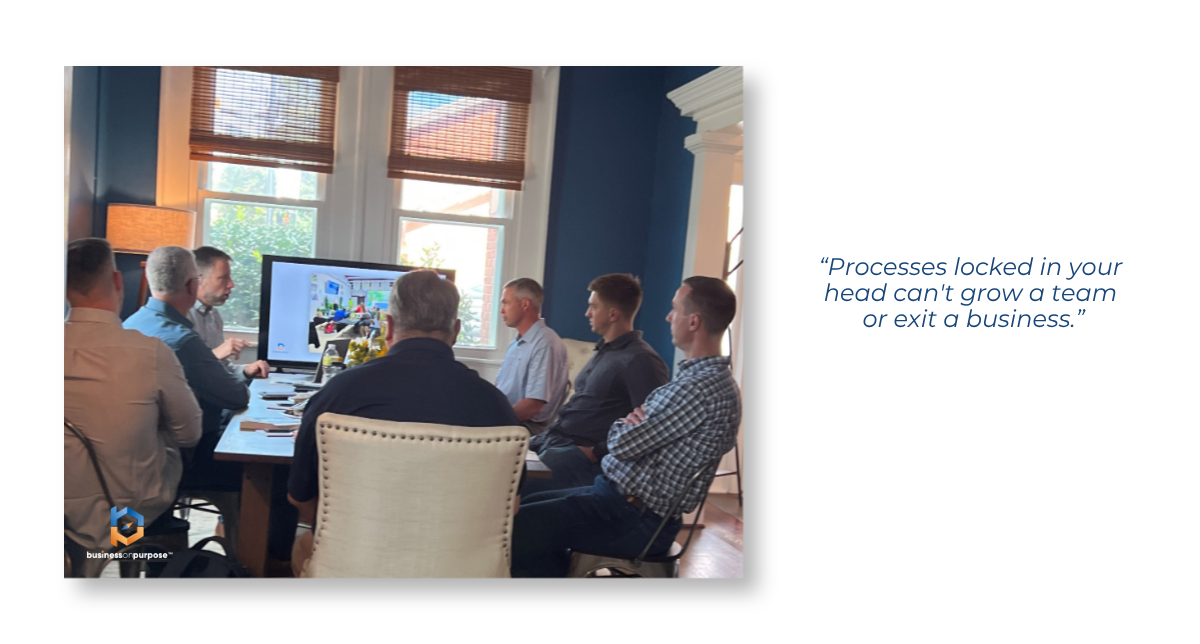
Processes locked in your head can’t grow a team or exit a business.
The Three Things That Breed Micromanagement
Micromanagement doesn’t appear out of nowhere. It grows in specific conditions. Here are the three most common breeding grounds:
1. No org chart. People don’t know where they fit in the organization.
2. No defined job role. People don’t know what they’re being asked to do.
3. No scorecard. People don’t know what they need to do daily, weekly, monthly, or quarterly.
When those three things are missing, you as the owner will step into every single one of those gaps to make sure things get done right. That’s not a character flaw. It’s a structural problem.
When you flip it around and build a proper org chart, define clear job roles, and create a scorecard that builds accountability recurrence around specific tasks, you create the right conditions for healthy leadership instead.
A quick note on org charts: keep them role-first, people-agnostic. You don’t need names on an org chart. You need roles. Every business has four core systems: marketing, sales, operations, and admin. Map your roles to those four systems. Once the roles are identified, the role tasks become clear. Once the tasks are clear, you can build a scorecard. It’s that straightforward.
Deputize Your Team Like Moses Did
There’s an Old Testament story worth knowing here. Moses was leading millions of people out of Egypt, and he was spending his entire day as the sole judge for everyone’s disputes. His father-in-law came to visit, watched him work all day, and basically said, “This is completely unsustainable. You need to find 50 or 150 other people and delegate some of this authority.”
A lot of business owners are sitting in that same seat right now. They’re trying to manage everything and everyone themselves when what they really need to do is deputize. Start with one, two, or three key people. Give them the org chart, the job role, the scorecard. Then scale from there.
The One-on-One Check-In: Where Accountability Actually Happens
Once you have the structure in place, you need a consistent touchpoint where the accountability actually shows up. We call this the one-on-one check-in, and it’s simpler than you think.
Meet with each of your direct reports at least twice a month. Not everyone in the company — just your direct reports. If everyone in the company is your direct report, that’s a separate problem that delegation can solve.
Here’s what to cover in each 15 to 20 minute meeting:
Big Wins: Start by asking for a big win from the last week. BIG stands for Begin in Gratitude, an idea from Dan Sullivan. This takes about 30 seconds and sets the right tone.
Scorecard Review: Walk through the scorecard together. Ask if they have any questions. Share your observations. Make sure accountability is happening in real time.
Open Questions: Ask what they’re seeing right now. Ask what blind spots might exist. Ask what they need from you.
Your Expectations: Close with “Here’s what I need from you.” This is not micromanagement. It’s expected. Both of you know this conversation is coming twice a month. There’s nothing unpredictable about it.
The right questions at the right time, in a structured and expected format. That’s what balanced leadership looks like in practice.
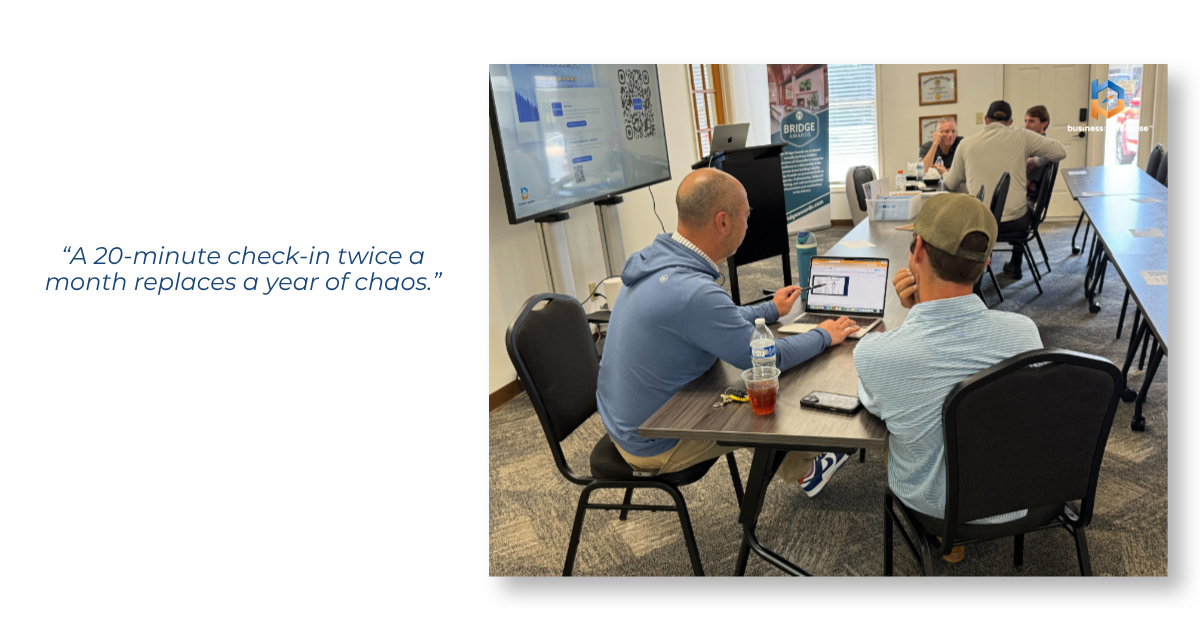
A 20-minute check-in twice a month replaces a year of chaos.
Stop Micromanaging. Start Leading.
If you want to hold your team accountable without hovering over every decision, the path forward is clear. Build the structure: org chart, job roles, scorecards. Free your processes from captivity. Identify who your direct reports are and start meeting with them consistently. Ask the right questions at the right time, in a predictable and documented way.
Accountability is not about control. It’s about clarity. Give your team clarity, and you’ll never have to micromanage again.
If you keep micromanaging, you’ll keep living in chaos. That’s not what we want for you. Our mission at Business On Purpose is to liberate you from that chaos so you can make time for the things that matter most.
Ready to take the next step? Visit businessonpurpose.com/healthy to get the tools and training you need to build a business that runs without you.
Scott Beebe is the founder of Business On Purpose (mybusinessonpurpose.com) and speaker for the AEC industry and author of the book Let Your Business Burn: Stop Putting Out Fires, Discover Purpose, and Build a Business That Matters. Business On Purpose works with business owners to articulate purpose, people, process, and profit to liberate owners from chaos and make time for what matters most.