Most small business owners who micromanage are not control freaks by nature. They are simply operating in a vacuum where no one knows what to do next, so the owner steps in every time. In this post, we are going to break down exactly how to build real accountability into your business so you can stop hovering and start leading.
The Real Reason Micromanagement Happens
Here is something worth sitting with: micromanagement is not the root problem. It is a symptom. It shows up when there is a vacuum inside the business that has not been filled. Your team is unclear on what they should be doing, when they should be doing it, and how decisions should be made. So you step in. Every time.
We once walked into a contracting business and sat down with one of the key leaders. When we asked him what the biggest roadblock in the business was, he did not hesitate. He pointed straight at the owner’s office and said, “That guy.”
That owner deserves real credit, though. When he heard that feedback, he made a decision. He wanted to build a business that could run and grow with or without him at the center of it. He had to set aside his ego, confront the habit of micromanagement, and realize that being the bottleneck does not make you the hero. It makes you the villain. And over time, it corrodes the culture from the inside out.
If you recognize yourself in that story, that is okay. Admitting it is the first step. But now let’s do something about it.
Being the bottleneck does not make you the hero. It makes you the villain.
Lead Well.
If you're looking for more resources to work ON your business, we have them.

Zoom Out First: Understand How Your Business Actually Works
Before we can solve accountability, we need to understand the whole organism. Think of it like medicine. A physician cannot diagnose a symptom without understanding how all the systems of the body interact. The skeletal system, the cardiovascular system, the endocrine system. If you do not understand the whole, you cannot treat the part.
Your business works the same way. It is an organism made up of interconnected systems. At Business On Purpose, we organize those systems into three major categories.
First: The Operating System. This is the foundation. Just like your phone needs an operating system to function, your business needs one too. Without it, your team is staring at a blank screen waiting to be told what to do. We organize this around four cornerstones: Purpose, People, Process, and Profit.
- Purpose covers vision, mission, values, and your culture handbook.
- People covers org charts, job roles, and hiring processes.
- Process sets the stage for how work actually gets done.
- Profit covers cash, budgets, dashboards, and accounting systems.
Second: The Master Process Roadmap. This is the home for your four core business systems in this order: Marketing, Sales, Operations, and Administration. Marketing must come before sales. Sales must come before delivery. Operations must come before administration. That sequence matters.
Third: The Anchor. This is a recurring cycle that ensures everything built in your operating system and process roadmap gets trained, reviewed, and held accountable on a regular schedule. Think of it as the heartbeat of your business.
You have the tools to run the business, the processes to deliver the product, and the recurring rhythm to make sure all of it actually gets done.
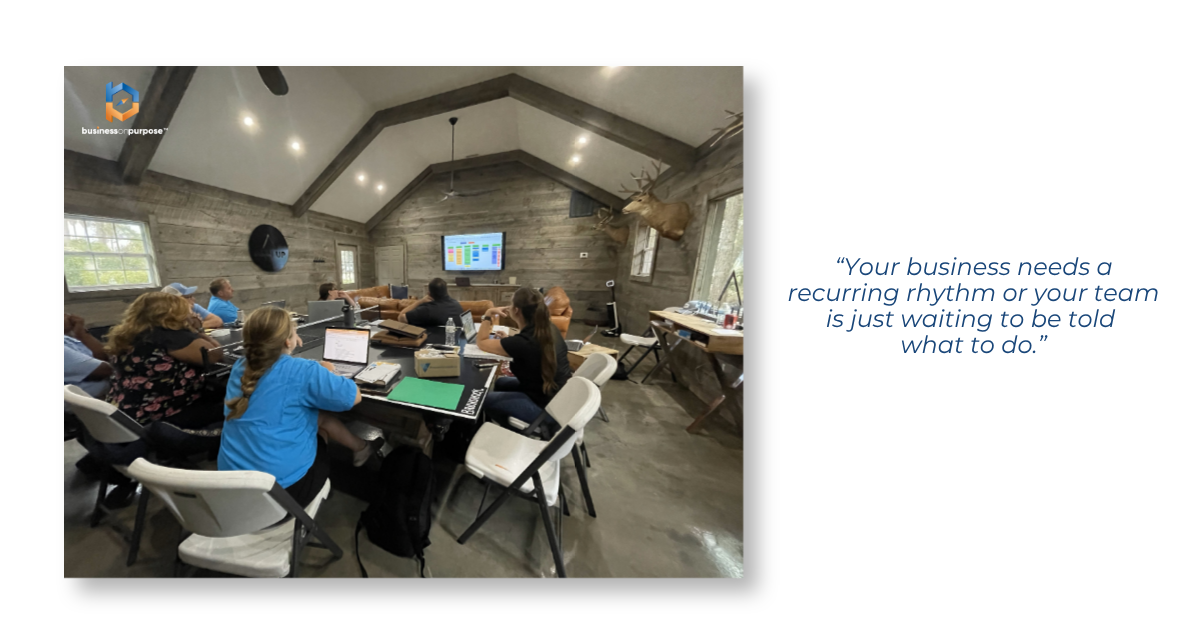
Your business needs a recurring rhythm or your team is just waiting to be told what to do.
The Role Scorecard: Your Accountability Game-Changer
Now let’s zoom in to where the rubber meets the road. Inside the People vertical of your operating system lives one of the most powerful tools for eliminating micromanagement: the Role Scorecard.
Here is how it works. Once you have an org chart showing what roles exist in your business, you create a detailed job role for each position outlining exactly what tasks that person is responsible for. Then you take it one step further. You ask: how often does each task need to happen? Daily? Weekly? Monthly? Quarterly?
That is your Role Scorecard. And you do not need expensive software to build one. A simple spreadsheet works perfectly. With AI tools available today, you can even paste in a job role and ask it to organize every task by frequency across 52 weeks of the year.
The result? Your team member does not just know what they are responsible for. They can see when to do it, laid out in front of them for the entire year. That is clarity. And clarity is the cure for micromanagement.
Close the Loop With the Big Five Feedback Meetings
A Role Scorecard without accountability check-ins is like a road map with no GPS signal. You need both. That is where what we call the Big Five Feedback Loop comes in.
These are the five meeting structures that, when all in place, create a closed-loop accountability system where information does not fall through the cracks:
- Once-weekly team meetings
- Once-weekly departmental meetings
- Twice-monthly executive meetings
- Twice-monthly one-on-one check-ins
- Once-annually performance reviews
The one-on-one check-in is especially powerful when paired with the Role Scorecard. Here is how to run one in 15 to 20 minutes, twice a month:
- Start with a big win. Spend 30 seconds asking for one personal or professional win since you last connected.
- Review the scorecard briefly. Any questions? Any gaps? Any roadblocks? Two to three minutes, no more.
- Ask four key questions:
- What are you seeing and thinking right now?
- What blind spots do I have that I might not be seeing?
- What do you need from me?
- Here is what I see, and here is what I need from you.
These four questions create a two-way accountability conversation. Your team member has a voice. You have a voice. And both of you leave the meeting with clarity on what comes next.
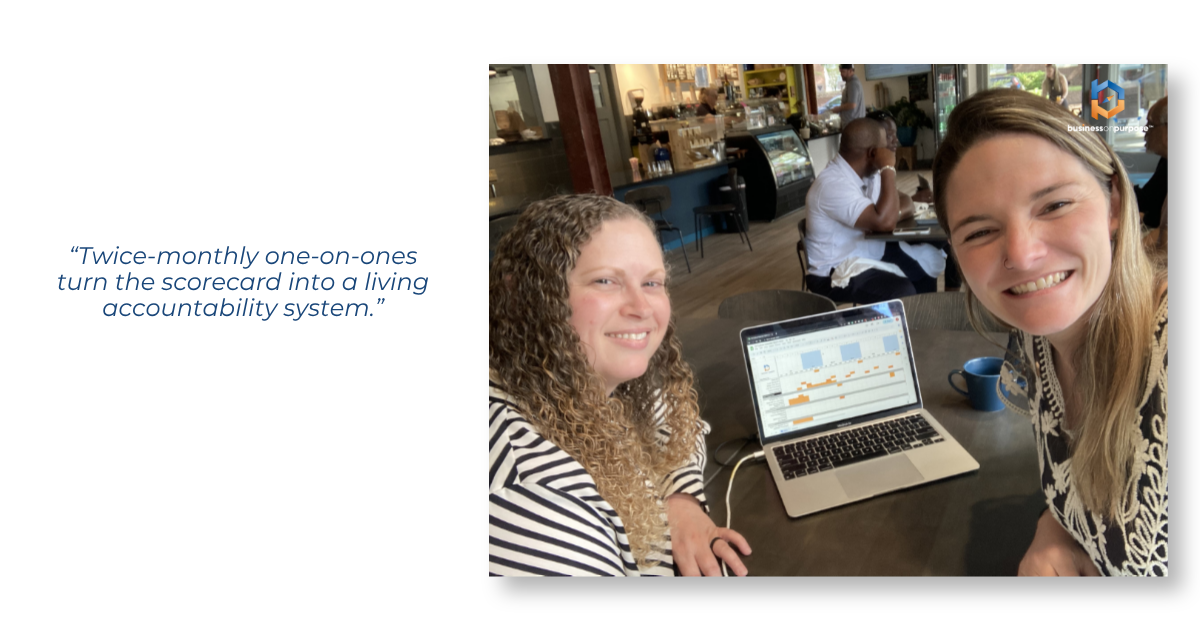
Twice-monthly one-on-ones turn the scorecard into a living accountability system.
Deputize, Do Not Hover
One more critical piece: you cannot have one-on-ones with everyone if everyone reports directly to you. That is just micromanagement with a calendar invite attached to it.
The goal is to deputize key leaders on your team. Think about how a sheriff’s department works. The sheriff does not handle every call. They deputize others, giving them not just responsibility but the authority to make decisions on their behalf.
In our own team of 12, there are three people who I spend the majority of my leadership time with. Those three individuals oversee the remaining eight. I am not the hub of every conversation. That is the goal for your business too.
Start by identifying who on your team could step into that kind of role. Give them a clear job role, a Role Scorecard, and the authority to lead their slice of the business. That is how you build a business that runs and grows with or without you.
Stop Living in Chaos
Many business owners, especially in contracting and trades, live their daily lives in complete chaos. Every day is reactive. Every decision runs through you. Every problem lands on your desk.
But it does not have to be that way. When you build a documented operating system, equip your team with Role Scorecards, run consistent one-on-one check-ins, and deputize leaders within your organization, you stop being the bottleneck and start being the visionary leader your business actually needs.
Accountability without micromanagement is not magic. It is structure. And structure sets your team free.
If you are ready to build a business that runs without you, head over to businessonpurpose.com/healthy and take the first step toward a healthier, more liberated business.