Let’s clear something up right from the start: marketing always comes before sales. The correct order is marketing, then sales, then operations, then administration. With that settled, here’s how to make these two disciplines work as a team instead of in silos.
Marketing and Sales Are Not the Same Thing
Here’s a simple way to think about it. Marketing tells the world you exist. Sales converts the right people in that world into paying clients. They are two distinct disciplines with two distinct outcomes, but they are deeply dependent on each other.
Sales without marketing is just cold calling forever. Marketing without sales is spending money with no revenue coming in. That is the trap too many small business owners fall into, and it almost always happens because the two functions never actually talk to each other.
At Business On Purpose, we work with a lot of businesses under 100 employees. In most of them, there is no formal marketing department. It is one person, maybe a small group, and often the owner themselves who is out there developing leads and trying to close them at the same time. The result is a big messy overlap where nobody has clarity on what they are supposed to be doing.
“Marketing tells the world you exist. Sales converts the right people.”
Lead Well.
If you're looking for more resources to work ON your business, we have them.

The Dangerous Gap Between Your Marketing Team and Your Sales Team
Here is something we see all the time. A business owner outsources marketing to an agency. The agency runs paid ads, handles messaging, places print advertising, and does all the tactical work. Meanwhile, someone on the inside is trying to close the leads that come in. The problem? Those two parties never talk.
When marketing and sales do not communicate, a critical exchange of information breaks down. Marketing learns what messaging resonates from the actual sales conversations. Sales gets the prospects it needs from marketing. When that feedback loop is broken, both sides operate blindly.
The handoff between a prospect and a booked appointment is one of the most delicate moments in your entire business. It requires both sides to be aligned, aimed in the same direction, and working from the same plan.
Boiled Down to the Basics
When you strip marketing and sales down to their simplest form, here is what you get:
Marketing develops leads and prospects. It identifies where your ideal clients gather, shows up in those places consistently, and builds a database of names, phone numbers, and emails. The one result marketing is responsible for is a booked appointment.
Sales takes those leads and converts them into clients. It walks prospects through a methodical process that leads to a clear yes or a clear no. The one result sales is responsible for is closed clients.
Notice each function has one result. Not several. One. When you try to blend marketing and sales into a single undefined mess, you lose clarity on the actions required and the outcomes expected. You have to have both, and both need to be clearly defined.
“Marketing has one result: a booked appointment. Sales has one result: a closed client.”

Two Tools That Keep Marketing and Sales Aligned
So how do you actually get marketing and sales communicating on a regular basis? There are two tools that make a real difference.
Tool One: The Scorecard
A scorecard is built around Key Performance Indicators, or KPIs. These are the specific actions and activities each function is responsible for tracking every week.
On your marketing scorecard, you might track things like the number of networking groups you attended, the number of new prospect contacts collected, and the number of booked appointments generated.
On your sales scorecard, you might track the number of appointments held, how many prospects moved to a next step, how many follow-up actions were completed, and ultimately how many leads converted into clients.
These scorecards create visibility and accountability. When everyone can see the numbers, everyone knows where the gaps are.
Tool Two: The Weekly Marketing and Sales Meeting
Once a week, one hour, agenda-driven, and leader-led. That is all it takes to keep marketing and sales on the same page.
At Business On Purpose, our weekly marketing and sales meeting happens every Monday at 4:15 PM. Here is how the agenda runs:
Celebrate big wins (3 to 5 minutes)
Review marketing and sales goals for the period
Marketing update covering actions, activities, and results
Sales update covering actions, activities, and results
Action items and next steps before the next meeting
That is it. Ours actually wraps up in about 45 minutes. We run 50 of those meetings a year, and in those 50 meetings we build real unity between our lead generation efforts and our client conversion efforts.
The Systems Mindset: Training Your Team Year-Round
Here is a best practice that takes everything to the next level: proactive, year-round training.
Think about how elite athletes or military units operate. When they are not competing or on a mission, they are training. In business, most owners skip this almost entirely.
Start with a simple spreadsheet. We call it an anchor. List 52 weeks across the top and different training categories down the side: marketing training, sales training, operations training, HR training, and so on. In each box, fill in the specific topic you want to cover that week.
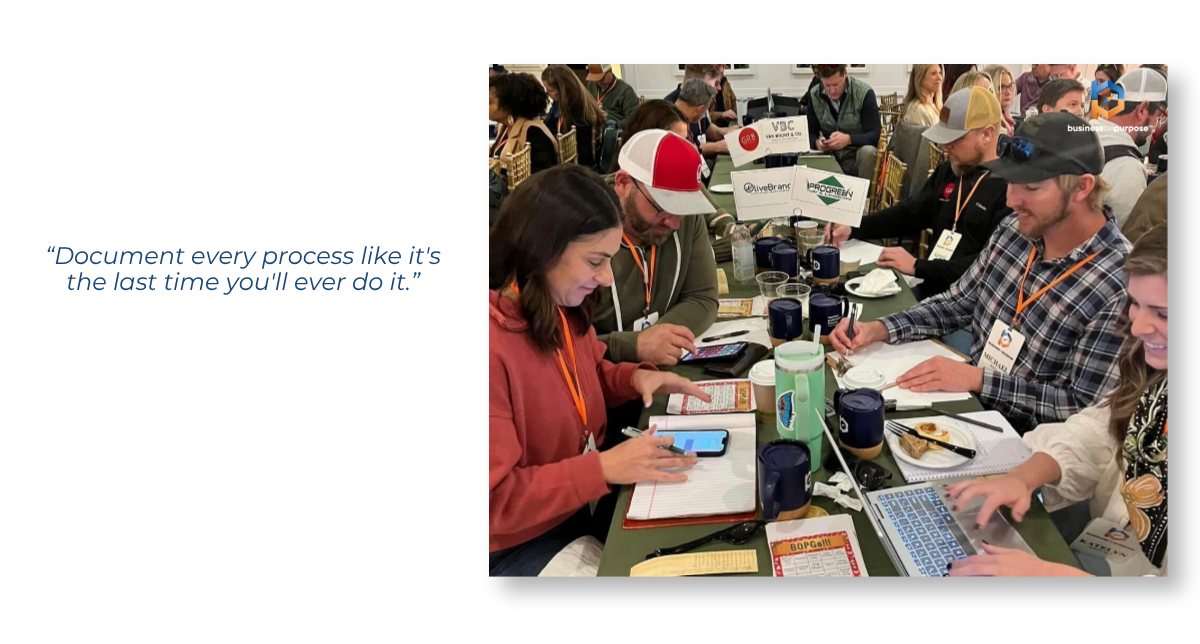
If that sounds overwhelming, here is the best way to start. The next time you do any process, document it like it is the last time you will ever do it. Then run that documentation through an AI tool and let it turn your notes into a structured training module. Simple, fast, and repeatable.
For example, at Business On Purpose we speak at Build Expos around the country. We have a 10-page document covering everything a team member needs to know before attending one. New team members read the full document before their first expo. Returning team members read the summary before each one. That is how you maintain consistency without hovering over your team.
“Document every process like it’s the last time you’ll ever do it.”
What You Are Really Building
When you put all of this together, you are not just organizing your marketing and sales. You are building a system that creates predictability in your revenue.
Scorecards give your team accountability. A clear distinction between marketing and sales gives everyone defined roles. A weekly meeting gives both functions a rhythm of communication. Repetitive, meaningful training gives your people the skills to perform consistently over time.
And here is why all of this matters: you want a business that runs and grows with or without you. You cannot get there while living in chaos. You get there by creating systems that other people can follow, even when you are not in the room.
The goal is to be liberated from the daily grind of chasing leads and closing deals yourself, so you can make time for the things that matter most in your business and in your life.
Ready to Build a Healthier Business?
If you are ready to take your marketing and sales from a chaotic guessing game to a predictable, system-driven engine, start by visiting businessonpurpose.com/healthy. You will find the tools, resources, and support you need to build a business that truly runs without you.