If your Monday through Friday feels like one long sprint with no finish line, you are not alone. Most small business owners are not failing because of bad people on their team. They are failing because their processes are broken or do not exist at all. Here is how to change that.
The Real Problem Is Not Your People
Think about your average week. You are reacting to everything. Fires everywhere. Customers calling. Jobs falling through the cracks. You look around and start pointing fingers at the people on your team.
But here is what we have seen working with hundreds of small business owners: the people are rarely the problem. The process, or the lack of one, is almost always the culprit.
We worked with a remodeler who is a perfect example of this. Every time he started a new project, he ran it like it was the first project he had ever touched. He was reinventing the wheel every single time. Sound familiar?
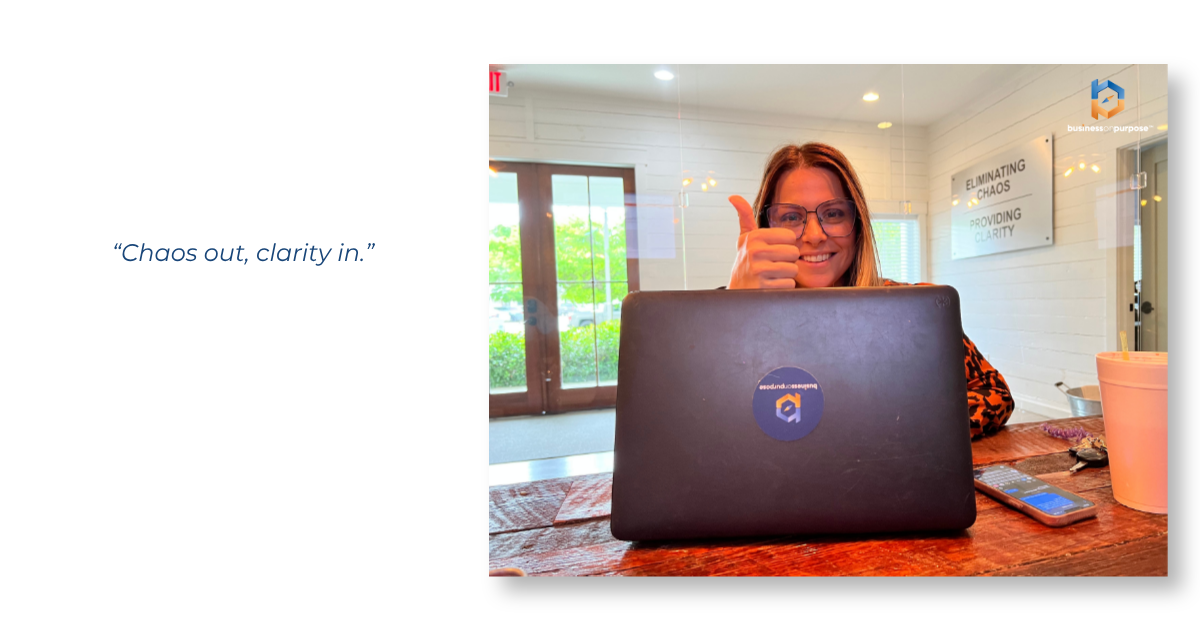
Remodeling is already unpredictable. You pull the sheetrock off the wall and you have no idea what is hiding behind it. But when we introduced this contractor to a proper process framework, something remarkable happened. Even with all the unpredictability of remodeling, every project started running the same way. Chaos out. Clarity in.
“Chaos out, clarity in.”
Lead Well.
If you're looking for more resources to work ON your business, we have them.
From Gig to Business: The Four Cornerstones
A lot of people get into contracting or small business because they want freedom. They want to be the boss. They want to call their own shots. And that spirit is great. But at some point, you have to stop treating your business like a gig and start running it like an actual business.
So what is the difference? A real business can be identified, led, and run like its own living organism. It does not need you personally executing every single step.
That transformation starts with what we call the Business Operating System. It is built on four foundational cornerstones:
- Purpose – Your vision, mission, values, and the direction your business is heading.
- People – How you interact with your team. Org charts, job roles, ideal weekly schedules, hiring, and onboarding.
- Process – The four core systems of every business: marketing, sales, operations, and administration.
- Profit – Your financial dashboards, subdivided cash accounts, reporting, budgets, and performance calculators.
Before you say “I only have three employees” or “I’m just in construction” — this framework applies to you regardless of your business size or industry. Too many business owners run their companies like a hobby. It is time to run yours like a business.
The Master Process Roadmap: Where the Real Work Happens
The second major tool is what we call the Master Process Roadmap. This is where you are going to invest your time when it comes to streamlining how your business actually runs.
Here is how it works in practice. Start with those four core systems: marketing, sales, operations, and admin. Then ask yourself a simple question: which process is giving you the most indigestion right now? Is it estimating? Payroll? Business development? Start there.
Here is a real example from just this past week. We have a client who runs an architecture firm. Their biggest challenge was business development, specifically how to consistently bring in new clients. Here is exactly what we did:
- We sat down with the person in charge of business development and asked them to walk us through every single step involved in their process from prospecting all the way to contract signing. We just let them talk while we typed it all out.
- We took all of that content and brought it into an AI tool, creating a dedicated agent specifically for their business development workflow.
- We told the AI agent to build an SOP that operates the same way every single time, and to also generate instructions for how to embed that workflow into their existing software.
The result? A complete, documented standard operating procedure for business development. Every new prospect now goes into their software, and the system guides the process automatically from that point forward.
The whole thing took 58 minutes from start to finish.
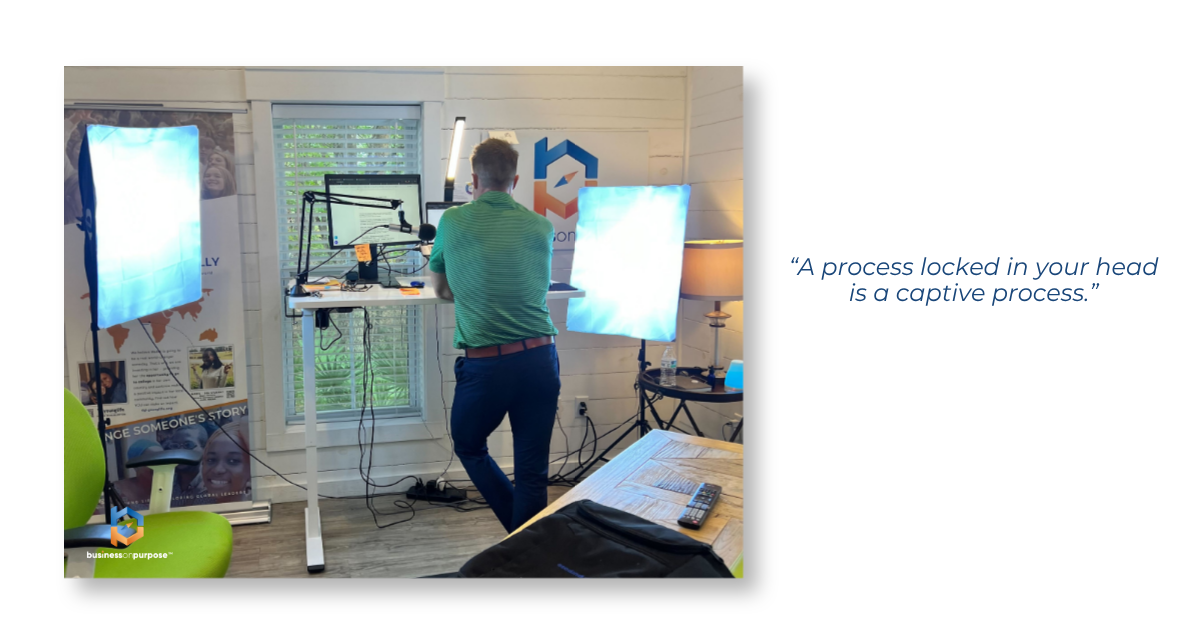
“A process locked in your head is a captive process.”
The Systems Mindset: Record It Like It’s the Last Time
You do not need to be a tech expert to start building your processes. You just need to adopt what we call the systems mindset.
The principle is simple: the next time you do anything in your business, whether it is pulling a permit, submitting plans, running payroll, or handling certificates of insurance, record it like it is the last time you will ever do it.
Hit record on your phone. Walk through what you are doing out loud. That recording becomes the foundation for your SOP. Then hand it off to an AI tool to turn it into a clean, structured process document your team can actually follow.
Once you start capturing processes this way, you stop being the bottleneck. Your team stops guessing. And your business starts running with a consistency that does not depend on you being in the room.
The Anchor: Making Sure It All Sticks
Building a great process document is only half the battle. The other half is making sure your team actually trains on it and uses it. That is where the third major tool comes in: the Anchor.
Think of it like a climbing anchor pinned at the top of a rock face. Every lead rope depends on it holding firm. If it comes loose, everything below it fails. Your processes are those lead ropes. The Anchor is the system that keeps everything connected and secure.
The Anchor creates repetition, predictability, and meaning around your standard operating procedures. It gives you a structured schedule to revisit and retrain on each process, whether that is every three weeks, every eighteen weeks, or whatever cadence fits your business. That consistency is what turns a documented process into an embedded part of your company culture.
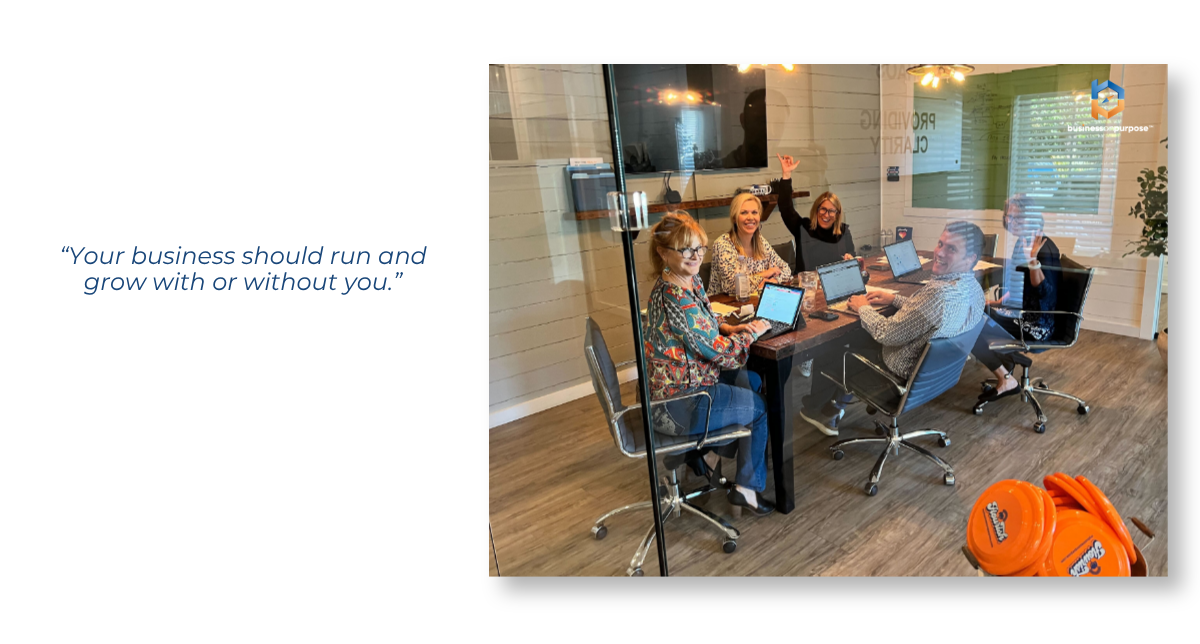
“Your business should run and grow with or without you.”
Get Out of Chaos for Good
Here is the truth about most contractor and small business owners: they are living in chaos every single day. And it is not because they are bad at their craft. It is because no one ever taught them how to build the business infrastructure that makes everything run without them.
The path forward is clear. Build your operating system. Document your processes using the Master Process Roadmap. Use the Anchor to train your team consistently. And use tools like AI to do the heavy lifting faster than you ever thought possible.
When you do this work, you get your time back. You get your sanity back. And you build something that truly runs and grows even when you are not in the room.
That is the goal. And it is more achievable than you think.
Ready to Build a Business That Runs Without You?
If you want to go deeper on the Business Operating System, the Master Process Roadmap, and the Anchor, visit businessonpurpose.com/healthy. It is the best first step toward building a business that does not depend on you for every single thing.
Scott Beebe is the founder of Business On Purpose (mybusinessonpurpose.com) and speaker for the AEC industry and author of the book Let Your Business Burn: Stop Putting Out Fires, Discover Purpose, and Build a Business That Matters. Business On Purpose works with business owners to articulate purpose, people, process, and profit to liberate owners from chaos and make time for what matters most.