The Missing Instruction Manual in Your Business
You know the reason your business cannot run without you? Because you do not have an instruction manual.
Even Legos come with instruction manuals, but your million-dollar business does not have one. Why not?
Think about that for a moment. When we buy something like a Lego set or furniture from IKEA, we expect a clear guide. We even get frustrated when it is missing. Yet when it comes to something far more complex, like a business, we often rely on memory, instinct, and constant oversight.
That creates confusion, inconsistency, and burnout.
A Simple Lesson From Legos
I remember when my son was growing up. He loved building things, especially Legos. One Christmas, he received a large Star Wars Lego set. It had hundreds of pieces and looked incredibly complex.
A couple of hours later, he came downstairs and said he was done.
We were shocked.
We walked upstairs and there it was, fully assembled. Perfect.
How did he do it?
He followed the instruction manual.
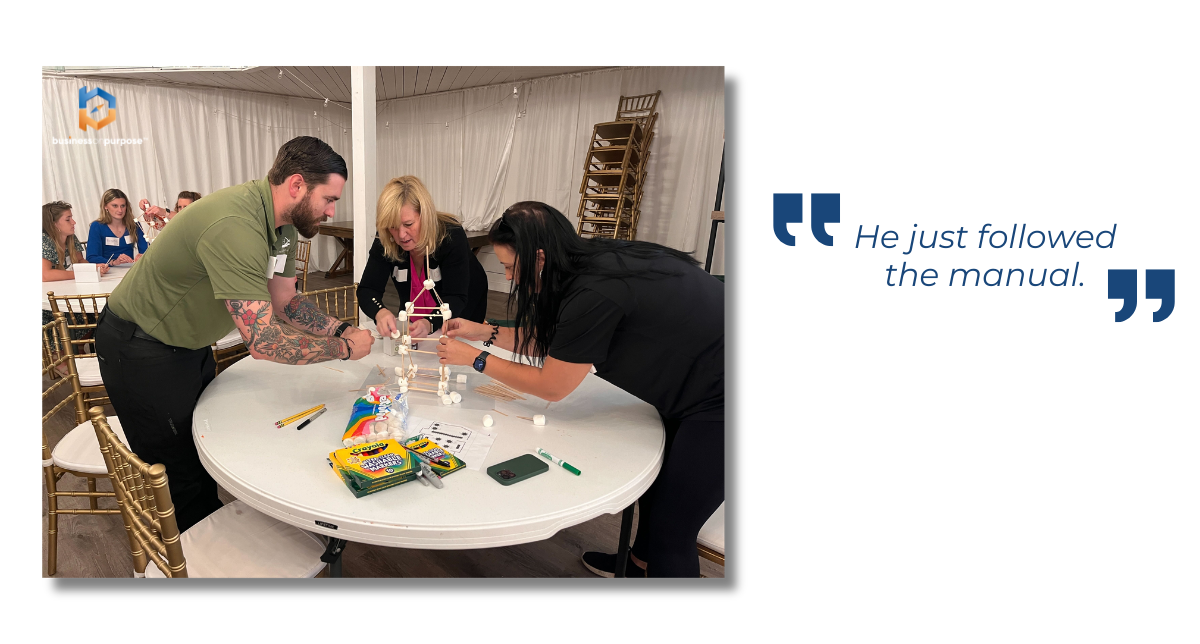
“He just followed the manual.”
Now compare that to your business. It is far more complex than a Lego set, yet most businesses operate without any clear instructions at all.
Lead Well.
If you're looking for more resources to work ON your business, we have them.
What Happens Without a Clear System
A client once shared an exercise from an event he attended. Everyone in the room was given the same Lego pieces and asked to build a duck. No instructions were provided.
After two minutes, every duck looked different.
Then they repeated the exercise, this time with instructions.
Every duck looked exactly the same.
“When we don’t create clarity, we cause confusion.”
This is exactly what happens in business. Without a defined operating model, every team member does things differently. That leads to inconsistency, frustration, and the classic thought:
“If they cannot do it like I do, I will just do it myself.”
What Is a Business Operating Model
A business operating model is your instruction manual.
It is the system that defines how your business runs, who is involved, what they do, and how everything connects.
Every business operates on four foundational cornerstones:
1. Purpose
Where you are going
2. People
Who is helping you get there
3. Process
How the work gets done
4. Profit
The fuel that keeps the business running
Together, these form a complete system.
Inside that system, you also have key functional areas:
• Marketing
• Sales
• Operations
• Administration
Each of these requires its own processes and structure.
“Without an operating model, you don’t have an asset, you just have a job.”
Macro vs Micro: How Your Business Runs
To build a strong operating model, you need to understand two levels:
Macro Level
These are the tools that run the business:
- Vision
- Mission
- Core values
- Culture
- Employee handbook
Micro Level
These are the processes that run the product or service:
- How you market
- How you sell
- How you deliver
- How you handle admin and finances
Both levels must be documented and aligned.
Building Your Operating Model Step by Step
- Define Your Vision
Document what you want your business to look like.
- Create a Master Process Roadmap
List out every process in your business:
- Marketing activities
- Sales steps
- Operational workflows
- Administrative tasks
- Capture Your Processes
The next time you complete a task, record it.
Walk through it step by step as if it is the last time you will ever do it.
- Map, Document, and Train
This is where clarity becomes execution:
- Map the process
- Document it clearly
- Train your team consistently
- Use Repetition, Predictability, and Meaning
Great leadership depends on rhythm and consistency. Regular meetings and communication ensure everyone understands and follows the system.
Why This Matters More Than You Think
Many business owners believe they are too small to need an operating model.
That is not true.
In fact, the earlier you build it, the easier it is to scale.
Without it:
- You stay stuck in daily operations
- Your team stays dependent on you
- Growth becomes chaotic
With it:
- Your business becomes predictable
- Your team becomes empowered
- Your business becomes sellable
Final Thoughts
Your business is already a system. The question is whether it is intentional or accidental.
When you take the time to build an operating model, you create clarity, consistency, and freedom.
And most importantly, you give your business the ability to run with or without you.
If you are serious about growing your business and stepping out of daily chaos, start today.
Write down your vision. List your processes. Capture what you do.
Do not wait until your business grows. Build the foundation now so it can grow the right way.
Scott Beebe is the founder of Business On Purpose (mybusinessonpurpose.com) and speaker for the AEC industry and author of the book Let Your Business Burn: Stop Putting Out Fires, Discover Purpose, and Build a Business That Matters. Business On Purpose works with business owners to articulate purpose, people, process, and profit to liberate owners from chaos and make time for what matters most.