If every small decision in your business lands on your desk, your team is not the problem. You are the bottleneck. Here is how to fix that in the next 90 days without losing control or creating more chaos.
The Story of a Leader Working 80-Hour Weeks
We were working with a key leader at one of the largest home builders in the world. You would recognize the name immediately. When we sat down with this leader, they were working 70 to 80 hours a week, missing their kids’ lives, and running on empty. It was unsustainable, and honestly, it made us sad to hear it.
Within about 10 minutes of conversation, we could see exactly what was happening. Every decision in the business was bottlenecking at their desk. Small decisions, big decisions, everything ran through them. They were the traffic cop. They were the toll booth operator, and every single car had to pass through them before moving forward.
After about 30 days of mapping out their processes and working through the principles of proper delegation, we helped drop their working hours down to 40 to 50 per week. More importantly, they became far more effective as a leader.
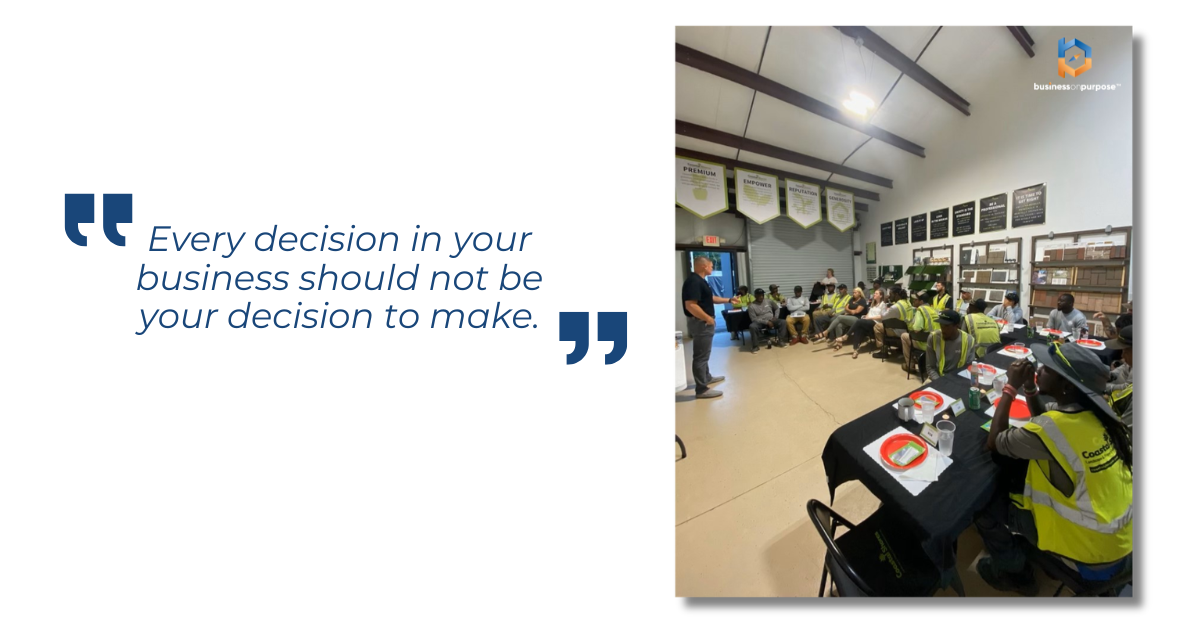
Every decision in your business should not be your decision to make.
Lead Well.
If you're looking for more resources to work ON your business, we have them.
Two Types of Decisions: Know Which Ones Are Yours
There are really two types of decisions in any business, and you should be spending the majority of your time on only one of them.
The first type is strategic decisions. These are yours. These are the big-picture, direction-setting choices that move the business forward. The second type is operational decisions. These belong to your team. The problem is that too many business owners make their team’s decisions their own decisions, and then stack strategic decisions on top of that. That is exactly how the bottleneck forms.
Michael Gerber described this as the difference between working on your business versus working in your business. Your job as the owner is to stay on the strategic side. When you are buried in operational decisions, you are working in it, not on it, and your business pays the price.
Delegation vs. Abdication: There Is a Big Difference
Here is where most business owners go wrong. They think they are delegating, but what they are actually doing is abdicating.
Abdication looks like this: you need someone to go represent your company at a networking event. So you look at a team member and say, “Hey, go to that event and network.” You tell them the location and the start time. That is it. No script. No process. No clear expectations. You have just handed off a responsibility without handing off the tools to succeed.
We saw this exact pattern with the home builder leader. He would send emails to his team that simply said, “We need to sell more.” That was the entire message. Here is a number. Go hit it. Figure it out. That is not delegation of authority. That is abdication dressed up to look like leadership.
Hire great people, then train, train, train. Process, training, accountability.
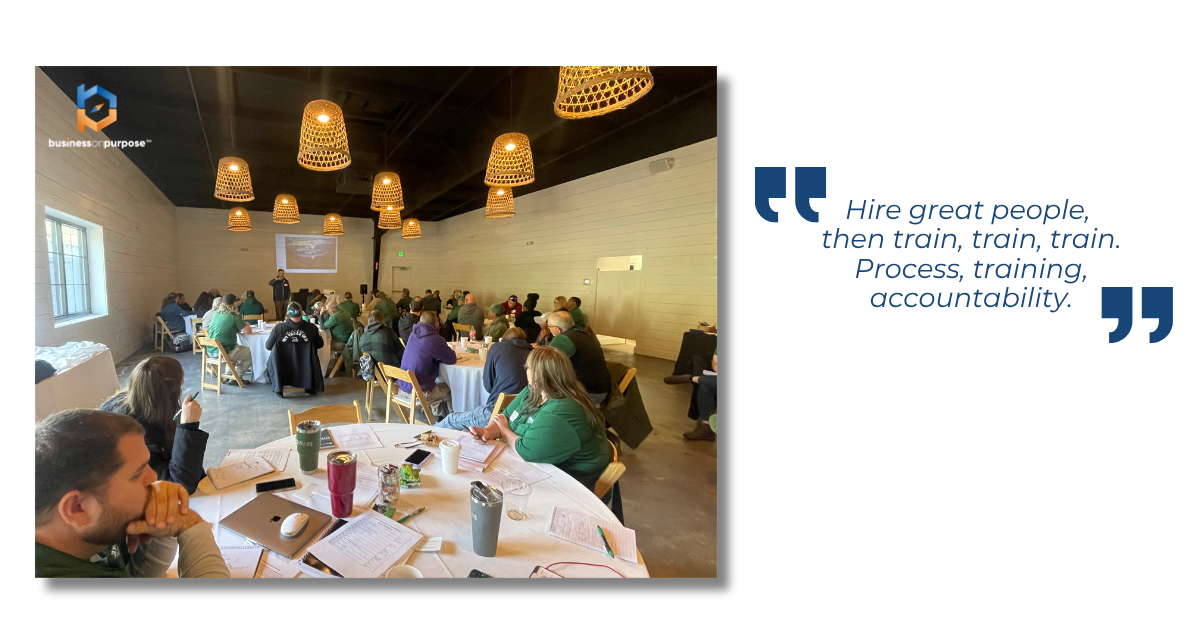
You have probably heard the saying, “Just hire great people and everything will work out.” That is a misnomer. Hire great people if you can find them, and then train, train, train, train, train. Process, training, and accountability. That is the PTA model, and it is the foundation of real delegation.
Too many business owners skip this step. They push off responsibility and hope for the best. Their strategy becomes finger-crossing and guessing instead of structured, intentional delegation.
How to Start Delegating the Right Way
Once you are committed to delegating instead of abdicating, here is a framework to get started. Every business operates through four core systems:
- Marketing tells the world you exist.
- Sales connects you to a customer through a contract.
- Operations is where you fulfill the promise of that contract.
- Administration holds it all together behind the scenes.
Start by doing a brain dump. Set a timer for 15 minutes. Grab a clean sheet of paper. Write out all the different processes that live underneath each of those four systems. Get everything out of your head and onto paper.
Once you have that list, rank each task through three lenses:
- Time: How many hours per week does this task take?
- Energy: Does this task give you energy, drain you, or feel neutral?
- Delegatability: On a scale of one to three, is this task only something you can do (1), something others could do similarly (2), or something you should have handed off already (3)?
The tasks that belong in your world are the ones that take meaningful time, give you energy, and score a one on delegatability. Everything else needs to be handed off using the PTA model: process it, train it, and hold your team accountable to it.
Your Shrub Will Always Grow Back
We call your total list of responsibilities your “shrub.” Once you write out your full job role, you need to regularly trim that shrub so you are only handling the things that are truly strategic. But here is the thing about healthy shrubs: they grow back.
Six months from now, maybe a year or two down the road, you will start feeling busy again. You will feel overwhelmed again. That is not a sign that something is wrong. That is a sign your shrub has grown back. It is time to trim the hedges again and push more responsibility to your team through proper delegation, not abdication.
Your chaos is not a team problem. It is a delegation problem.

Your 90-Day Delegation Goal
Here is your challenge. Take three processes from your brain dump and fully delegate them within the next 90 days. That means documenting the process, training someone on it, and holding them accountable through regular check-ins.
Right now you might feel like you are living in chaos. A big part of that chaos is the weight of decisions and tasks that should not be yours. The goal is to liberate you from that chaos so you can make time for the things that matter most, both in your business and in your life.
You built a business. You should not be a prisoner of it.
Ready to Build a Business That Runs Without You?
If you want a proven system to help you delegate effectively, build strong processes, and create a business that does not depend entirely on you, visit http://solvecashflow.com/. It is the starting point for business owners who are done being the bottleneck and ready to lead with purpose.
Scott Beebe is the founder of Business On Purpose (mybusinessonpurpose.com) and speaker for the AEC industry and author of the book Let Your Business Burn: Stop Putting Out Fires, Discover Purpose, and Build a Business That Matters. Business On Purpose works with business owners to articulate purpose, people, process, and profit to liberate owners from chaos and make time for what matters most.