Here’s a practical, proven framework to delegate entire projects, build accountability into your team, and finally step into the role of owner instead of operator.
The Cabinet Maker Disaster That Changed Everything
A renovation builder working in a historic district learned this lesson the hard way. They handed a cabinet maker a job with one instruction: “Here’s what the client wants.” No timeline. No budget. No process.
The result? Over budget. Behind schedule. A total mess.
The problem wasn’t the cabinet maker. The problem was the builder never translated the client’s expectations into clear, actionable direction. The client had expectations. The builder just never passed them along.
The second time around, everything changed. The builder mapped out the process before the work began, and the cabinet maker came in on time, on budget, and hit every mark. Same person. Completely different outcome. The only variable was the system behind the handoff.
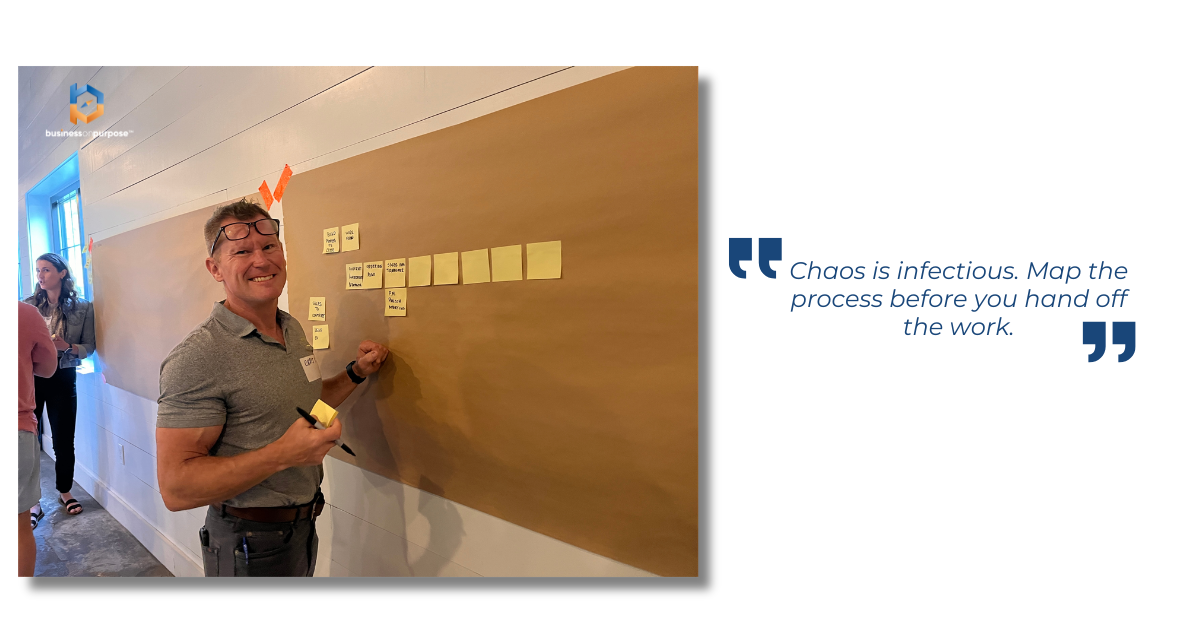
Chaos is infectious. Map the process before you hand off the work.
Lead Well.
If you're looking for more resources to work ON your business, we have them.
The Seesaw Model: Understanding the Line Between Leadership and Micromanagement
Before we talk tools, let’s talk about the mindset. Micromanagement is one of the most overused buzzwords in business, but it’s worth defining clearly so you know exactly what to avoid.
Picture a seesaw on a fulcrum. On one side you have time. On the other side you have questions. Healthy leadership keeps that seesaw balanced. When either side tips too far, you’ve crossed into micromanagement territory.
Here’s what that looks like in practice:
- Asking for sales results from 15 years ago during a live sales meeting? That’s the wrong question at the right time. Micromanagement.
- Asking for last week’s sales results on a Thursday night when your team should be sleeping? That’s the right question at the wrong time. Also micromanagement.
- Asking for last week’s sales results at this week’s sales meeting? Right question, right time. That’s healthy leadership.
When you get the balance right, you earn the authority to delegate effectively. But that authority comes with responsibility to set your team up for success.
Your OBCs: The Foundation of Every Delegation
Forget your ABCs. Before you hand off any project, you need your OBCs: Outcomes, Boundaries, and Criteria.
Outcomes define what success looks like. For the cabinet maker example, the outcome was cabinets installed in a specific home, on a specific schedule, within a specific budget. Every detail matters here. Vague outcomes produce vague results.
Boundaries are the unique core values and decision-making guardrails your team operates within. These are not generic values like “integrity” or “respect.” Those are baseline expectations for anyone in business. Real boundaries are the ones unique to your company. At Business On Purpose, our values include things like “85/15,” “four Rs,” and “relentless learning.” They’re specific, meaningful, and they guide every decision our team makes independently.
Criteria is the process itself. It’s the how. When you hand someone a project without criteria, you’re hoping they figure out the path on their own. When you provide criteria, you give them a map.
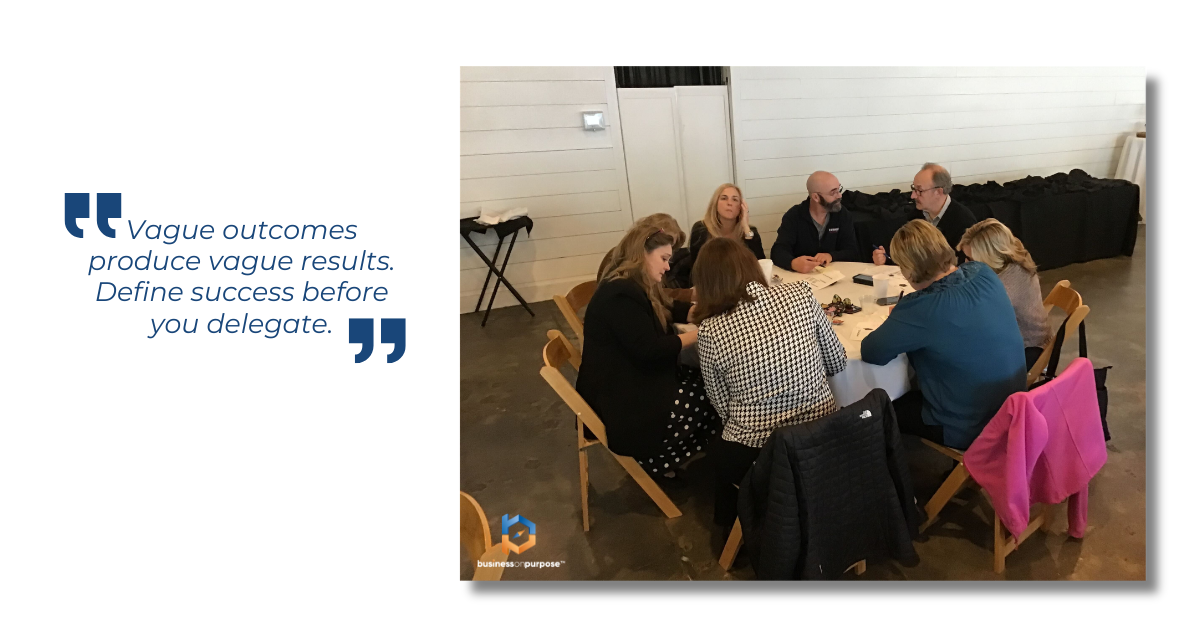
Vague outcomes produce vague results. Define success before you delegate.
The PTA Method: Process, Train, Accountable
Once you have your OBCs in place, you’re ready to delegate using the PTA methodology.
Process: Identify the step-by-step process required to complete the project. Don’t assume your team member knows how it’s done just because you do. Write it out. Make it clear.
Train: Walk your team through the process with repetition, predictability, and meaning. Repetition builds confidence. Predictability builds trust. Meaning builds motivation. Training isn’t a one-time event. It’s an ongoing rhythm.
Accountable: Hold your team accountable to the outcomes and boundaries you set upfront. Accountability isn’t punishment. It’s the follow-through that makes the whole system work. Without it, even the best process falls apart.
When you apply PTA consistently, you stop being the person who holds every project together and start being the leader who builds the system that holds it together.
Scaling Delegation Across Your Entire Business
One project is manageable. But what happens when you need to delegate across your entire operation? That’s where the Master Process Roadmap comes in.
Every business runs on four core systems: marketing, sales, operations, and administration. Set a timer and do a brain dump of every process that exists in each of those four areas. Hundreds, even thousands of processes run inside your business every week. Most of them live only in your head.
Start with marketing, move through sales, operations, and administration. Map them all out. Now you have a complete picture of what it actually takes to run your business.
From there, you build what’s called an anchor. Not a boat anchor. Think of a climbing anchor at the top of a rock face. Every rope connects to it. If the anchor fails, everything fails. Your business anchor maps all 52 weeks of the year across a simple spreadsheet, week one through week 52, and assigns training, review, and accountability to each project and process on a regular schedule.
If it’s week four, you open week four and see exactly what needs attention. No guessing. No dropping the ball. Consistent focus baked into the rhythm of your business.
The Delegation Roadmap: Getting Yourself Out of the Weeds
If you want to delegate your entire role as an owner, not just individual projects, the Delegation Roadmap is your tool.
Here’s how to use it:
- List every task you’re involved in. Use the Master Process Roadmap as a reference.
- Track the time. How many minutes per week do you spend on each task? If it’s monthly or quarterly, convert it to a weekly average.
- Measure your energy. Does the task give you energy, drain you, or feel neutral?
- Rate its delegatability. Use a simple 1-2-3 scale:
- 1 = Only you can do it. There should be very few of these.
- 2 = You thought only you could do it, but it could be delegated.
- 3 = You should have delegated this a long time ago.
No judgment here. This is a judgment-free zone. The goal is clarity.
Once you’ve rated everything, focus on the tasks that take the most time, drain your energy or feel neutral, and score a 2 or 3 on delegatability. Package those tasks into job roles. Then apply process, training, and accountability to each one throughout the year.
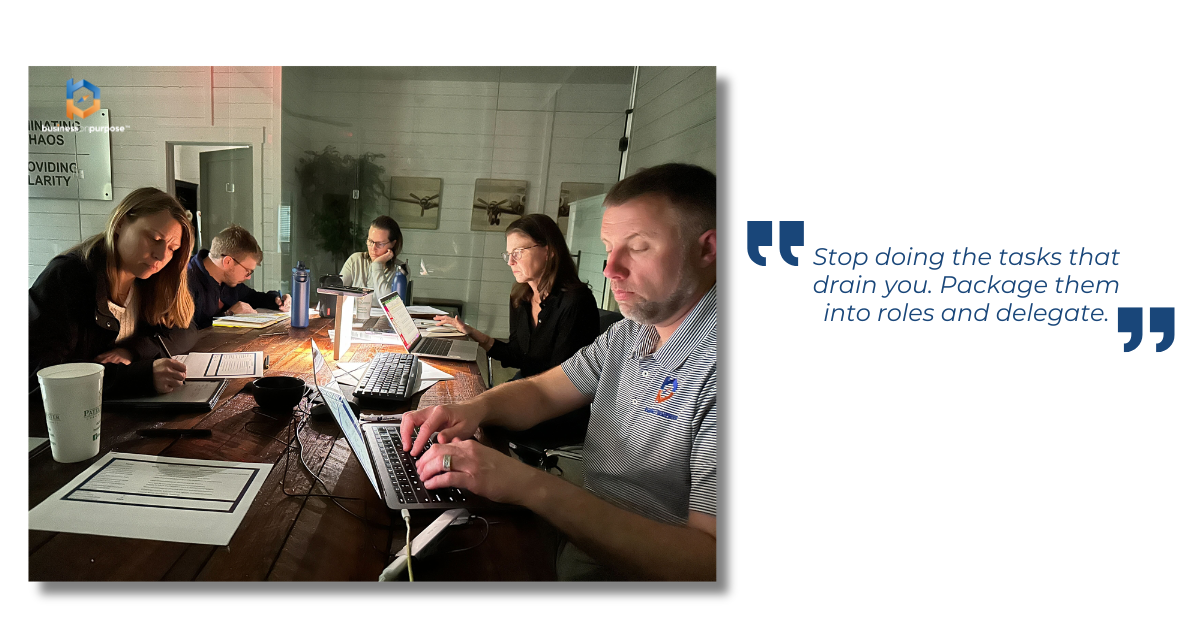
Stop doing the tasks that drain you. Package them into roles and delegate.
What This Makes Possible
When you follow this framework consistently, something powerful happens. You stop doing task-oriented work and start doing strategic work. Michael Gerber called it working on the business instead of in the business. You become the architect instead of the laborer.
Your team members know what’s expected. They have a process to follow. They’re trained regularly. And they’re held accountable with a rhythm that keeps everything on track.
Here’s a quick summary of the full delegation framework:
- List your processes using the Master Process Roadmap.
- Identify the most important projects and define Outcomes, Boundaries, and Criteria.
- Apply Process, Train, and Accountable (PTA) consistently.
- Use the anchor to build repetition, predictability, and meaning into your calendar.
- Align delegated tasks with job roles using the Delegation Roadmap.
The result is a business that runs without you having to hold every piece together. That’s the mission. That’s what this is all about.
You Were Made for More Than Managing Chaos
Too many small business owners are buried in the day-to-day, missing important moments in their lives because their business can’t function without them. That’s not why you started your business.
Our mission at Business On Purpose is to liberate you from that chaos and help you build a business that gives you your time back for what matters most. If you’re ready to stop surviving and start leading, we’re here to help.
Visit businessonpurpose.com/healthy to take the first step toward a healthier business and a life you actually love.