Running a business without clarity on your money is like trying to navigate without a map. Many business owners feel like they are constantly bleeding cash, yet cannot pinpoint exactly why. The root issue is simple. All money looks the same.
When every dollar goes into one big bucket, it becomes nearly impossible to understand what is actually happening in your business.
Let’s fix that.
The Dangerous Myth About Money
There is a common belief that causes more damage than most people realize:
“If there is money in the bank, I must be making money.”
Lead Well.
If you're looking for more resources to work ON your business, we have them.

That belief is false.
Money in your account does not equal profit. It does not even mean stability. It just means cash is present, for now.
The reality is this:
- A dollar out is always more than a dollar
- A dollar in is always less than a dollar
- A dollar is never just a dollar
Think about buying a car. You do not just pay the sticker price. You pay taxes, maintenance, fuel, insurance, and more.
The same applies in your business.
Why Your Current System Is Failing You
Most businesses operate with one or two bank accounts. Everything flows in and out of the same place. This creates confusion and poor decision making.
Psychologically, when money is sitting in one account, it feels available.
So it gets spent.
“When everything is in one bucket, you will use it like it is all yours.”
This is where the problem begins.

The Solution: Subdivide Your Cash
Instead of one account, you should have multiple accounts with specific purposes.
Yes, more accounts. Not fewer.
This is based on a simple behavioral principle. When money is separated, you treat it differently.
Here is a basic structure:
- Income Account
All revenue goes here first.
- Cost of Goods Account
Used for materials, subcontractors, and anything tied directly to delivering your product or service.
- Operating Expenses Account
Covers payroll, rent, utilities, and ongoing business costs.
- Capital Reinvestment Account
For equipment, vehicles, upgrades, and growth investments.
- Tax Account
Reserved for taxes so you stay compliant and avoid penalties.
- Profit Account
This is your reward. This money should not be touched for operations.
Understanding Cost of Goods vs Operating Expenses
This distinction matters more than most business owners realize.
- Cost of Goods (COGS): Only exists when you are selling something
- Operating Expenses: Exist whether you make a sale or not
For example:
- A home builder pays for lumber and subcontractors only when building
- But payroll, rent, and utilities continue regardless of sales
This is why one fluctuates and the other stays relatively fixed.
Make Your Business Speak to You
When your accounts are separated, something powerful happens.
You stop guessing.
You start seeing.
If your cost of goods account runs dry, your pricing or percentages are off. If your operating account is struggling, your overhead is too high.
Your business begins to communicate clearly.
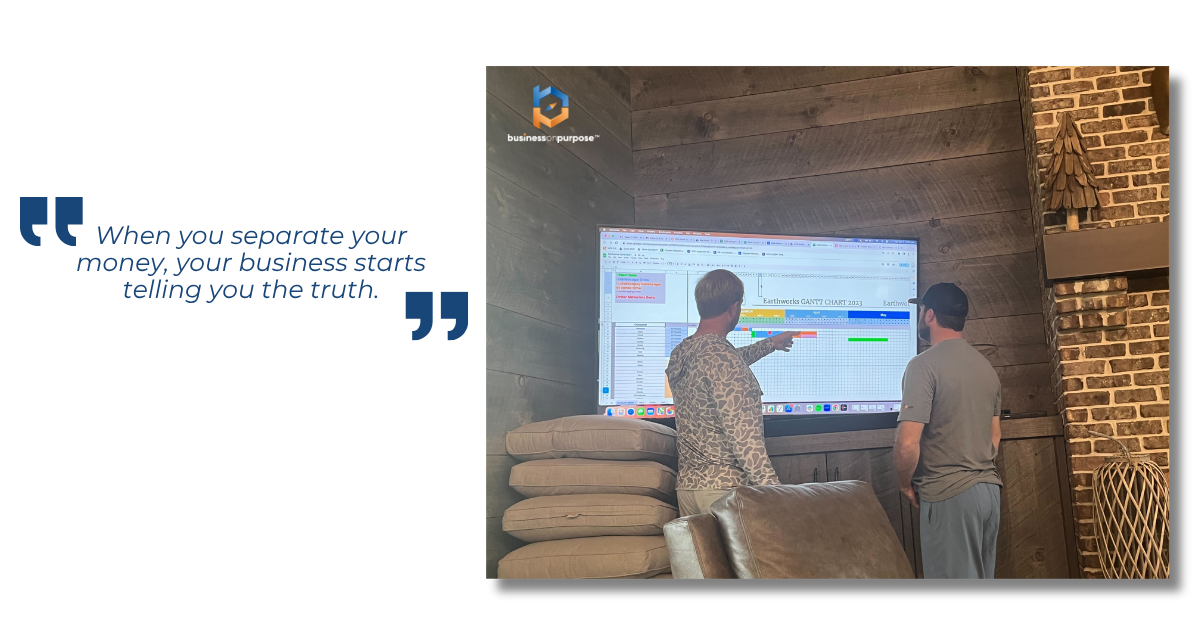
“When you separate your money, your business starts telling you the truth.”
Track Cash Flow Weekly
You do not need complex software to understand your cash flow.
Start simple.
- Create a spreadsheet
- List all your bank accounts vertically
- Add 52 weeks across the top
- Once a week, record each account balance
That is it.
Over time, patterns will emerge. You will see trends weeks or even months before problems hit.
This allows you to make proactive decisions instead of reactive ones.
Why This Works
Large accounts hide problems.
Small, separated accounts expose them.
Think of it like this:
A large ship can have leaks you never notice. A small boat with the same holes sinks quickly, forcing you to act.
Your business needs visibility, not volume.
The Real Reason Businesses Struggle
Many business owners are not running their money.
Their money is running them.
They operate:
- From paycheck to paycheck
- From receivable to receivable
- From loan to loan
“If you are constantly borrowing, you are spending more than you should.”
This cycle creates stress, chaos, and poor decision making.
But it can be broken.

The Barriers You Will Face
As simple as this system is, expect resistance.
- Your mindset
You may think this will not work - Your bookkeeper
They may worry about complexity - Your bank
They may charge fees for multiple accounts - Your CPA
They may focus only on past financial reports
None of these are valid reasons to avoid clarity.
You are the business owner. You decide how your money is managed.
Final Thoughts
Operating costs are not just numbers on a report. They are behaviors, patterns, and decisions reflected in how your money moves.
When you separate your accounts, track weekly, and assign purpose to every dollar, everything changes.
You gain:
- Clarity
- Control
- Confidence
And most importantly, you stop guessing.
Ready To Take Control Of Your Cash?
If your business feels chaotic, it is not because you lack effort. It is because you lack visibility.
Start by separating your accounts. Track your numbers weekly. Let your business speak.
If you want a deeper system to help you structure and scale your operations, take the next step and explore proven frameworks that bring clarity and control to your business finances.
Scott Beebe is the founder of Business On Purpose (mybusinessonpurpose.com) and speaker for the AEC industry and author of the book Let Your Business Burn: Stop Putting Out Fires, Discover Purpose, and Build a Business That Matters. Business On Purpose works with business owners to articulate purpose, people, process, and profit to liberate owners from chaos and make time for what matters most.