You hired a marketing team to take work off your plate, but somehow you’re still the one making every decision. Sound familiar? The problem isn’t your team — it’s that you haven’t given them the system they need to operate without you.
Here’s how to change that using a proven delegation framework that turns your marketing team into a lead-generating machine that runs on its own.
The Real Job of Your Marketing Team
Before you can delegate effectively, your team needs to be crystal clear on one thing: their job is to generate leads. Not impressions. Not brand awareness. Not making the business look good on Instagram. Leads.
Everything else — branding, social media presence, website design — exists to support that one mission. If your team doesn’t understand this, they’ll stay busy doing tasks that never move the needle.
This confusion became a real problem after the pandemic. During that time, many businesses — especially in construction and related industries — experienced a wave of inbound demand. Marketing teams got comfortable just taking orders. They stopped cultivating new business and started waiting for it to show up. When the market shifted, those same teams came back to owners with roundabout questions that were really asking, “What do we do now?”
The lesson: a team that was never trained to hunt will always come back to you when the work dries up. You need a system that builds proactive marketers, not order takers.
“A team never trained to hunt will always come back to you when the work dries up.”
Lead Well.
If you're looking for more resources to work ON your business, we have them.

The PTA Model: Process, Train, Accountability
To build a marketing team that operates without you, use what we call the PTA model: Process, Training, and Accountability. Let’s walk through each one.
Step One: Document the Process
Every business has four core systems: Marketing, Sales, Operations, and Administration (we call it MSOA). Within each of those systems, you have multiple processes. Marketing alone might have ten or more.
Your first job is to map out every marketing process that currently exists in your business — even if you’re the one doing all of it right now. Because until those steps are written down, no one else can follow them.
Think about the specific tactics your team uses to generate leads. These generally fall into two categories:
- Air Support: Website management, LinkedIn, social media, content creation
- Ground Game: Face-to-face meetings, outreach, BNI, proposals, relationship building
Here’s the truth most business owners miss: most clients are won through the ground game. Unless you’re spending five or six figures on digital advertising, your leads are coming from real human interaction. The air support is what gives you credibility after someone meets you in person. They look you up, see a strong online presence, and their trust in you grows.
Wars are won on the ground. The air support just clears the way. Document both sides of your marketing effort so your team knows exactly how to execute each one.
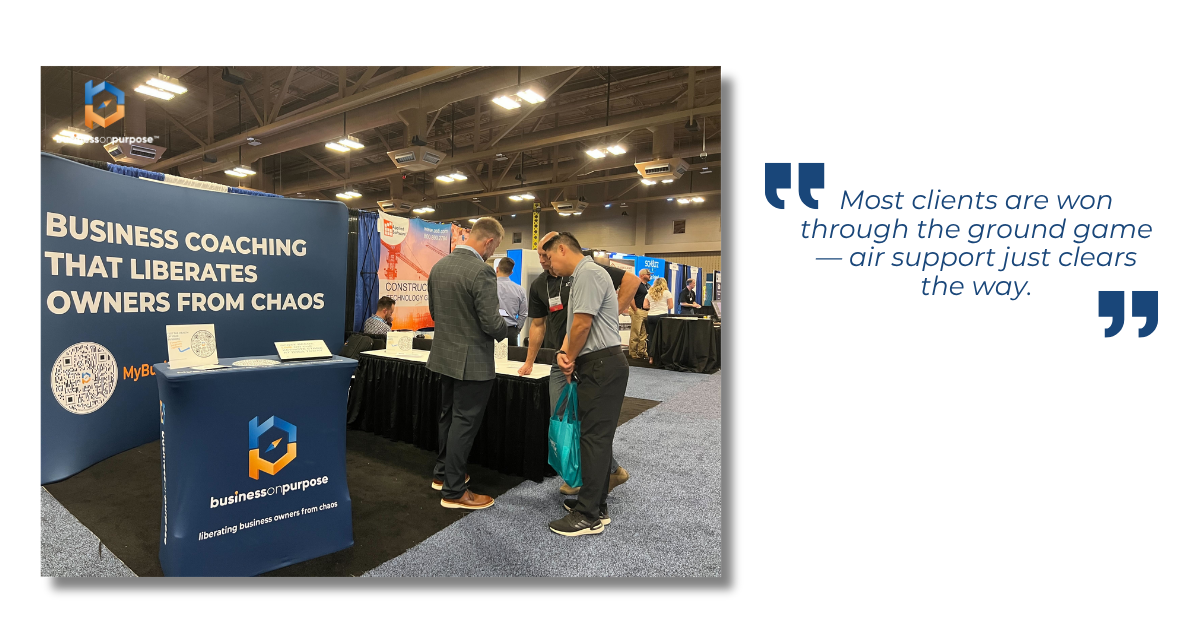
“Most clients are won through the ground game — air support just clears the way.”
Step Two: Train Relentlessly
Think about what a military unit and a professional sports team have in common. When they’re not in battle or playing the game, they’re training. Constantly. Year-round. No off-season.
Your business needs the same mindset. Training isn’t a one-time onboarding event. It’s a continuous rhythm built into the way your team operates.
The best vehicle for this is a weekly marketing and sales meeting. Here’s the formula that works:
- Once a week, one hour
- Agenda-driven and leader-led
- The leader should not be you
That last point is critical. Handing off the leadership of this meeting is one of the best ways to develop new leadership inside your business. Give a team member the agenda and the responsibility to run it. You’ll be surprised what they’re capable of when given the chance.
If you’re not sure what to cover in a marketing meeting, start simple: celebrate wins, report on leads, and train on one process. That’s it. Over time, you build a rhythm where your team is constantly improving and holding each other accountable without needing you in the room.
Step Three: Build Accountability Into the Meeting
Training without accountability is just information. To make the system stick, you need to track two things consistently: actions and results.
Results are obvious — leads generated. But actions are the leading indicators that predict those results. How many outreach emails went out? How many face-to-face meetings happened? How many follow-ups were made?
When you track both, your team stops flying blind. They know exactly what behaviors drive outcomes, and they hold each other to those standards week after week. Your marketing meeting becomes the place where you identify process, train on it, and keep everyone accountable to it.
Your Time Is Worth More Than You Think
Here’s something that might surprise you. As a business owner, your time is statistically worth between $200 and $1,000 per hour. That means every time you log into your website backend to make an update, you’re doing a $40-per-hour task at $200 an hour or more.
There are people who will handle those tasks well and gladly — at a fraction of your hourly value. Delegating those tasks isn’t laziness. It’s leverage. It frees you to focus on the high-level, strategic work that only you can do.
Even if your business is just you right now, your time is still worth $200 an hour minimum. Start acting like it. Delegate the process, train the people, and hold them accountable — so you can focus on growing the business instead of running it.
“Your time is worth $200 an hour minimum — stop doing $40-an-hour work.”

Start Building the System Today
The goal is simple: build a marketing team that generates leads, follows a documented process, trains continuously, and holds itself accountable — all without needing you to drive every decision.
That’s not a dream. That’s what happens when you put the right system in place.
If you’re ready to take the next step toward a business that runs without you, we’ve built tools and resources to help you get there faster. Visit https://trainnewhires.com to get started today.
Scott Beebe is the founder of Business On Purpose (mybusinessonpurpose.com) and speaker for the AEC industry and author of the book Let Your Business Burn: Stop Putting Out Fires, Discover Purpose, and Build a Business That Matters. Business On Purpose works with business owners to articulate purpose, people, process, and profit to liberate owners from chaos and make time for what matters most.