If your business only runs when you are in the room, you do not have a business — you have a job. System building is the key to changing that, and it is more accessible than most small business owners think.
Let’s break down exactly what system building is, why it matters, and how to start doing it right now using a simple three-part framework.
Systems Are Not About Control — They Are About Liberation
Here is the biggest misconception about building systems in your business: people think it is about controlling their team. It is actually the opposite. System building is about liberating the business from the one person who holds all the knowledge — usually you.
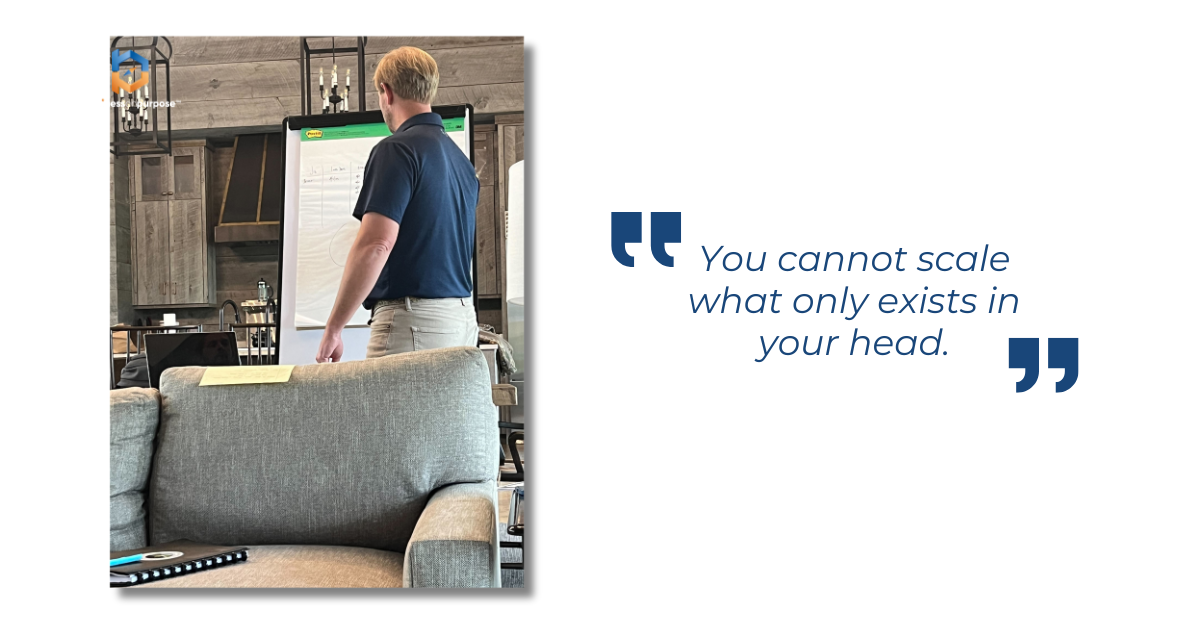
Right now, a lot of what makes your business run only exists in your head. Your processes, your preferences, your way of doing things — all of it is locked up in one place. That is a problem. You cannot scale what only lives in your head. Systems turn that personal knowledge into company assets that anyone on your team can access and use.
Think about it this way: in football, everybody talks about the offense and the defense. But the teams that consistently win? They never have a gap in their special teams. Systems are the special teams of your business. Everyone talks about the product. Everyone talks about the people. Very few people talk about the actual systems. And that gap is exactly where businesses get stuck.
“You cannot scale what only exists in your head.”
Lead Well.
If you're looking for more resources to work ON your business, we have them.
Systems Are Built from Tribal Knowledge
Think of system building as tribe building. You are taking the knowledge that exists within your culture and intentionally scaling it so that everyone operates from the same foundation.
Consider Chick-fil-A. No matter which location you visit anywhere in the world, when you say “thank you,” the response is always “my pleasure.” That is not an accident. That is a system. When visiting their headquarters in Peachtree City, Georgia, you could feel that culture baked into every hallway and every interaction. Every single person embodied that same response.
Or think about Hawaii, where “aloha” is not just a greeting — it is a deeply embedded cultural system. From the airport to the rental car counter to the hotel lobby, everyone operates by the same cultural code. Nations build these systems. Businesses can too.
What it takes is repetition, predictability, and meaning — all under the umbrella of intentionality. So before you build anything, ask yourself this honest question: are you willing to build business systems with real intentionality?
The Difference Between a System and a Process
Before you start building, you need to understand the distinction between a system and a process. A system is the macro collection of related processes. A process is one of the individual steps that makes up the system.
Think about the braking system in your car. It is made up of brake pads, hydraulic lines, and a brake pedal. Each of those is its own process. Together, they form the system. The same logic applies to your business.
Your four core business systems are marketing, sales, operations, and administration. Within each of those systems, there are dozens of individual processes. For example, within your marketing system, you might have processes for your website, social media, outreach, and print advertising. Within your sales system, you have follow-up sequences, sales scripts, and new client onboarding. Each of those is a process that contributes to the larger system.
The PTA Model: Your Framework for Building Systems
This has nothing to do with elementary school. PTA stands for Process, Training, and Accountability — and it is the three-step framework that makes system building practical and sustainable.
Step One: Identify the Process
Start simple. Set a timer for five minutes. Put “marketing” at the top of a sheet of paper and brain dump every single process you can think of that tells the world your business exists. Do not overthink it. Just get it out of your head and onto paper.
Pick one specific process — let’s use payroll as an example. Document how payroll gets done, step by step. The easiest way to do this for anything that happens on a computer is to use screen capture software. Hit record, walk through the process, and you have just documented it. That video becomes the foundation of everything that follows.
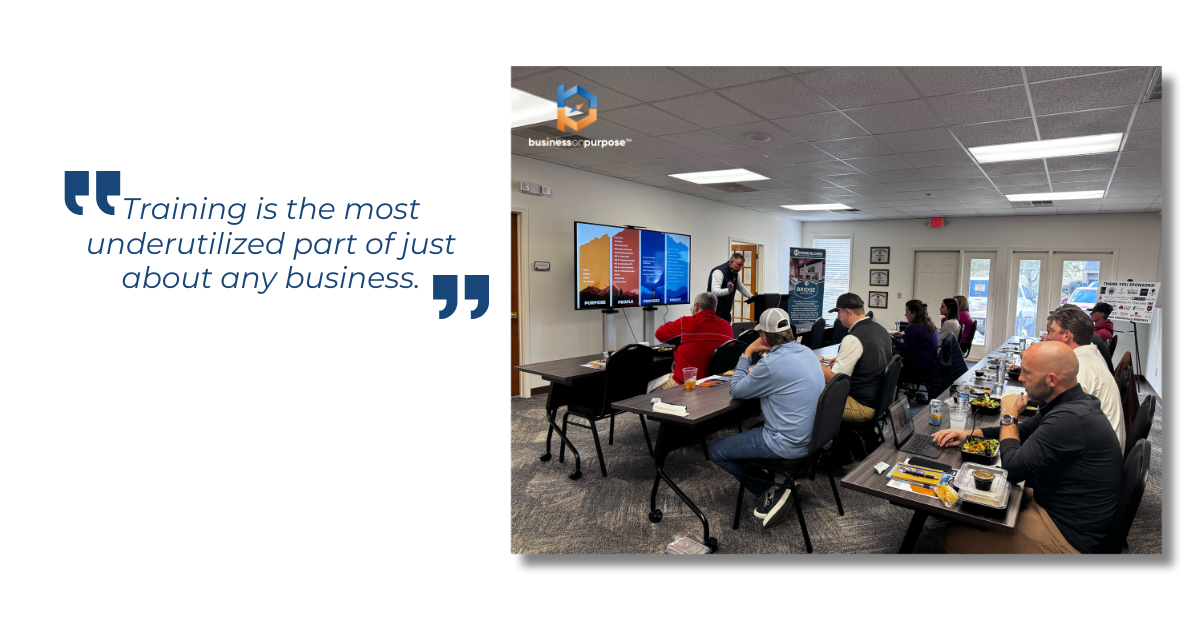
“Training is the most underutilized part of just about any business.”
Step Two: Train — Repetitively, Predictably, and Meaningfully
Training is the most underutilized step in almost every small business. Sports teams and military units spend more time training than they do competing or fighting. But in most businesses, training happens once during onboarding and then disappears.
The key is not one big training day or an expensive offsite event. Most of that does not stick. What sticks is training that is repeated consistently over time.
At Business On Purpose, there are three recurring training touchpoints every single week, 50 weeks out of the year. A weekly coaches meeting. A marketing and sales meeting. A full team meeting. Each one includes intentional training elements tied to specific processes — drip by drip by drip.
When you are training someone on a specific process, use the Model, Assist, Watch, and Leave approach:
- Model: Show them exactly how it is done. Use that screen capture video.
- Assist: Work alongside them for a few weeks or months to make sure they are on track.
- Watch: Step back and check in periodically — weekly or monthly.
- Leave: Once they have it down, trust them with full ownership.
This is the difference between delegation and abdication. Abdication is saying, “Go do payroll.” Delegation is modeling it, assisting through it, watching it, and then releasing it with confidence.
Step Three: Build in Accountability
Once a process is documented and trained, you need a way to ensure it is being done consistently and correctly. That is accountability — and it is not micromanagement.
Accountability is not about looking over someone’s shoulder. It is not a judgment on who they are as a person. It is simply making sure the work is getting done the right way, every time.
One practical example: at Business On Purpose, all coaching calls are recorded automatically and uploaded to a shared folder. Those recordings are then run through an AI scoring rubric that evaluates each call against a set of defined coaching criteria. Every week, coaches receive a scorecard showing how they performed — not so leadership can criticize them, but so the coaches themselves can grow and stay consistent.
You do not need AI to create accountability. A simple spot check on payroll once a month gets the job done. The point is that accountability needs to exist in a predictable, objective, and non-threatening way.
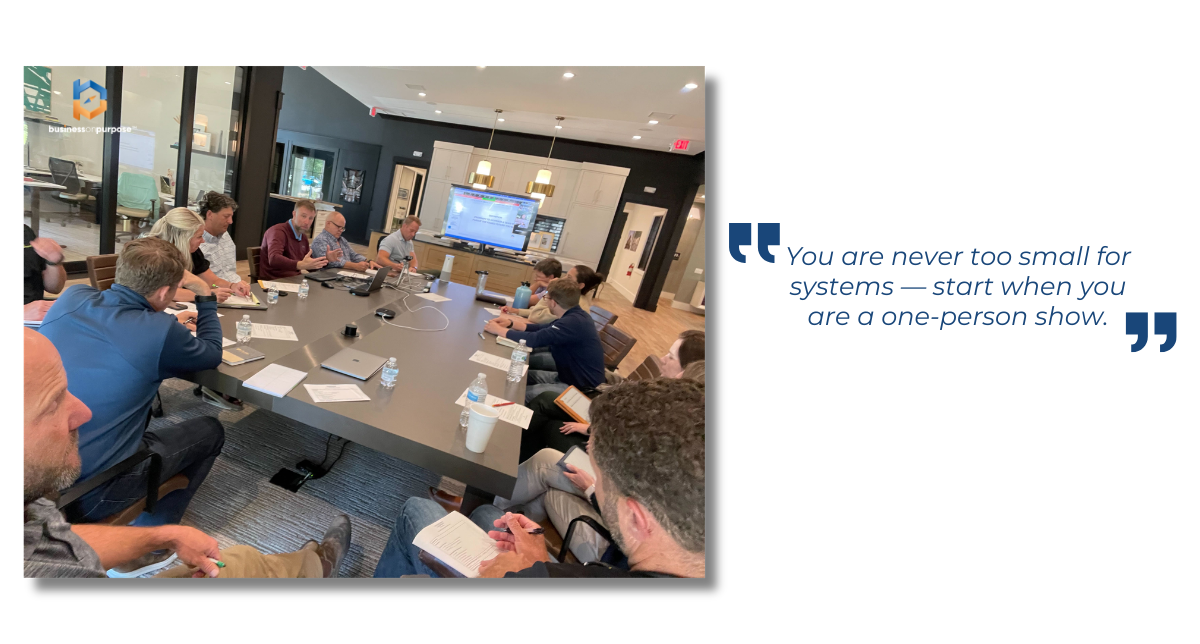
“You are never too small for systems — start when you are a one-person show.”
Systems Compound Over Time
Here is the most encouraging part of all of this: you do not have to build everything at once. You build one process this week. You build another one next week. By the end of a year, you have 50 to 100 documented, trained, and accountable processes. And those processes compound over time.
You are never too small to start. Even if you are a one-person operation right now, building systems is what gets you ready for person number two. It is what allows you to grow without growing chaos.
The goal is simple: get the knowledge out of your head, get it into the hands of your team, and free yourself up to focus on what matters most. That is what business systems do. That is what running a business on purpose looks like.
Ready to Build a Business That Runs Without You?
If you are tired of being the bottleneck in your own business and you are ready to build real, lasting systems that give you your time and freedom back, visit https://trainnewhires.com/. You will find the tools, resources, and coaching you need to start building a business that works for you — not the other way around.
Scott Beebe is the founder of Business On Purpose (mybusinessonpurpose.com) and speaker for the AEC industry and author of the book Let Your Business Burn: Stop Putting Out Fires, Discover Purpose, and Build a Business That Matters. Business On Purpose works with business owners to articulate purpose, people, process, and profit to liberate owners from chaos and make time for what matters most.