Most business owners think they have a delegation problem. They don’t. What they actually have is a documentation problem — and that distinction changes everything. If you are ready to stop doing it all yourself and finally build a business that runs without you, this is the framework you need.
You Are Not Bad at Delegating — You Are Bad at Preparing to Delegate
Here is a scenario that plays out constantly with small business owners. Someone asks them how they delegate, and the answer is some version of: “I just tell them what to do and hope for the best.” That is not delegation. That is the business equivalent of teaching someone to swim by throwing them into a creek. There is a better way — and it starts with a framework we call the PTA Model.
PTA stands for Process, Train, and Accountability. These are the three non-negotiables of effective delegation. Miss any one of them and the whole system breaks down.
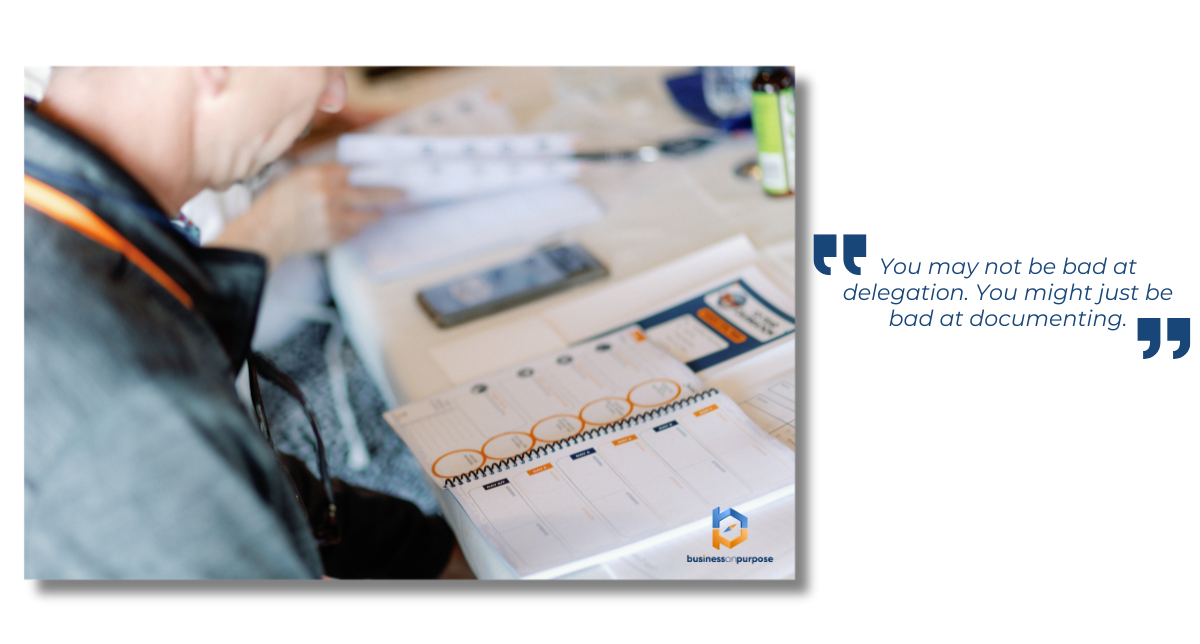
“You may not be bad at delegation. You might just be bad at documenting.”
Lead Well.
If you're looking for more resources to work ON your business, we have them.
Step 1: Process It Before You Pass It
You cannot hand off a task you have never clearly defined. That is the trap most owners fall into. Before anything can be delegated, you have to package your knowledge and your methods into a repeatable system.
Think about it this way. If your business runs on your intuition, your habits, and the way things live inside your head, then no one else can run it. The goal is to take what you know, turn it into a documented process, and make it bite-size enough for someone else to follow.
This is something we had to do inside Business on Purpose in our early years. The coaching and advisory work we do is built on wisdom and methodology — not a physical product. In order to bring other people onto the team and scale the mission, that wisdom had to be packaged into a system. Once it was in a system, it could be trained. Once it could be trained, it could be repeated. That is how real delegation begins.
Step 2: Train with Repetition, Predictability, and Meaning
Telling someone something one time is not training. A landscaper in Georgia once vented his frustration about his team not following through on something. When asked when he had told them, his answer was: “Six months ago.” He had told them once and assumed it was done.
That is not how people learn. Training requires repetition. Sports coaches do not run a play once and move on. They say, “Do it again.” And again. And again. The same principle applies to your team. You need to build a training rhythm that is predictable — weekly check-ins, regular walkthroughs, consistent feedback loops.
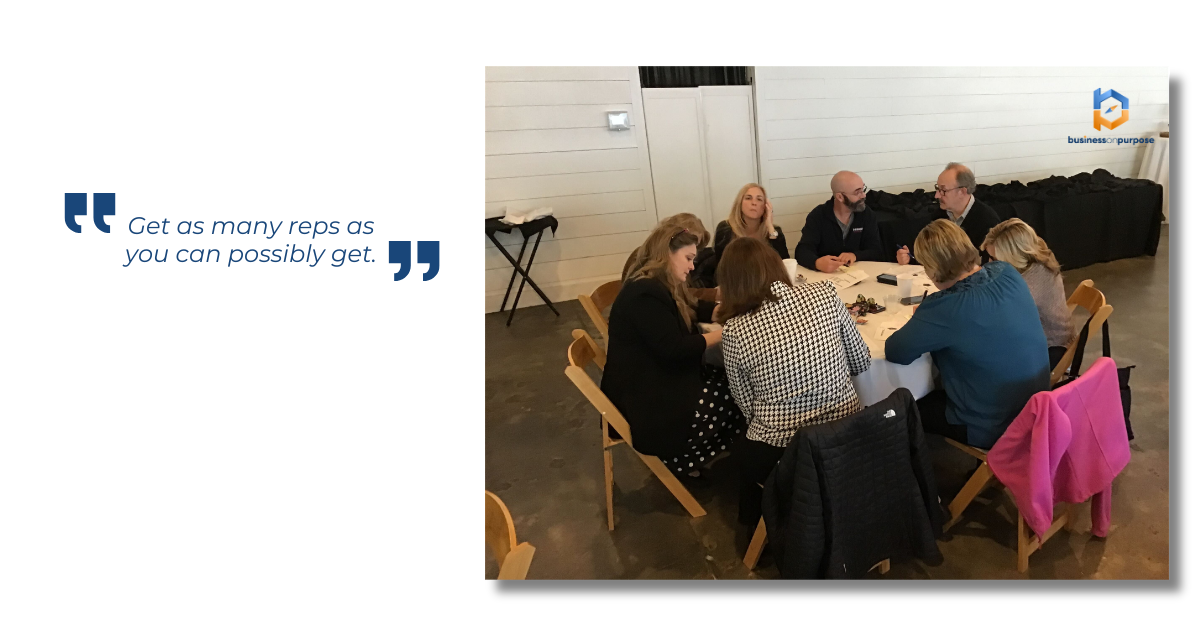
“Get as many reps as you can possibly get.”
Great training has three elements: repetition, predictability, and meaning. People need to hear things more than once. They need to know when to expect feedback. And they need to understand why the task matters. All three together create the conditions for real skill development on your team.
Step 3: Hold People Accountable Without Micromanaging
Accountability is not micromanagement. The difference comes down to what we call the seesaw of predictability.
Healthy leadership is asking the right question at the right time. If you ask for last week’s sales results during your weekly team meeting — right question, right time — that is healthy management. But if you ask for a 2010 sales report during that same meeting, that is the wrong question at the right time. And if you text your team member asking for last week’s numbers at 11:37 on a Friday night, that is the right question at the wrong time. Both versions are micromanagement.
Once you have processed a task and trained your team member on it, you have every right to ask for accountability around it. Just make sure your questions are appropriate to the moment. Build a regular meeting rhythm, ask what was agreed upon, and let the process do its job.
Every time you go behind someone and redo their work, you are reinforcing that you do not trust them. That cycle is expensive — and it never ends unless you break it intentionally.
The Delegation Roadmap: A Practical Tool to Get You Started
Now that you understand the PTA framework, here is a practical exercise to identify exactly what you should be delegating right now. We call it the Delegation Roadmap.
Think of your job as a business owner like a shrub. Over time, that shrub grows bigger and heavier and starts to lean. The goal is to trim it — to hand off the branches that do not need to live with you anymore. Here is how to do it step by step.
Step 1 — List every task you do. Set a timer for 10 to 15 minutes and write down every process, task, and responsibility on your plate right now. Payroll. Sales calls. Taking out the trash. All of it. Be granular. A good rule of thumb: if your list has fewer than 50 items, you are either not being detailed enough or not being fully honest with yourself. Your time as an owner is worth $200 to $1,000 per hour. Every task counts.
Step 2 — Estimate the time each task takes. Next to each task, write down how many minutes per week it costs you on average. Even if a task is monthly, divide it out across the weeks. This gives you a realistic picture of where your time is actually going.
Step 3 — Rank each task by energy. Give each item an up, a down, or a neutral. Up means it gives you energy. Down means it drains you. Be honest with yourself here — do not put an up because you think you should. This is just for you.
Step 4 — Rank each task by delegatability. Use a 1, 2, or 3.
- A 1 means only you can do this. Think high-level vision and strategy. Realistically, 2 to 5 percent of your list should be a 1.
- A 2 means you thought only you could do it, but you could delegate it if pressed. Email is a perfect example. The average business owner spends three and a half hours per day on email. At $200 per hour, that is $3,000 per week. Delegating email alone can transform your week.
- A 3 means you should have delegated this a long time ago — bank runs, trash, routine admin tasks. These should go first.
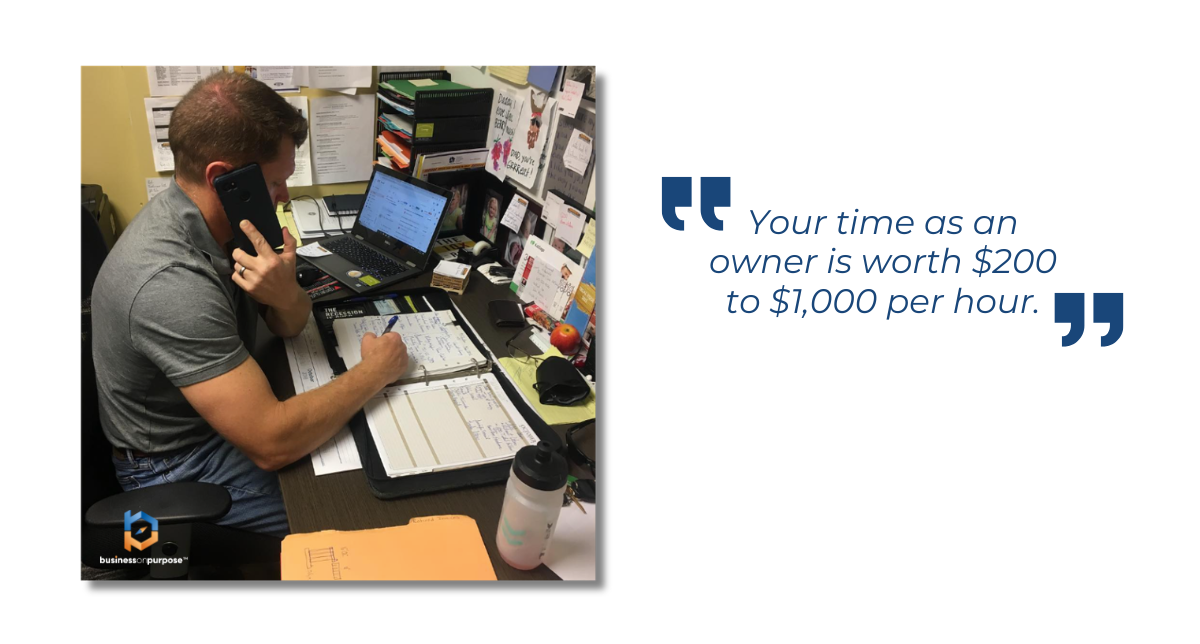
“Your time as an owner is worth $200 to $1,000 per hour.”
Once you have completed this exercise, look for the tasks that take the most time, drain your energy the most, and carry a 2 or 3 delegatability score. Group those together. You just built a job description. That is the role you need to fill — or fill better — so you can get your time back.
What Happens After You Delegate
Here is something important to prepare for. Once you start delegating well, your shrub is going to start growing again. New responsibilities will appear. New opportunities will surface. New weight will accumulate. That is not a failure — that is a sign your business is growing.
This is why we encourage owners to revisit the Delegation Roadmap at least once a year. It is not a one-time exercise. It is a regular practice that keeps your business healthy and keeps you working in the zone where you are most valuable.
The goal is not just to hand off tasks. The goal is to build a business that runs without you — one where your team is equipped, trained, and held accountable, and where you are free to lead at the level your business needs from you.
Ready to Go Deeper?
You now have the PTA framework and the Delegation Roadmap. The next step is making sure you have the right people to delegate to and a system to onboard them well. That is exactly what we help business owners build every day.
Visit https://trainnewhires.com/ to get the tools, templates, and support you need to stop doing it all yourself and start building a business that truly runs without you.
Scott Beebe is the founder of Business On Purpose (mybusinessonpurpose.com) and speaker for the AEC industry and author of the book Let Your Business Burn: Stop Putting Out Fires, Discover Purpose, and Build a Business That Matters. Business On Purpose works with business owners to articulate purpose, people, process, and profit to liberate owners from chaos and make time for what matters most.