Let’s break down exactly how to delegate authority, not just tasks, so your team can make great decisions with or without you in the room.
The Difference Between Delegating in Word and Delegating in Action
We worked with a business owner who was completely exasperated. He kept telling his team, “You’ve got the authority. I’ve empowered you.” But his team still came to him for everything. He was the bottleneck on every single decision.
The problem? He was delegating in word only. He said the right things, but he never showed any evidence of actual delegation. His team had no visible proof that authority had truly shifted to them.
Once we walked him through our delegation roadmap process — mapping out everything that needed to be delegated and then actually processing those elements with the team — things changed. His team could finally see what was being handed to them, rather than just hearing about it.
The result? That owner went from spending roughly 55 hours a week on tactical, day-to-day decisions to spending about 20 hours a week focused on strategic work: vision, mission, values, and culture building. That is the goal. That is what it looks like when delegation actually works.
“You’re not leading if you’re the bottleneck.”
Lead Well.
If you're looking for more resources to work ON your business, we have them.

The Ultimate Litmus Test for Your Leadership
Here is the one question every business owner needs to sit with: What happens when you are not there? Can your business run with or without you?
If the honest answer is no, that tells you something important. It tells you that you are still living in the operational day-to-day, and your team has not truly been handed the authority they need to lead on your behalf.
Real delegation is not just handing off a task. It is handing off the authority that goes with that task. Here is a concrete example of what that looks like in practice.
At a recent event, one of our coaches was delivering a talk for the very first time. During the Q&A, I was on stage with them. Some people in the room knew I was the owner of the firm, and you could see their heads starting to turn toward me when questions came in.
So I made a deliberate choice. I kept my eyes fixed on our other coach. I did not look at the audience. I was visually signaling that the authority in that room belonged to the coach, not to me.
Ask yourself this honestly: when you are in the room with your team members, do you suck the leadership air out of the space? Or do you allow your team member to hold court and be the final authority? When the tough question comes in, does everyone turn to look at you? That gaze tells you everything about whether authority has genuinely been delegated or whether it still lives with you alone.
Why Delegation Feels So Overwhelming (And What to Do About It)
There is a reason delegation feels hard. Running a business means managing an enormous amount of responsibility across four foundational areas every single day: Purpose, People, Process, and Profit.
Within each of those areas lives a deep layer of detail. Your purpose vertical includes your vision story, mission statement, core values, and culture-building tools. Your people vertical covers org structure, job roles, hiring, and onboarding. Your process vertical spans marketing, sales, operations, and admin. And your profit vertical includes cash accounts, past reports, budgets, and future projections.
When you see all of that laid out, it is no wonder delegation feels like too much to hand off. You have been carrying all of it, often without ever having it mapped out clearly in front of you. Recognizing that weight is the first step toward releasing it.
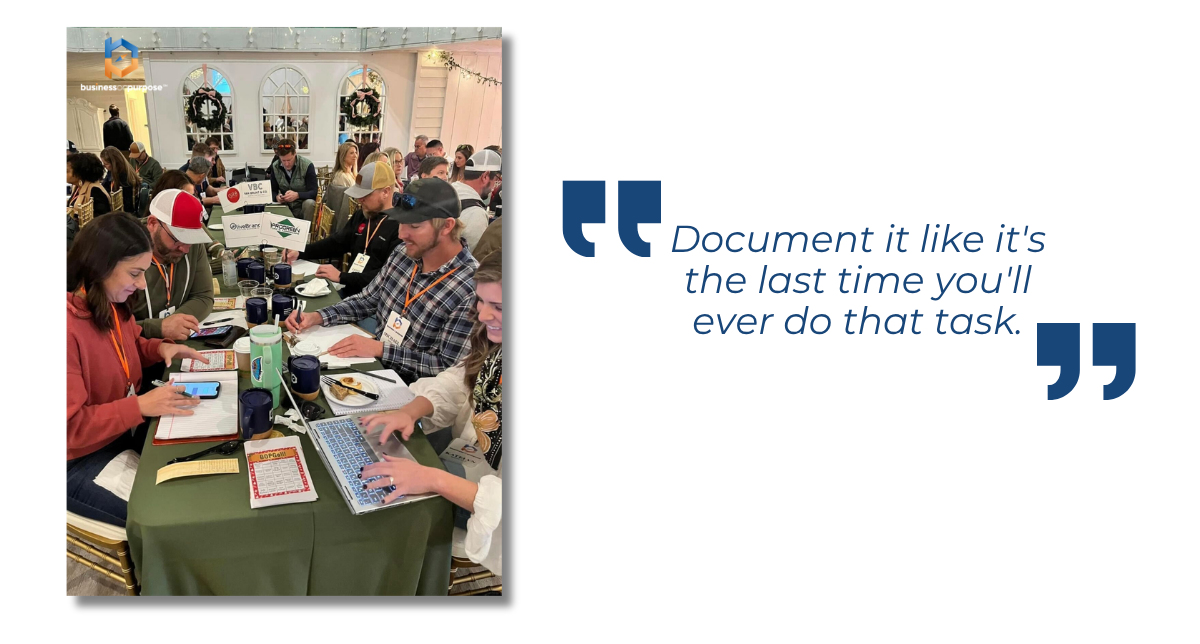
“Document it like it’s the last time you’ll ever do that task.”
The PTA Model: Process, Training, Accountability
To delegate effectively, follow the PTA model: Process, Training, and Accountability.
Process comes first. Whatever you are about to do in your business, document it. Capture it. Record it as if it is the last time you will ever do that task. Hit record on your screen while you run payroll. Walk through your sales follow-up steps out loud while someone documents them. Once you have a documented process, you have something real to hand off.
Training comes next. Walk your team member through that documented process. Let them watch, then let them do it themselves while you watch. Give them real reps on the actual work.
Accountability closes the loop. When they come back to you with a question, resist the urge to just give them the answer. Instead, ask: “How would you solve this if I wasn’t here?” Let them work through it. They are building confidence, competence, and ownership. Those reps are what turn a delegated task into a fully owned responsibility.
One of our coaches recently delivered his first talk to a new audience. Afterward, he asked me how he did. I gave him honest stop, start, and continue feedback. But my final word of encouragement was simple: get more reps. Keep putting yourself in the position to do the thing. Skill is built through repetition, and the same is true for the people you are developing.
Shift from Decision-Maker to Decision Coach
This is the mindset shift that changes how you lead. Instead of answering every question your team brings to you, start asking questions back.
When someone asks, “What should I do here?” your new response is: “Let’s walk through that together. What do you think you should do? If I wasn’t here, what would you do?” Then let them answer. Let them reason through it. You are not abandoning them — you are building their capacity to lead.
Edwin Friedman, in his book A Failure of Nerve, talks about the concept of the well-differentiated leader. His insight is that anxiety is contagious. When your team brings their stress and uncertainty to you, it is easy to get pulled into that swirl. A well-differentiated leader can stand apart from that anxiety while still staying present, still seeing the person, and still caring about the outcome.
Brené Brown calls this above-the-line leadership, and it shows up in three ways:
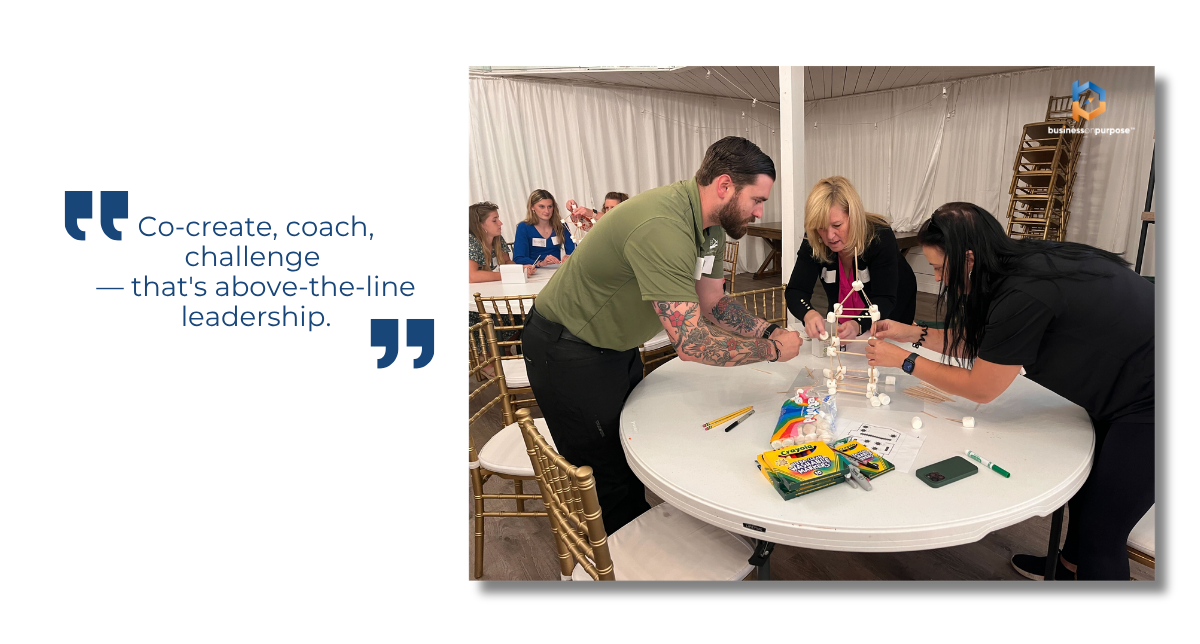
- Co-create: “Let’s work on this together. How would you approach it if I weren’t here?”
- Coach: “Here is what experience has taught me, but let’s get you more reps so you can own this.”
- Challenge: “I want to call out something I see that might be holding you back — not to push you down, but to help you grow.”
These three postures are the opposite of being the hero who solves everything, the victim who complains that no one does it right, or the villain who bulldozes because they think they know best.
“Co-create, coach, challenge — that’s above-the-line leadership.”
Delegation Only Works With the Right People
All of this works best when you have the right people in the right seats. Delegation without the right team in place will always feel like pushing a boulder uphill. The process, the training, the accountability — all of it depends on having people who are ready and willing to receive it.
That is why finding, hiring, and onboarding well is not a separate topic from delegation. It is the foundation that makes delegation possible.
The goal of all of this is simple: we want you to be liberated from the chaos so you can make time for the things that matter most — in your business and in your life.
Ready to Build a Business That Runs Without You?
Effective delegation is one of the most powerful tools you have as a business owner, and it starts with having the right systems, the right team, and the right mindset. If you are ready to take the next step, visit https://trainnewhires.com/ to get the tools and support you need to build a business that truly runs without you.