Here is a step-by-step system to help you delegate work in a way that truly stays delegated, so you can stop being the bottleneck in your own business.
The $30,000 Lesson Every Owner Needs to Hear
At Business On Purpose, we work with business owners who have anywhere from three to one hundred employees. Every single day we hear stories about delegation gone wrong, but one stands out.
A contractor owner decided to hand off material purchasing to a team member. Sounds reasonable. But that team member ended up making a $30,000 mistake. When we dug into what actually happened, it became clear that the owner had not truly delegated authority. He had simply pointed at someone and said, “You’re in charge of material ordering from now on.” No training. No documented process. No accountability. Just a task tossed over the fence.
That is not delegation. That is abdication. And the painful irony is that the very mistakes that result from abdication are what scare owners away from delegating in the first place. The goal here is to give you a confident, objective process so that when you delegate, you can trust what you are delegating to.
Employees fail not from incompetency, but because we never gave them a roadmap.
Lead Well.
If you're looking for more resources to work ON your business, we have them.

The Foundation: PTA (Process, Train, and Hold Accountable)
Before you can delegate anything, you need a framework. At Business On Purpose, we call it PTA: Process, Train, and Hold Accountable.
But here is the question most owners never ask: What exactly do I need to process?
The answer lives inside what we call the Master Process Roadmap. Every business, no matter what it sells, has four foundational systems. We call them the Four Core:
- Marketing
- Sales
- Operations
- Administration
Set a timer for 15 minutes. Grab a pen. Brain dump every single process that exists within each of these four categories. What does your marketing follow-up look like? How does a sale move from inquiry to close? What happens step-by-step in your operations? What does your admin and accounting workflow include?
Once you have mapped all of that out, you suddenly know exactly what needs to be documented, trained, and held accountable. No more guessing. No more gaps.
To make training consistent, use what we call the RPMs of Great Leadership: Repetition, Predictability, and Meaning. Think of it as a simple spreadsheet with 52 columns for the 52 weeks of the year, and your four core systems running down the left side. You assign processes to specific weeks and repeat them throughout the year. That rhythm is what turns one-time training into a lasting culture.
The Delegation Roadmap: What Should You Actually Hand Off?
Now that you know what processes exist in your business, it is time to get honest about your own role. There are tasks sitting on your plate right now that you absolutely do not need to be doing. The Delegation Roadmap is how you figure out exactly which ones.
This is a simple four-column exercise. Here is how it works:
Step 1: List every task you currently do. Big and small. If you still take out the trash, write it down. If you do bank runs, write it down. Customer meetings, team appointments, payroll, everything. You should have a minimum of 50 to 60 tasks on this list.
Step 2: Measure the time each task takes. Convert everything to minutes per week. A task that takes five minutes a day, five days a week, is 25 minutes per week. A monthly task like payroll? Take how long it takes and divide by four. A yearly task? Divide by 52. You want a consistent weekly average so you can see exactly where your time is going.
Step 3: Measure your energy. Think Roman Coliseum. For each task, give it a thumbs up, thumbs down, or sideways thumb. Thumbs up means it gives you energy. Thumbs down means it drains the life out of you. Sideways means it is neutral, no big deal either way.
Step 4: Rate its delegatability. Assign each task a 1, 2, or 3.
- 1 means you are genuinely the only person on earth who can do this. Hint: you should only have one, two, or three of these. The vision of your business is a 1. Payroll is not.
- 2 means you used to think only you could do it, but you are starting to believe otherwise.
- 3 means you should have handed this off a long time ago, but you have been playing the hero or just haven’t gotten around to it yet.
Payroll is not a “1.” Stop treating it like only you can do it.

- Take the most time
- Are neutral or negative in energy
- Are a 2 or 3 in delegatability
The tasks you keep are the ones that:
- Do not take much time
- Give you a lot of energy
- Are rated a 1
That is your real job description. Everything else is what you build your team around.
Accountability That Actually Works: The Weekly Team Meeting
Delegation without accountability is just hope. And hope is not a strategy.
Once you have documented your processes and trained your team using the RPM rhythm, you need a weekly meeting to reinforce accountability. This meeting does not have to be complicated. It just has to happen, and it has to be consistent.
A few ground rules for making it work:
- Have a written agenda.
- Have a designated leader, and preferably that leader is not you.
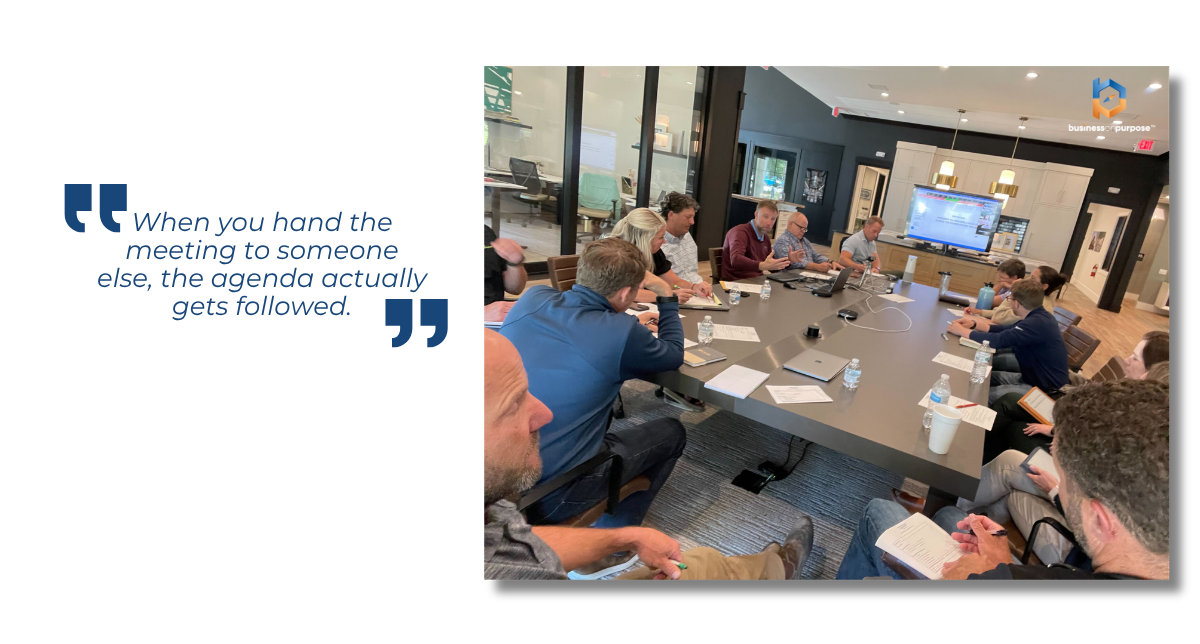
Here is something worth being honest about: many business owners are not great meeting facilitators. You can have the agenda right in front of you and still go off script. When you hand the meeting to someone else, they follow it from top to bottom. The meeting starts at 4 and ends at 5. Not done by 5? Do better next week.
That kind of structure creates a culture where process, training, and accountability all fit inside a predictable rhythm. Over time, that rhythm becomes the operating standard for your team. The first few weeks will feel rough. That is normal. Stay with it and the habit will form.
When you hand the meeting to someone else, the agenda actually gets followed.
What to Do When You Are Ready to Delegate But Do Not Have the People Yet
Maybe you are sold on the process. Maybe you have already filled out your Delegation Roadmap. But your honest concern is, “I do not have the right people to delegate to.”
That is a real and fair problem, and it has a real solution. Building a team you can actually delegate to starts with knowing how to hire, onboard, and retain the right talent. Without that foundation, even the best delegation system falls apart.
The mission of Business On Purpose is simple: to liberate business owners from chaos and make time for what matters most. The tools in this article are the starting point. The process works when you work it.
Your Next Step
You now have the framework. You know how to identify what to delegate, how to build the processes around it, how to train your team consistently, and how to hold everyone accountable inside a predictable weekly rhythm.
The hardest part is not knowing the system. The hardest part is starting. So start today. Set a 15-minute timer and map your four core systems. List your tasks. Rate your energy and your delegatability scores. Then take the first task rated a 3 with a thumbs down and build the process around it.
Your business should not run because of you. It should run for you.
Ready to take the next step toward a business that runs without you? Visit businessonpurpose.com/healthy and find out how healthy your business really is.