The truth is, being great at marketing and sales has very little to do with personality and almost everything to do with process. Here are the three skills that will make anyone better at marketing and sales — no charisma required.
The “Dry Toast” Business Owner Who Doubled His Revenue
Over the last 11 years, Business On Purpose has worked with roughly 300 business owners. That means a wide range of personalities — especially when you factor in how many of them came from the contractor space.
One business owner in particular stands out. When asked to describe his personality, the best description that came to mind was dry toast. Just picture a plain piece of dry toast sitting on a plate. That was him. Deeply introverted, uncomfortable getting in front of people, and genuinely struggling with the idea of “doing sales.”
But here is what happened: once a system was built for both marketing and sales, he doubled his revenue in two years. Not because he became a different person. Not because he found his inner salesman. He simply stopped seeing sales as a charismatic performance and started seeing it as a process. Then he worked the process.
That story is the foundation of everything below.
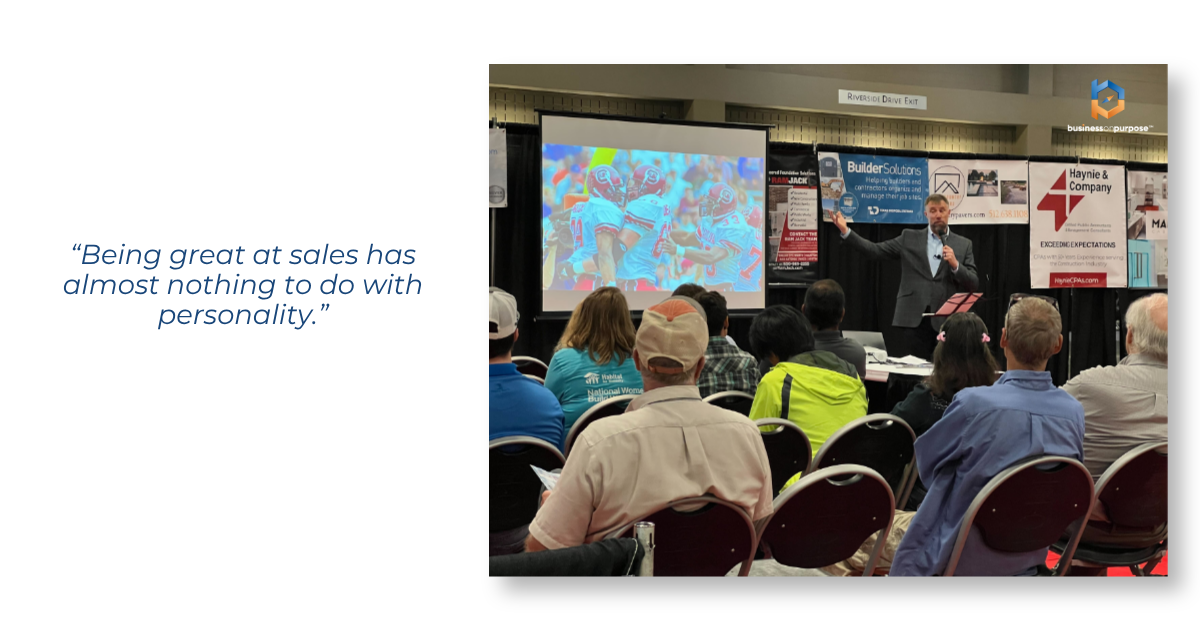
“Being great at sales has almost nothing to do with personality.”
Lead Well.
If you're looking for more resources to work ON your business, we have them.
Skill #1: Commit to Consistency Over Creativity
The first skill that separates struggling business owners from thriving ones is the willingness to choose consistency over creativity. A lot of people assume they need to be wildly creative to succeed at marketing. But AI is quickly closing that gap. Creativity is becoming a commodity. Consistency is not.
Think about it in terms of three words: repetition, predictability, and meaning. These are what we call the RPMs of great leadership and great marketing.
Consider Ernest Shackleton, the explorer who attempted to cross the Antarctic continent in the early 1900s. His ship, the Endurance, got trapped in the Weddell Sea in 1915. The crew spent ten months frozen in place before the ship cracked and sank. They then lived on lifeboats in the most treacherous seas on Earth for another year.
After nearly two years stranded, not one of his 28 men died. Every single person made it home alive.
How? Shackleton was not the most creative leader in history. He had his moments. But what he was — relentlessly — was consistent, repetitive, predictable, and meaningful in his leadership. That steady drumbeat kept people alive.
The same principle applies to your marketing and sales. Your coach is telling you the same thing a football coach says during practice: do it again. Put out the email. Post the video. Show up at the networking event. Then do it again. And again. And again.
Too many business owners launch something once, watch it underperform, and move on. That is not a strategy. That is impatience dressed up as decision-making.
Skill #2: Track What Works and Cut What Doesn’t
The second skill is tracking — but with an important caveat. Too many business owners deploy a new idea, give it a day or a week, decide it is not working, and scrap it. That is not tracking. That is quitting.
Real tracking means action plus time equals consistency. You need to be doing the thing consistently over a meaningful period before the data tells you anything useful.
Now, to be fair, there is also a trap on the other side. Some marketers will tell you to “just give it more time” indefinitely while they keep cashing your checks. That is not what this is about either. What you want is active, consistent effort over a defined window — and then you look at what the numbers are telling you.
Here is a simple framework: take a spreadsheet and track two things for both your marketing system and your sales system.
- Actions: What activities are you doing consistently?
- Results: What outcomes are those activities producing?
It helps to understand the difference between the two systems. Marketing exists to reach out to qualified prospects and identify who they are. Sales exists to take those prospects and convert them into customers. They are not the same job, and they each need their own tracking system.
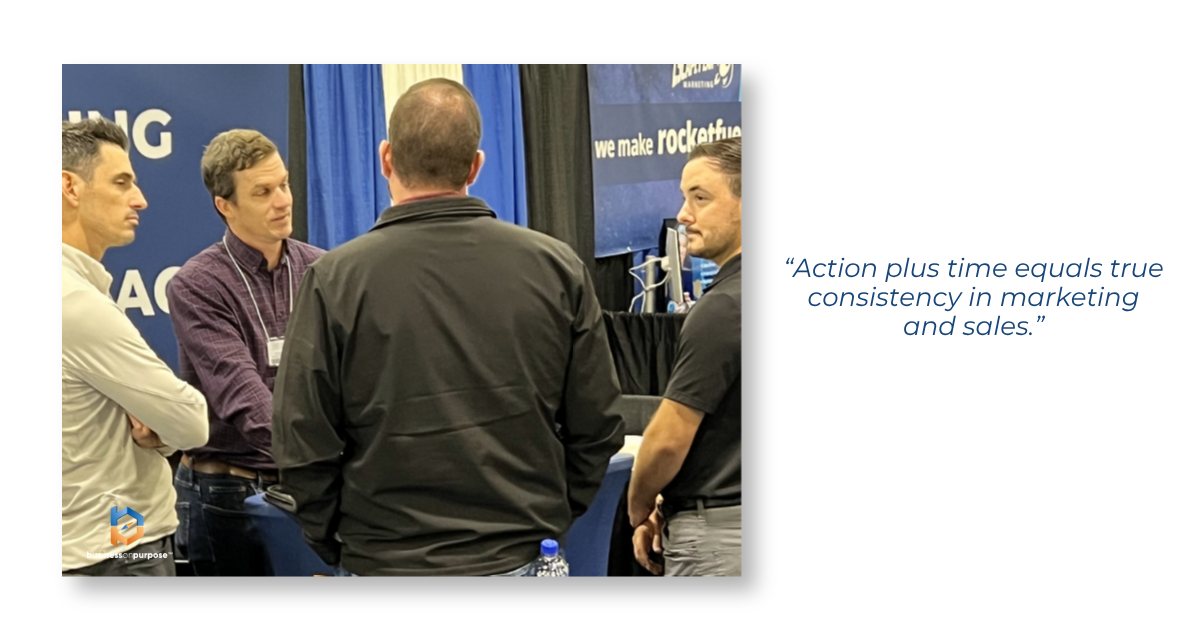
“Action plus time equals true consistency in marketing and sales.”
Skill #3: Radical Follow-Up (Yes, the FU Method)
The third skill might be the most uncomfortable to talk about, but it is also the one most business owners are missing. It goes by the initials FU — and no, that is not what you are thinking. It stands for Follow-Up. Radical follow-up, to be exact.
Here is the honest truth: if someone were to look at your current marketing and sales system right now, they would almost certainly find that you had a big launch or outreach push at some point, and then the follow-up fell apart. You got a lead at a trade show or a networking event, called them once, sent one email three months ago, and then told yourself, “I tried.”
That is not follow-up. That is a one-time attempt with a follow-up-shaped label on it.
Radical follow-up means building a system around the follow-up process. Not just a reminder to call someone back, but a repeatable sequence that your team can run without you having to manage every step.
This brings up a critical point about how to think about marketing and sales at all. These are not just “nice-to-have activities” in your business. Marketing is a system. Sales is a system. Along with operations and administration, these are the four core systems of every business. And a system must be built out with component parts, just like the braking system in a car. You press the brake pedal and a whole sequence of parts — the stem, the hydraulic lines, the brake pads — all activate together.
Your marketing system has component parts too. There is your air support: websites, social media, email, print advertising. And there is your ground game: one-on-one meetings, networking events, in-person connections. Both layers need to be mapped out, documented, and run consistently by a team that understands the system.
Build the System, Then Hand It Off
Once you commit to consistency, start tracking your results, and build in radical follow-up, the next step is to deploy your team. The goal is not for you to become the world’s most consistent marketer. The goal is to build a system your team can run so you are not the bottleneck.
That means training your team members on how the systems work, then properly delegating to them — not abdicating, but delegating with accountability and clarity.
When your team can run marketing and sales the way you would run marketing and sales, something powerful happens. The business starts to grow with or without you in the room. The chaos starts to quiet down. And you get back time for the things that matter most.
That is the whole point. Not just more revenue. Liberation from chaos.
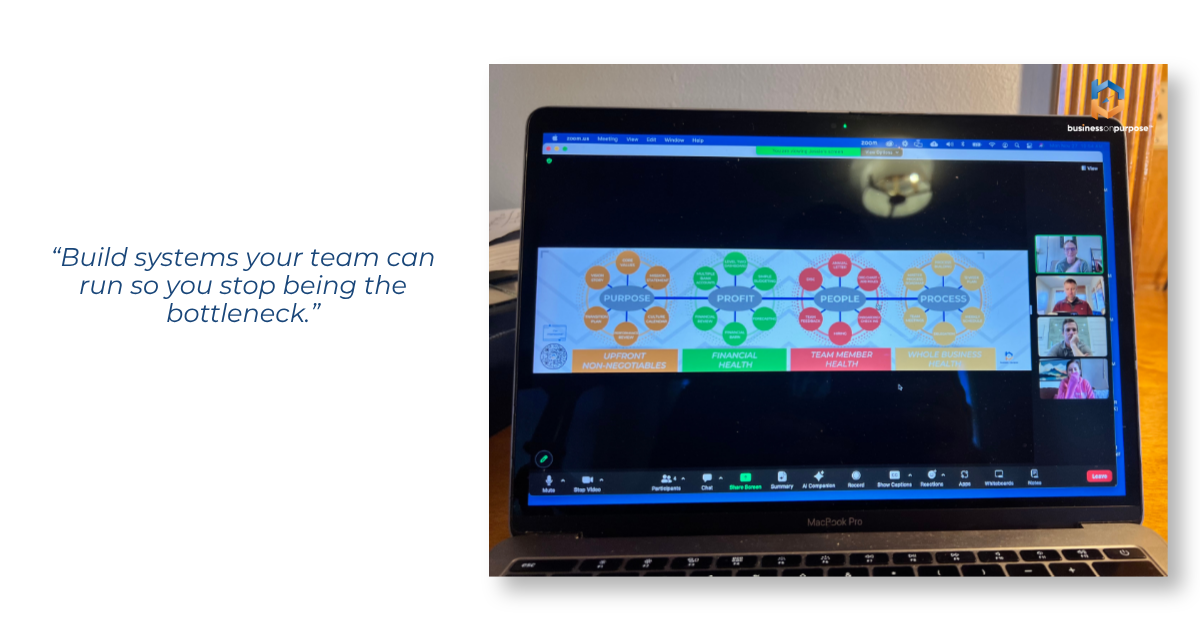
“Build systems your team can run so you stop being the bottleneck.”
You Are Closer Than You Think
The dry toast business owner is proof that you do not need to be extroverted, charismatic, or naturally gifted at selling to build a thriving business. You need a system, the discipline to work it consistently, and the courage to follow up long after most people would have given up.
Start with these three skills:
- Consistency over creativity — show up with a regular rhythm and keep doing it.
- Track actions and results — build a simple system to see what is working over time.
- Radical follow-up — build a repeatable follow-up process that your team can own.
Do those three things, and your marketing and sales will work. Not because you became someone different — but because you built something that works for you.
Ready to Build a Business That Runs Without You?
If this resonated with you and you are ready to stop being the bottleneck in your own business, we want to help. Visit businessonpurpose.com/healthy to take the first step toward a business that runs and grows — with or without you in the room.