Let’s break down exactly how to budget for marketing and sales so you can stop the feast-or-famine cycle for good.
The Feast-or-Famine Trap Most Business Owners Fall Into
We have worked with a lot of different industries over the years, but one of our favorites is homebuilders. We affectionately call them riverboat gamblers. They take big swings, and they do the best they can. Most of them get into the business because they are genuinely talented at building things. But once those big receivable checks start rolling in, things can go sideways fast — especially when it comes to marketing and sales.
We worked with one homebuilder who, about a year in, was stuck in a feast-or-famine cycle. Here is what kept happening: he would build up his pipeline, get flooded with work, and then go all in on operations — completely starving his marketing and sales efforts of the time and attention they needed to keep the pipeline full. Then the pipeline would run dry, panic would set in, and the cycle would repeat.
The fix was not complicated. Instead of treating his marketing time and budget as variable — on again, off again — we set it up as a consistent, recurring drip. That one shift did two things. It kept the pipeline relatively steady throughout the year, and it dramatically reduced the anxiety that came from watching the work dry up.
Stop treating marketing like a relationship you are not sure about.
Lead Well.
If you're looking for more resources to work ON your business, we have them.

Marketing Should Be a Fixed Cost
Here is an important distinction before we get into numbers. Marketing and sales are two separate systems. In fact, every business has four core systems: marketing, sales, operations, and admin. Marketing always comes before sales, and they are not the same thing.
For your marketing spend specifically, you want to treat it as a fixed recurring cost every single month. So what is a reasonable number to start with?
A good range for marketing spend is 3 to 13% of your gross margin — also called your real revenue. Here is how to calculate that number: take your total revenue, subtract your cost of goods sold, and what is left is your gross margin. That is the money available to actually run the business. It is not profit, but it is the foundation for setting your marketing budget.
For example, if your gross margin is one million dollars, a 3% marketing budget would be $30,000 per year, or $2,500 per month. That is a conservative starting point. Some businesses, like billboard law firms, spend 13 to 20% because marketing is their single biggest lead generation source. For most small businesses, starting at 3 to 5% of gross margin is a solid and sustainable place to begin.
Once you have that monthly marketing budget established, spend it consistently every single month. Do not cut it when things get busy. Do not blow past it when things get slow. Treat it like rent.
One practical tip when you are ready to hire a marketer: do not get dazzled by impressions, clicks, or beautiful website redesigns. Ask one focused question — how are you going to generate qualified leads? That is the only metric that actually matters. A plain, functional website that delivers consistent qualified leads beats a flashy one that delivers nothing.
Sales Should Be a Variable Cost
Here is where the approach shifts. While marketing costs should be mostly fixed, sales compensation should be largely variable — tied directly to closed deals.
Salespeople are motivated by results. Paying a salesperson a flat salary with no tie to performance removes that motivation and puts the financial risk entirely on you. The goal is to structure compensation so that the more they produce, the more they earn — and the more you earn too.
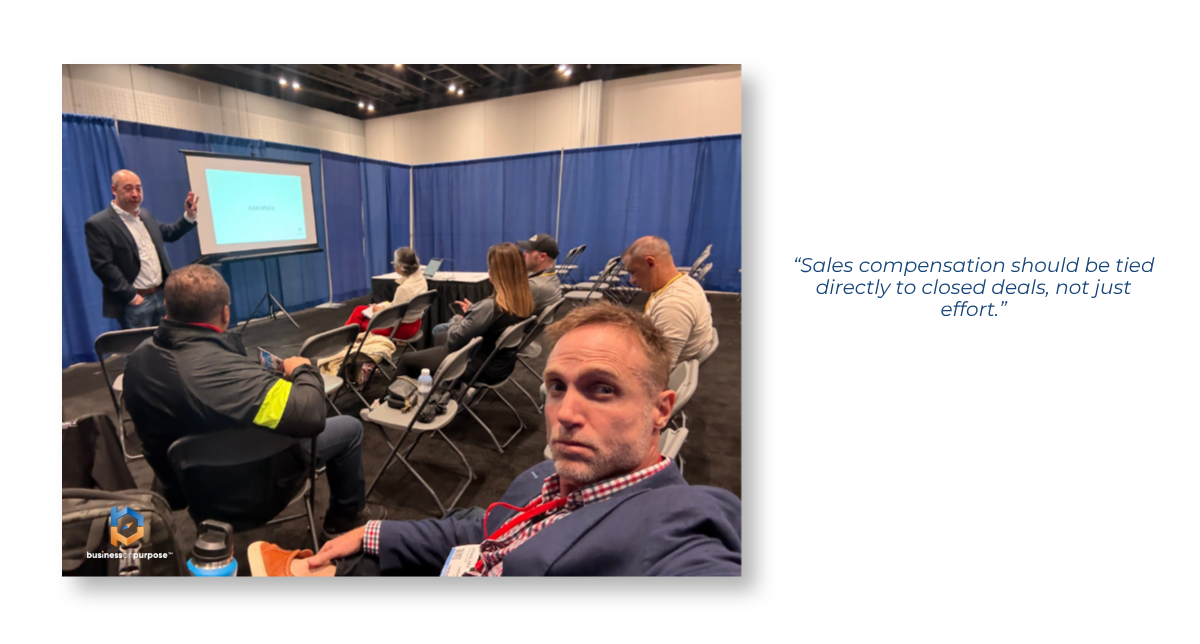
Sales compensation should be tied directly to closed deals, not just effort.
Tier One: A livable base. This gives the salesperson enough to cover basics — rent and groceries — but not much more. It provides stability without removing the hunger to close.
Tier Two: Commission on closed deals. This is the main incentive. You will need to decide whether it is a one-time payment per deal or an ongoing commission structure. That decision depends on the nature of your business and the type of relationships being sold.
Tier Three: A one-time kicker. This is a performance bonus for hitting a defined target — for example, closing 100 deals within three months earns an additional $10,000 bonus. You define the numbers based on what works for your business model.
This three-tier structure keeps compensation variable where it counts, adds a small fixed element to attract good people, and puts the ball in the salesperson’s court to perform.
How to Find the Right Commission Percentage
Sales commission percentages will vary depending on your business type. If you are in a business with significant cost of goods — like homebuilding or spray foam insulation — your salespeople will likely land in single-digit commission territory. If you are in a professional services firm like an architecture or law firm with minimal cost of goods, the percentage can be higher because there is more margin to work with.
A simple place to start is 10%. Run a quick pro forma — you can use AI to help with this — and ask yourself whether 10% of an average sale is too high, too low, or just right. Then work up or down from there until the numbers make sense for both you and your salesperson. The goal is to find a number that motivates performance without putting your business at risk.
Start at 10% commission and work up or down until the numbers make sense.

Putting It All Together
Here is a simple summary to take action on right now:
For marketing: Calculate your gross margin (total revenue minus cost of goods sold), then multiply by 3 to 5%. Divide that number by 12. That is your fixed monthly marketing budget. Include everything in that figure — the marketer’s fee, ad spend, your CRM, any tools used to generate leads. Spend it every single month without skipping.
For sales: Build a three-tier compensation structure — a livable base, commissions on closed deals, and a one-time performance kicker. Start at 10% commission and run your pro forma to see if the numbers work. Adjust from there.
The bottom line is this: marketing is mostly fixed, and sales is mostly variable. Both are systems. Both deserve consistent attention. And both need to be budgeted with the same intentionality you bring to your operations.
When you treat marketing and sales like the real business systems they are, you stop reacting and start leading. You get clarity on your numbers, consistency in your pipeline, and the freedom that comes from knowing what to expect month after month.
Do not let chaos win. Budget with purpose, stay consistent, and give yourself the predictability you deserve so you can spend more time on the things that matter most.
Want to Build a Business That Runs Without You?
This is exactly the kind of work we do every day at Business On Purpose. If you are ready to get clarity on your numbers and build the systems that create real freedom, start by checking out our resources at businessonpurpose.com/healthy. Take the first step toward a healthier business today.