Most small business owners avoid marketing and sales because it feels uncomfortable, even a little gross. But what if everything you believed about marketing and sales was simply wrong? These three habits will change the way you think about growing your business, and more importantly, they will actually work.
First, Let’s Flip the Script
Stop saying “sales and marketing.” Seriously. Marketing always comes before sales, so the order matters. More importantly, let’s kill the image that comes to mind when you hear those two words together.
Marketing and sales is not about pointing finger guns, flashing a cheesy grin, or channeling your inner Tony Robbins. It is not used car salesmen and slick pitches. Here is the plain truth:
Marketing qualifies prospects. Sales converts those prospects into customers. That is it. Nothing more, nothing less.
For too many business owners, excellence in marketing looks like going viral or landing one massive client. It is not. Excellence is a steady stream of qualified prospects that lead to closed business you can serve with real effectiveness. So how do you build that? You build it with habits.
Marketing and Sales Work Like Compound Interest
When someone showed a teenager a compound interest chart years ago, the reaction was predictable: “I’m a teenager. I like fun stuff, not charts.” But the chart told a story that was hard to ignore.
Save $2,000 a year. After seven years, fourteen years, twenty-one years, the number grows into something remarkable. Albert Einstein reportedly called compound interest the eighth wonder of the world. He said, “He who understands it earns it. He who doesn’t pays it.”
Marketing and sales work on the exact same principle.
Here is the problem most business owners run into. They dump a one-time investment into marketing, it does not produce instant results, and they pull out completely. Then the pipeline runs dry, they rush back in, get discouraged again, and pull out again. It becomes an exhausting cycle of feast and famine instead of a steady, compounding build.
A steady clip over time, day after day and month after month, will build something you cannot buy with a single big spend. That is the foundation everything else rests on.
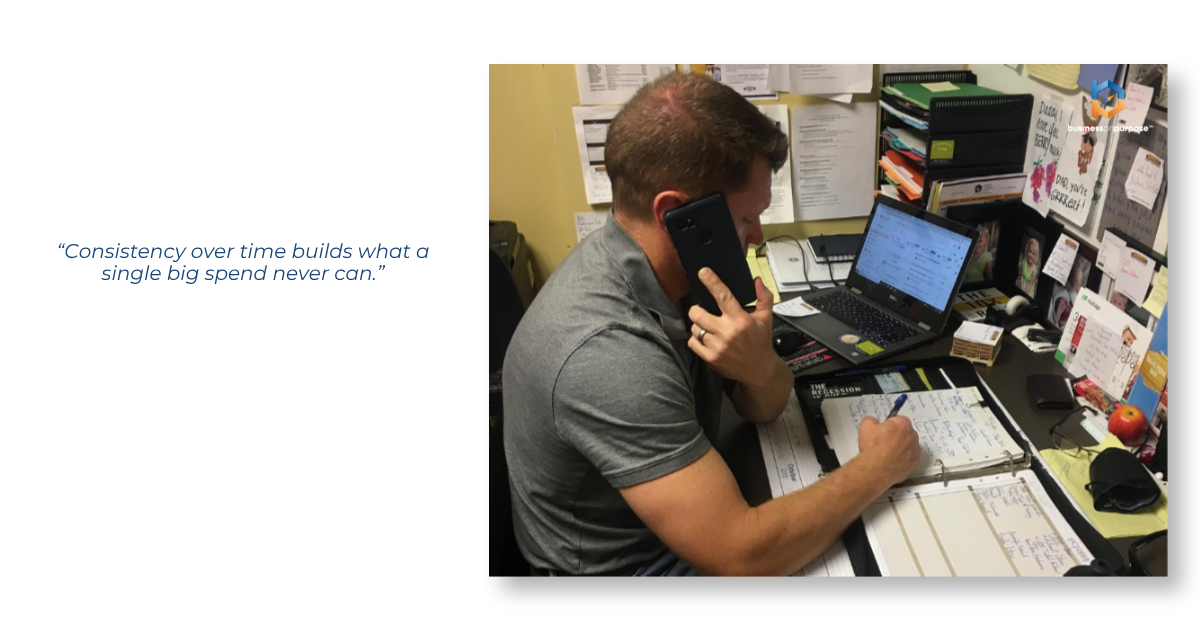
“Consistency over time builds what a single big spend never can.”
Lead Well.
If you're looking for more resources to work ON your business, we have them.
Habit One: Weekly Consistency Beats Monthly Heroics
There are Major League Baseball teams loaded with home run hitters who never win the World Series. Why? Because consistency beats the big splash over time. Every time.
Think about it this way. If you only invested in your marriage during the big moments, the fancy dinners and the milestone trips, but neglected the daily conversations and the weekly connection, the relationship would be fragile. One bad night at a nice hotel would feel catastrophic because you had nothing else to fall back on.
The same is true for your marketing and sales. Most YouTube videos get tens or hundreds of views, not thousands. But showing up every single week, with intentionality, creates a body of work that compounds over time.
One practical step: schedule a weekly marketing and sales meeting. Build an agenda. Walk through it from top to bottom. Cover prospect development, marketing activity, and sales conversion. Keep the rhythm, even when it feels routine. Especially when it feels routine.
Habit Two: Measure Everything on a Scorecard
Marketing is a system. Sales is a system. And if you want to build a business that can run without you, or one that you can eventually sell or pass to family members, you cannot keep any of it locked inside your head. Buyers want a business, not a person.
Building a scorecard is simpler than it sounds. Here is a starting framework:
Marketing Scorecard: Open a spreadsheet and create two columns. On the left, list all your activities to develop prospects. On the right, track the one result those activities should produce, whether that is booked calls, sales appointments, or something similar. Every marketing effort should funnel down to one clear outcome: getting a sales meeting on the calendar.
Sales Scorecard: Same structure, two columns. On the left, list your actions and activities, including sales scripts, follow-up cadences, and sales aids. On the right, track the singular result. Notice the difference: actions and activities are plural, but the result is singular. Stay focused on that one result.
“You can’t systematize what only lives inside your head.”

Habit Three: Analyze and Double Down on What Works
Once you are tracking, you have to actually look at what the numbers are telling you.
Say you have been showing up to a networking group for two years. Pull up your scorecard. Did it generate any leads? Did any of those leads turn into qualified prospects that closed? If the answer is no, it is time to pivot. That is not failure. That is information.
Meanwhile, something like leaving door hangers on neighboring houses after a photo shoot at a client’s home might produce unexpected new business. When that happens, double down on what works.
Not every tactic will perform. Paid advertising can cost thousands of dollars and generate very little without the right person behind it. Sometimes you have to go person-to-person. The scorecard will show you the truth. Track it across weeks, months, and years.
And here is the piece that ties all three habits together: doing any one of these habits for an hour, a day, or even a week produces zero compounding effect. Do them for months and years, and you will start to see real growth that builds on itself.
What About the Risk of Stopping Too Early?
You might be wondering what happens if you commit to all three habits and stop before growth kicks in. Welcome to the risk of being a business owner. That risk is real and it is yours to own.
But here is the good news: consistency over time is the single best thing you can do to reduce that risk. Commit to showing up, measuring what matters, and analyzing your results with honesty. Over time, your marketing and sales will shift from chaos and unknowns into a rhythmic system that gives you your time back and lets you focus on what matters most.
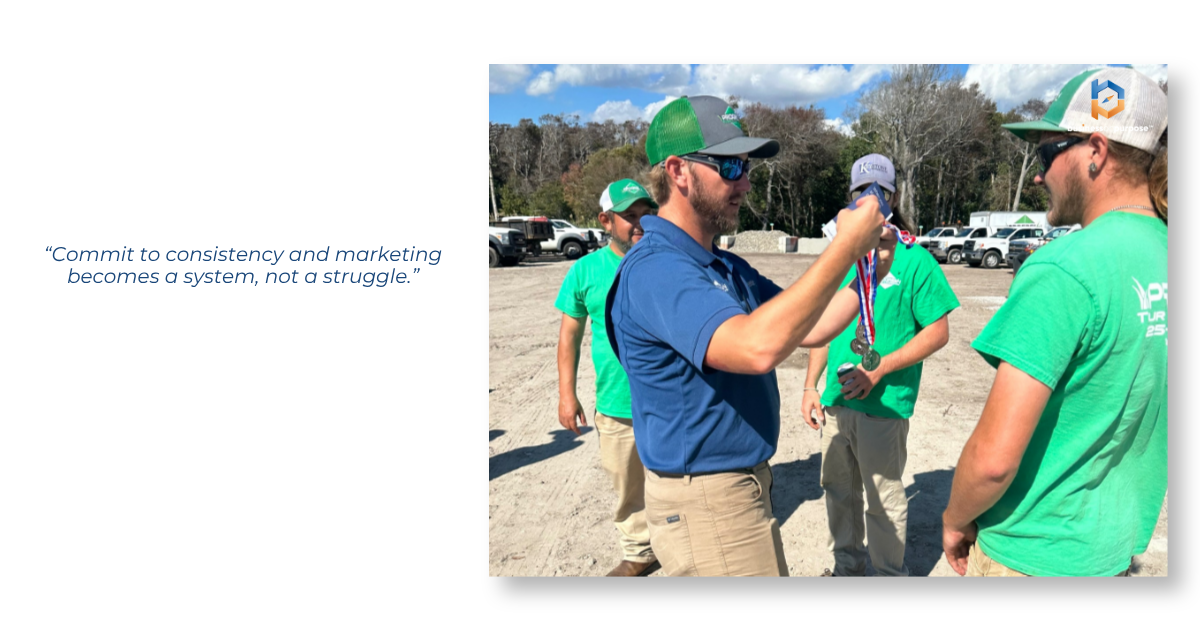
“Commit to consistency and marketing becomes a system, not a struggle.”
Ready to Build a Business That Works Without You?
These three habits are just the beginning. If you are serious about creating a business that runs on systems instead of stress, visit businessonpurpose.com/healthy to take the next step toward a healthier, more intentional business.
Scott Beebe is the founder of Business On Purpose (mybusinessonpurpose.com) and speaker for the AEC industry and author of the book Let Your Business Burn: Stop Putting Out Fires, Discover Purpose, and Build a Business That Matters. Business On Purpose works with business owners to articulate purpose, people, process, and profit to liberate owners from chaos and make time for what matters most.