If you are spending money on paid ads and just hoping for the best, that is not a budget — that is a bet. Most small business owners either overspend on marketing out of excitement or underspend out of fear, and both will quietly strangle your growth. It is time to stop guessing and start budgeting with intention.
Think of Your Budget Like a Road Trip
Before traveling to places like Cinque Terre in Italy or the Cappadocia region of Turkey, the smart move is to sit down and map out a spending plan. Nobody wants to be halfway around the world and suddenly run out of money. The same logic applies to your business.
When you head into a new year without a marketing and sales budget, you are essentially driving without a map. You either spend too much chasing shiny tactics or hold back so tightly that you never gain traction. A proper budget gives you the freedom to invest with confidence and the clarity to course-correct when needed.
And before we go further, here is something worth noting: marketing and sales are not the same thing. They work together in a complementary relationship, but they are separate systems that each deserve their own budget and strategy.
Start at the Top: Know Your Real Revenue
The first step in building your budget is identifying your anticipated revenue for the year. If you are not sure, look back at the last one to three years and make your best informed estimate. You have to commit to a number — even if it is a projection — because everything else flows from it.
Once you have your total revenue figure, the next step is to subtract your cost of goods sold. This means:
- For a contractor, that is labor and materials
- For a restaurant, that is food cost
- For an ice cream shop, that is the ice cream itself
- For a gas station, that is the fuel you purchase
After subtracting those costs, what remains is what author Mike Michalowicz calls “real revenue” — the money you actually have available to run and grow your business. For example, if your total revenue is $1,000,000 and your cost of goods is 30%, your real revenue is $700,000. That is the number you will use to set your marketing and sales budgets.
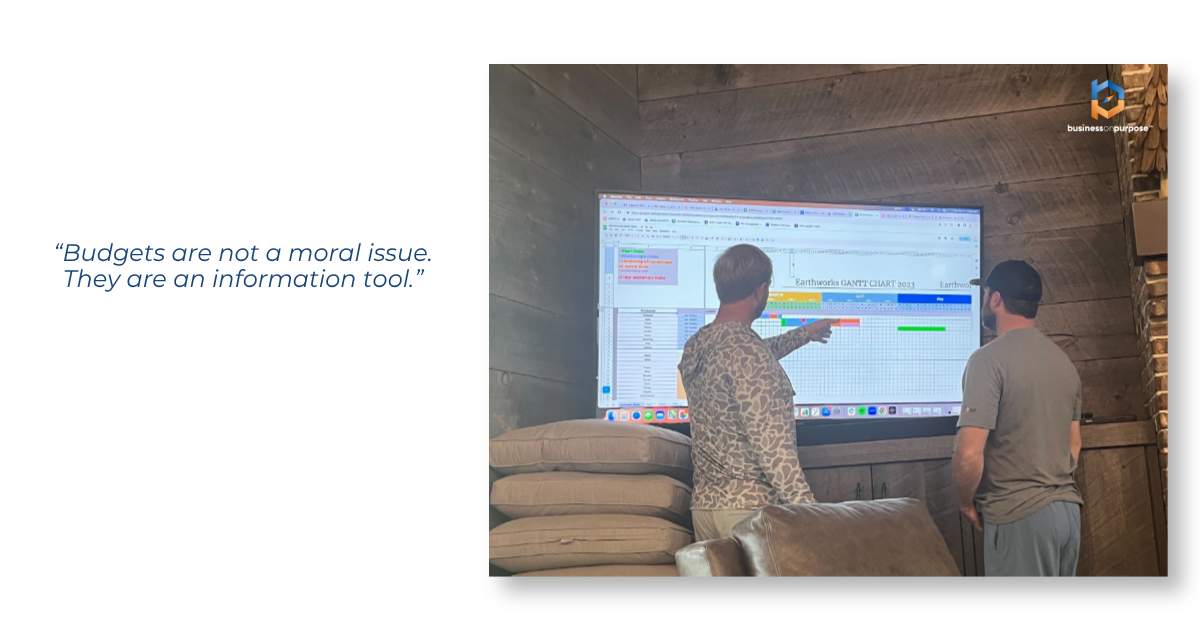
“Budgets are not a moral issue. They are an information tool.”
Lead Well.
If you're looking for more resources to work ON your business, we have them.
Setting Your Marketing Budget: The 3 to 13 Percent Range
Once you know your real revenue, you can determine how much to invest in marketing. A helpful starting range is 3% to 13% of your real revenue. Here is how to think about it:
- 3% is a conservative starting point — enough to get things moving without overextending
- 13% is an aggressive investment — appropriate when you are pushing hard for growth
- Some industries, like high-visibility law firms, spend even beyond 13% to maintain constant brand presence
Using the $700,000 real revenue example, a 10% marketing investment would equal $70,000 for the year. That budget needs to cover everything in your marketing ecosystem: your CRM software, agency fees, any team members who spend time on marketing, and lead generation commissions.
Here is the key mindset shift: budgets are not there to judge whether you are right or wrong. They are information tools. They help you see where your money is going and what kind of return that investment is generating. If you cannot stay within your target percentage right now, that is useful information — not a failing grade.
Building Your Sales Budget
Now let’s talk about the sales side. A solid starting point for your sales budget is 10% of your real revenue. In our example, that is another $70,000 dedicated specifically to driving and closing business.
Here is where business owners have real flexibility. If you are still handling all the sales yourself, you may decide to hold that $70,000 in reserve and keep doing what you are doing. But if you are ready to bring someone on or expand your sales capacity, you can shift the percentages around to make room.
For instance, you might increase your sales allocation to 15% while pulling your marketing budget down to 5%. The tradeoff is that your salesperson may need to take on some marketing responsibilities — like attending networking events — since you reduced that budget. The total investment stays within your real revenue ceiling; you are simply redirecting where it flows.
“Any lever you pull up, you need to pull another lever down.”

How to Compensate Your Salespeople: A Three-Tier Structure
One of the most common questions business owners have is how to pay their salespeople. The answer needs to fit within your sales budget percentage — whether that is 10%, 15%, or wherever you land. Here is a three-tier compensation structure that works well across many industries:
Tier One: The Base
This is a consistent monthly payment — a livable base — that gives your salesperson stability. It could be $1,000 a month or $5,000 a month depending on your business. The goal is to give them enough to cover their basic needs while keeping them hungry to earn more. In return for this base, they are expected to fulfill the sales activities and KPIs you have defined for their role.
Tier Two: Commission
Commission should be tied to closed deals — not just conversations or booked appointments, but actual signed contracts or completed sales. A good target is for the commission opportunity to equal or exceed the base salary. If you are paying $50,000 as an annual base, structure the commission so they can realistically earn another $50,000 or more on top of that.
Tier Three: The One-Time Kicker
This is a performance bonus paid out quarterly, semi-annually, or annually when the salesperson hits specific thresholds. Maybe it is 15 closes in a quarter, a specific revenue milestone, or a set number of new accounts. When they hit it, they receive a one-time bonus check. Using our earlier example, a salesperson might earn $50,000 in base, $55,000 in commission, and an additional $10,000 in kicker bonuses for the year — a strong total compensation package that rewards performance at every level.
Do not get lost in the mechanics of the compensation structure. The bigger priority is understanding the total investment you are making and staying within your budget.
The Real Goal: Getting Out of the Way
You might be thinking, “Nobody can sell or market my business the way I can.” That feeling is completely understandable — but it is not entirely true. When you hire the right people and train them consistently, they will eventually outperform you simply because they are doing it more often than you can. And that is exactly where you want to be as a business owner.
Trying to be the Swiss Army knife of your own business — handling marketing, sales, operations, and administration all at once — is exhausting and unsustainable. A proper marketing and sales budget gives you the structure to invest in other people, build systems that work without you, and free yourself from the daily chaos.
“Train the right people and they will sell better than you ever could.”

Put a Number on It and Get Moving
Here is your action plan in simple terms:
- Determine your anticipated annual revenue
- Subtract your cost of goods to find your real revenue
- Allocate 3% to 13% of real revenue to marketing
- Allocate starting at 10% of real revenue to sales
- Adjust the levers between marketing and sales based on your priorities
- Structure your sales compensation using the three-tier model
Your budget is not a perfect document — it is a living tool. It will evolve as your business grows. The important thing is to stop spending blindly and start investing with a plan.
If you want help building the financial foundation your business needs to run without you, visit businessonpurpose.com/healthy to take the next step toward a business that works for you — not the other way around.
Scott Beebe is the founder of Business On Purpose (mybusinessonpurpose.com) and speaker for the AEC industry and author of the book Let Your Business Burn: Stop Putting Out Fires, Discover Purpose, and Build a Business That Matters. Business On Purpose works with business owners to articulate purpose, people, process, and profit to liberate owners from chaos and make time for what matters most.